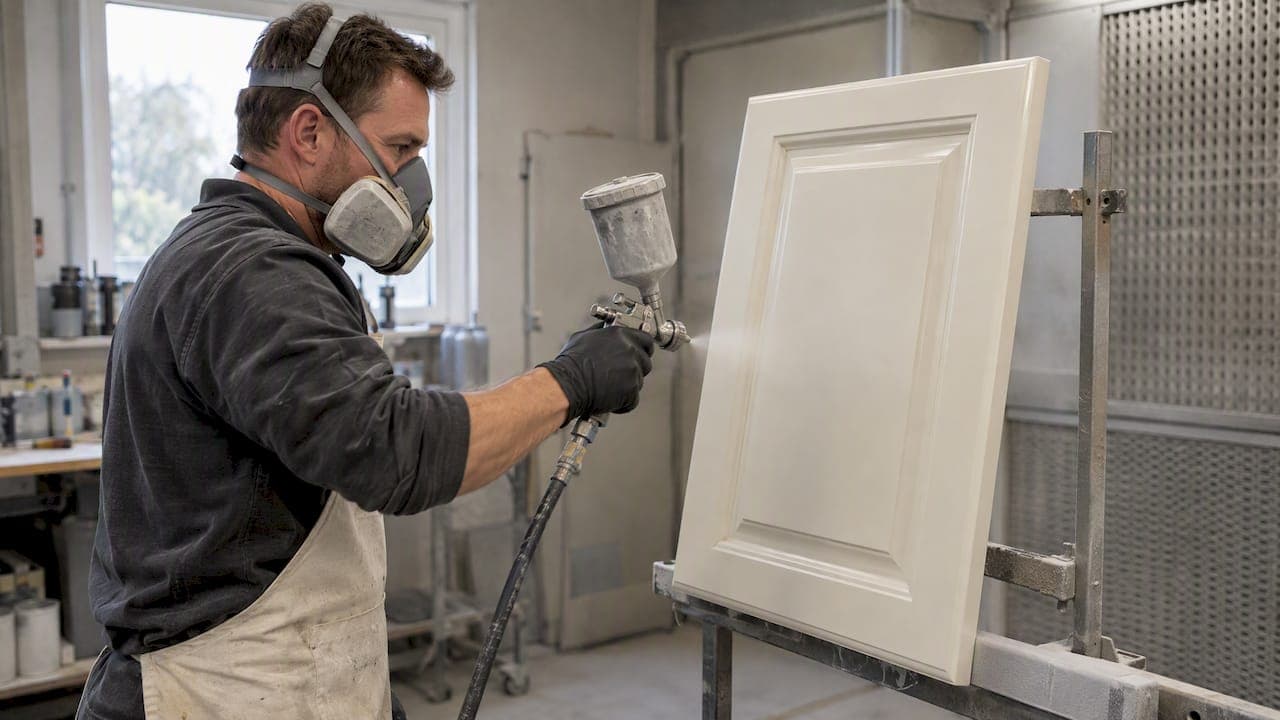
Profiled kitchen doors, the Shaker, raised-panel and routed designs with grooves and mouldings, can be sprayed very successfully. They are also the doors where a poor job shows most: paint pooling in the corners of a panel, thin edges, dust nibs caught in the recess. This guide explains how a proper spray finish is built up on profiled doors, what separates a lasting result from one that peels, what the work typically costs, and how to judge a sprayer before you sign anything.
TL;DR
- Profiled doors can be sprayed well, and spraying reaches into grooves and corners that a brush or roller tends to clog.
- Preparation decides the result: degreasing, sanding for a mechanical key and an adhesion primer matter more than the spray gun.
- Doors should come off and be sprayed in a controlled space, not hung in a dusty kitchen.
- Professional kitchen resprays in the UK commonly cost from £1,500 for a small kitchen, and a written, transferable guarantee is worth asking for.
- We spray UPVC and kitchens across South Wales, by hand, with no subcontractors and payment only on completion.
Table of Contents
- Why profiled doors are different
- What your doors are made of
- How profiled doors are sprayed, step by step
- Choosing the paint and the sheen
- Can you spray profiled doors yourself?
- What spraying profiled doors costs
- Our perspective: where profiled door jobs go wrong
- How to choose a sprayer for profiled doors
- Having your kitchen sprayed in South Wales
- FAQ
- Sources
Why profiled doors are different
A flat slab door is forgiving. You coat one face, one set of edges, and a machine can lay an even film across it. A profiled door has an inner panel, a frame, a bevel or a routed groove, and often a moulded bead where they meet. Each of those is a place where paint can run, build up or go on too thin.
There is a reason industrial finishers treat the two differently. One UK joinery sprayer notes that flat doors and panels are where a robotic line beats hand work, because the film thickness is identical every time. Profiled work is the opposite: the shape changes across the door, so the sprayer has to change angle, distance and speed as they go. That is craft, not automation, and it is why we hand-spray every door rather than pushing them through a production line.
What this means for you in practice:
- Recesses need a controlled film. Too heavy and paint sags into the corner of the panel. Too light and the original colour or primer shows through on the bevel.
- Edges need attention. Door edges take the knocks and the cleaning. A thin edge is where chips begin.
- Inspection matters. Spraying profiled doors well includes checking them under strong, raking light, because that is when thin spots and dust nibs show.
What your doors are made of
Before anyone picks a colour, the door material needs identifying. Most profiled kitchen doors in UK homes are one of these:
| Door type | What it is | Sprays well? |
|---|---|---|
| Painted MDF | Routed or shaped MDF with an existing paint finish | Yes, usually the best candidate |
| Solid timber or veneer | Real wood Shaker or raised panel | Yes, with the right primer for tannins and grain |
| Vinyl-wrapped (thermofoil) | MDF with a heat-pressed plastic skin | Often, but the condition of the wrap decides it |
| Melamine or laminate | Flat, hard-faced board | Possible with the correct primer; usually not profiled |
| Acrylic or high-gloss | Often flat | Case by case |
The vinyl-wrapped door is the one that catches people out. If the wrap is peeling at the edges or lifting in the recesses, spraying over it risks the new finish failing with it. A sprayer should inspect it in person and tell you honestly whether the wrap can stay or must come off first. If you have a flat melamine kitchen as well, our guide on how to spray melamine cabinets covers what that substrate needs.
How profiled doors are sprayed, step by step
The sequence below is the standard professional approach. The equipment gets the attention, but the early steps are what keep the finish on the door.
1. Remove, label and protect
Doors and drawer fronts come off the cabinets, hinges and handles are removed, and every door is labelled so it returns to the same opening. Professional respraying means doors are taken to a controlled spray space, while on-site spraying is generally limited to fixed carcass parts. The reason is simple: spraying doors inside a lived-in kitchen lets airborne household dust settle in wet paint, and those imperfections cannot be removed once it cures.
2. Degrease properly
Kitchen doors carry an invisible film of cooking grease, wax polish and sometimes silicone from sprays. Household cleaner does not remove all of it. Industry guidance says that missed contamination is the most frequent cause of respray failure, preventing the primer from bonding and leading to peeling within a year or two. The doors nearest the hob and the cupboard under the sink are usually the worst.
3. Sand to create a key
Paint needs something to grip. On profiled doors this means sanding the flat areas and then working into the mouldings with flexible pads and small abrasives, so the profile is keyed without softening its crisp edges. Over-sanding rounds off a Shaker frame; under-sanding leaves a glossy patch that the topcoat will not hold on. Any chips, dents or open joints are filled and sanded flush at this stage.
4. Prime with an adhesion primer
The primer is the bridge between the old surface and the new colour. Experts say the factory look comes from the multi-stage preparation as much as the spraying, and that cutting corners here is the commonest reason resprays fail in the first two years. On bare timber or MDF edges, a suitable sealer stops the material drinking the topcoat unevenly.
5. Spray in the right order
On a profiled door the usual approach is to spray the profile first (the inner edges of the frame, the bevel and the panel recess) and then the flat rails and stiles, so overspray does not land on a finished surface. The doors are sprayed in thin, even coats, not one heavy pass. Each coat is allowed to flash off before the next.

6. Inspect under strong light
Before a door is called finished, it is checked under high-intensity light. As the same finishing specialist notes about shaped door work, this is how dust nibs and thin spots are caught that standard room lighting hides. Anything found is rubbed back and re-coated.

7. Cure, refit and walk through
Newly sprayed doors need time to harden before they are hung and used. Professionals refit the hinges and handles (or fill the old holes if you are changing handle style) and walk you through the finished kitchen. We take payment only after that walkthrough.
Choosing the paint and the sheen
The question "what is the best paint for kitchen doors?" has a short answer for sprayed work: a hard-wearing coating made for kitchens, not a tin of wall or standard trim paint. Professional sprayers use industrial-grade water-based coatings designed to withstand heat, steam and frequent wiping, which is where most DIY paints struggle.
Sheen matters more on profiled doors than on flat ones:
- Matt looks contemporary and hides small surface variations, but needs gentle cleaning.
- Eggshell is a popular middle ground for Shaker kitchens: a soft glow that shows the shadow lines of the profile.
- Satin is easier to wipe and suits busy family kitchens.
- Gloss shows every flaw in the surface and the profile edges, so it demands the best preparation.
We can match RAL, BS and custom colours. Dark colours and gloss sheens are the least forgiving, so ask for a sample board in the actual sheen and look at it in your own kitchen light, morning and evening.
Can you spray profiled doors yourself?
Some people try, and the sources are honest about the effort. One home-improvement guide describes a sprayed finish as the smoothest option but with a real learning curve, and notes you may need to rent equipment and mask the kitchen. Another guide stresses that removing the doors and painting them away from the kitchen gives better results because paint mist is difficult to control.
If you go the DIY route, the realistic problems with profiled doors are:
- Runs and sags in panel corners, where a spray pass dwells a fraction too long.
- A dusty finish from spraying in a garage or spare room.
- Skipped degreasing, which looks fine for six months and then lifts.
- No warranty if it fails.
For a handful of doors, a confident decorator can manage it. For a whole kitchen of profiled doors, most people find the cost of kit, masking and a failed first attempt closes the gap with a professional quote quickly. We would rather you knew that before deciding.
What spraying profiled doors costs
Pricing depends on door count, condition and complexity, so any honest quote comes after a site visit. For orientation, here are published 2026 figures from a Yorkshire respray firm. They are regional, not South Wales prices, but they show how the market is structured: from £1,500 for a small kitchen of up to 10 doors, £1,800 to £2,500 for a medium kitchen and £2,500 to £4,000 or more for a large or complex one. Those figures include preparation, primer, two topcoats and a five-year written guarantee.
Profiled doors usually sit towards the upper end of any band, because they take longer to prepare and spray than slab doors. Islands, glazed panels and end panels add to the total.
Spraying is also generally far cheaper than a new kitchen, roughly 60 to 80 per cent less by the same source, and it typically takes 4 to 7 days rather than weeks. If the carcasses are sound and the layout works, replacing only the finish is the sensible spend. We compare the two options in detail in kitchen respraying vs a new kitchen, and our South Wales cost guide explains how we quote. We do not publish a fixed kitchen price, because a fixed figure would ignore your door count and condition.
Once the work is finished and the kitchen is back in use, a thorough clean helps you start with it spotless. A professional kitchen deep clean is worth considering before you sell or let the property, although leave it until the new coating has fully hardened and use only gentle, non-abrasive products on it.
Our perspective: where profiled door jobs go wrong
We only do two things: UPVC and kitchen respraying. That narrow focus means we see the same failures repeatedly, and profiled doors produce a particular set.
The first is sprayers who treat a Shaker door like a slab. They coat the flat panel nicely and leave the inside edge of the frame thin or dry-sprayed, which feels rough under a finger. The second is the rushed prep: a quick wipe, a light scuff and straight on with colour. It photographs well on the day. Two winters later the doors beside the hob are lifting.
So we do it the slow way. The same people who quote your job prep and spray it, with no subcontractors and no production line. We would much rather turn down a door that is not suitable, such as a badly delaminating wrap, than spray it and have it come back. After more than 1,000 projects, the best predictor of a happy customer is not the colour they picked. It is whether we were straight with them about the condition of what they have.
We back the work with a written five-year warranty that transfers to the next owner, which landlords and anyone planning to sell tend to value. You pay on completion, after the walkthrough, when you can see the result in your own light.
— Mitchell
How to choose a sprayer for profiled doors
Whether you use us or someone else, ask these questions and expect specific answers:
- Where will my doors be sprayed? Doors should be removed and sprayed away from your kitchen.
- What is the prep process? You want to hear degreasing, sanding and an adhesion primer, not just "a good clean".
- Which coating do you use, and how many coats? Ask for the product name and the system, not a brand slogan.
- Is the guarantee written, and does it transfer? A real guarantee is a document, and it should travel with the property.
- Who actually does the work? Many firms subcontract. Ask if the person quoting is the person spraying.
- When do I pay? Payment on completion, after a walkthrough, keeps incentives aligned.
- Can I see profiled doors you have finished? Photos of Shaker or raised-panel work, taken at an angle, tell you more than a flat before-and-after.
If you want to understand the wider process and what to compare, our guide to kitchen cabinet spraying costs, process and choosing a sprayer goes through it, and a smaller space has its own considerations in our small kitchen respray ideas.
Having your kitchen sprayed in South Wales
We work across South Wales, including Cardiff and Swansea. We hand-spray kitchen doors, drawer fronts, end panels and islands, and can convert to handleless. You can choose RAL, BS or custom colours and a matt, eggshell, satin or gloss finish. See the details on our kitchen respraying pages or our kitchen cupboard spraying service, or get in touch through our site for a survey and a written quote.
FAQ
Can you spray Shaker and other profiled kitchen doors?
Yes. Shaker, raised-panel and routed MDF or timber doors spray well when they are properly prepared. Spraying actually suits the profile, as it reaches the inside edges without leaving brush marks. The key is thin, controlled coats and careful inspection of the recesses.
Is spraying kitchen doors a good idea?
It is a good idea when the cabinet frames are sound and you like the layout. It costs far less than replacement and causes much less disruption. It is a poor idea over failing vinyl wrap or swollen, water-damaged board, which should be repaired or replaced first.
How long does a sprayed finish last?
That depends on preparation and coating. Poor prep is the common reason resprays fail within the first two years. We give a written five-year warranty on our work, which is transferable if you sell.
How long does it take?
A professional respray for a standard kitchen typically takes 4 to 7 days, depending on the number of components and whether doors are finished off-site. Profiled doors sit toward the longer end because of the extra prep and curing between coats.
Can I change the handles when the doors are sprayed?
Yes. Old handle holes can be filled and finished, or you can switch to handleless. Let us know at the survey so it is priced and planned before spraying starts.
Sources
- Kitchen Spray Painting Cost Guide 2026, ColourHaus
- The Complete Kitchen Spray Painting Guide, ColourHaus
- Door & Panel Spraying, Painted
- How to Paint Kitchen Cabinets in 9 Steps, This Old House
- How to Spray Paint Kitchen Cabinets, The Spruce