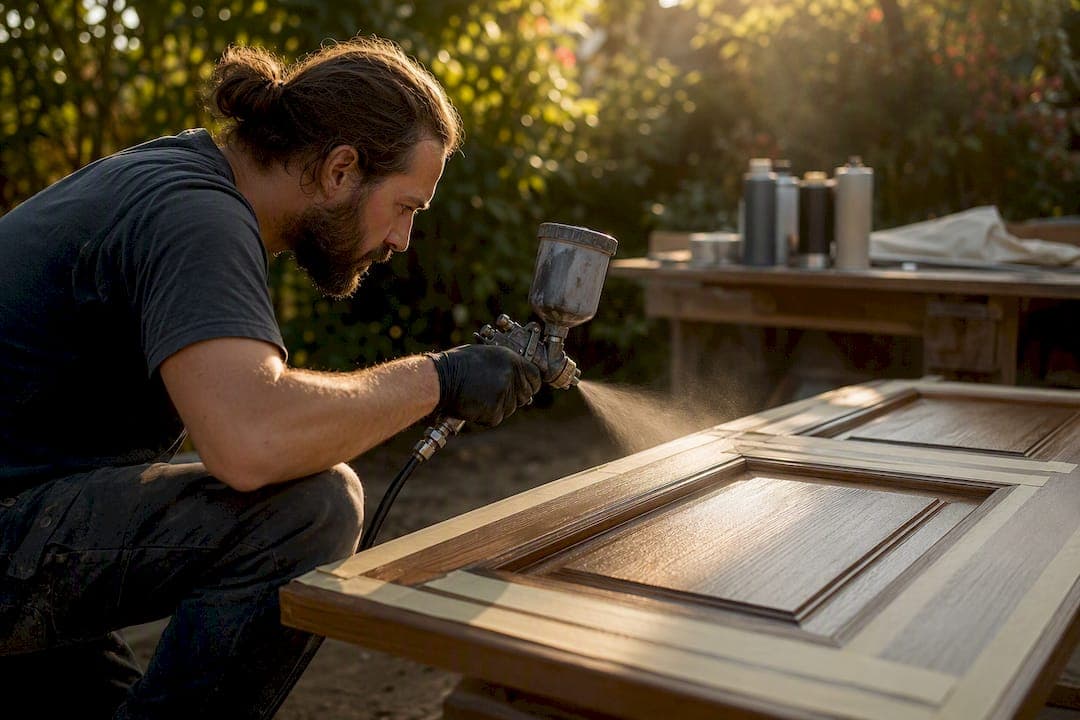
Yes, you can spray over a woodgrain composite door. The catch is that it only works properly with specialist preparation and a professional two-pack (2K) polyurethane spray system. Skip that, and you risk peeling within a year and a flat, grain-less finish that looks nothing like the door you started with.
Two things to check first:
- Confirm your door manufacturer's warranty terms before anyone touches it with sandpaper or a spray gun.
- A standard DIY paint, brushed or rolled straight from a tin, tends to fill the grain rather than sit within it, leaving a flat, plasticky surface.
A proper job uses SB400 degreaser to strip contamination, J Tape Orange for crisp masking lines, and a 2K polyurethane topcoat applied by a specialist such as Refinishing Studio. Get that combination right and the finish holds its colour and flex for years, not months.
Key Takeaways
A woodgrain composite door can be successfully resprayed only with proper GRP-specific preparation and a flexible 2K polyurethane system, never a standard DIY paint.
| Point | Details |
|---|---|
| Spraying works, with caveats | Use specialist prep and a 2K system; check your door warranty before starting. |
| Prep is most of the job | Degreasing with SB400 and scuffing the GRP skin matter more than the spraying itself. |
| Grain needs a specific technique | Thin glazing or graining tools preserve texture; heavy flat coats fill it in. |
| Warranty checks cut both ways | Resprays can void factory cover, so insist on a written guarantee from your installer. |
| Refinishing Studio offers a proven route | Hand-sprayed 2K finishes with a five-year transferable warranty across South Wales. |
Table of Contents
- Why composite doors need a different approach to spraying
- What does a professional respray actually involve?
- Spray or brush and roller: which suits your door?
- How do you change colour without flattening the grain?
- How long does a respray last, and what about your warranty?
- Why do DIY spray jobs on composite doors usually fail?
- What should you ask before hiring a professional?
- Why choose Refinishing Studio for a composite door respray
- Ready to refresh your composite door?
- Frequently asked questions
- Sources
Why composite doors need a different approach to spraying
A composite door isn't one material. It's a sandwich: a timber subframe, a rigid foam core, and an outer skin made from glass-reinforced polymer (GRP), which is where that woodgrain texture is moulded in. GRP is hard, non-porous, and slick, nothing like the open grain of real timber or the flat plastic of uPVC.
That construction moves. Composite doors expand and contract at different rates through the seasons, and any coating applied on top has to flex with the substrate or it will crack along stress points within a few winters. Factory finishes are also cured under controlled industrial conditions that a tin of household paint simply can't replicate, which is part of why adhesion and UV resistance differ so much between a factory coat and a DIY topcoat.
- Three components: wooden subframe, GRP skin, insulating foam core.
- The door flexes seasonally; rigid coatings fail first.
- Factory cure conditions beat anything achievable with a brush at home.
What does a professional respray actually involve?
A composite door respray follows a fixed sequence, and skipping a step is usually where DIY jobs go wrong. Here's the order a competent sprayer works to:
- Remove hardware — handles, letterboxes, and hinges come off or get carefully masked.
- Degrease thoroughly with a specialist cleaner such as SB400, which strips silicone residue and factory contaminants that ordinary sugar soap won't shift.
- Scuff and key the surface so the new coating has something to physically grip onto GRP's slick skin.
- Mask meticulously using J Tape Orange, a high-strength tape, plus paper extending up to 200mm across surrounding brickwork to control overspray.
- Spray the 2K polyurethane using a gravity-fed HVLP gun, working in overlapping passes at roughly 50% coverage per pass for an even, drip-free build.
- Cure and reassemble, respecting touch-dry windows that vary between GRP and PVC substrates.
- Test patch first, always, on an inconspicuous panel or offcut before committing to the full door.
Pro Tip: Ask any installer to spray a test patch on the door's edge or an inner panel first. If the colour or sheen looks wrong on a small area, you've saved yourself a full respray rather than discovering the problem across the whole slab.
Trade guidance consistently treats preparation as the bulk of the labour, not the spraying itself. Cleaning, scuffing, and masking eat up far more time on site than the actual application.
Spray or brush and roller: which suits your door?
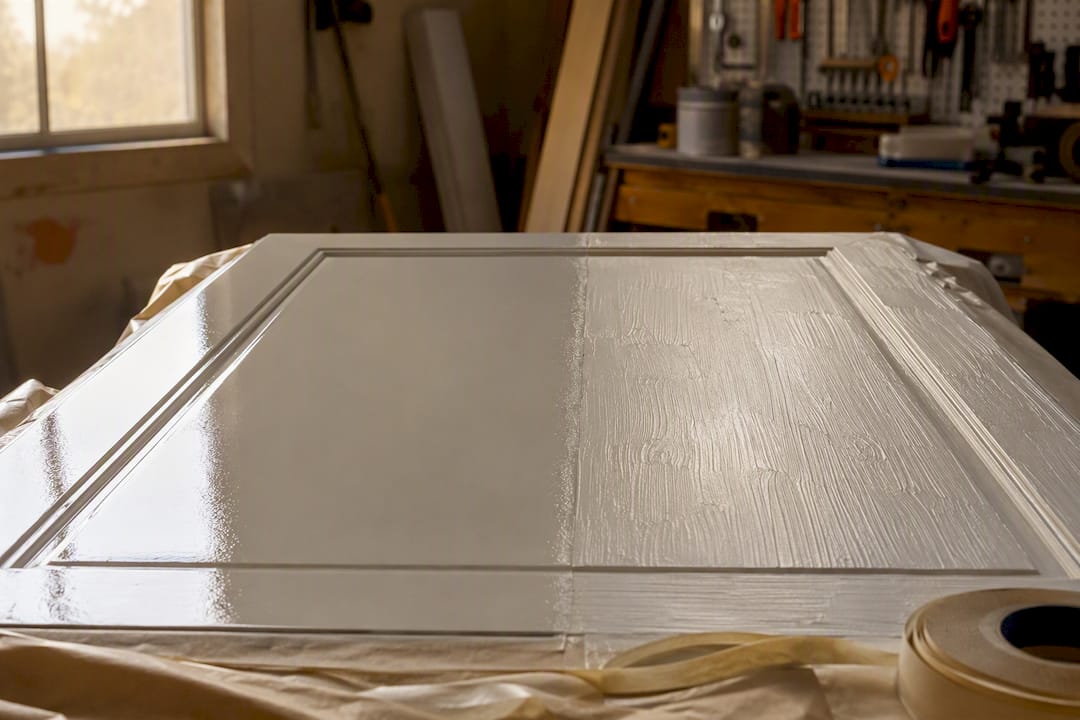
Spraying delivers a smooth, factory-like finish because the paint atomises into a fine mist rather than dragging across the surface. Brush and roller work is more accessible if you're doing it yourself, but it tends to leave visible strokes and can build up unevenly around the moulded grain lines.
Durability tells a similar story. A professional 2K system flexes with the door through temperature swings; most DIY tins simply don't have that engineering, so they crack sooner. Brush work also demands multiple thin coats and long drying gaps between them, whereas a sprayed job compresses that into a single controlled session.
- Small scuffs or a minor colour touch-up: brush or roller is fine.
- A full colour change you want to last: professional spray, every time.
| Factor | Professional spray (2K) | Brush and roller (DIY) |
|---|---|---|
| Finish quality | Smooth, factory-like | Visible strokes, texture buildup |
| Durability and flex | Built to move with the door | Prone to cracking sooner |
| Prep time | Longer, but done once, properly | Shorter, but often incomplete |
| Cost and disruption | Higher upfront, less repeat work | Lower upfront, higher repeat risk |
| Grain preservation | Achievable with the right technique | Grain often fills in |
How do you change colour without flattening the grain?
Plain paint, applied thickly enough to fully cover a door, sits in the moulded grooves and levels them out. That's the single biggest reason DIY resprays look wrong: the colour changes, but the texture that made the door look like timber disappears with it.
Two routes avoid that. Professional glazing and toning techniques build colour in thin, controlled layers that leave the grain lines visible underneath. Faux wood-graining goes further, using a glazing medium and a graining tool dragged through wet glaze to recreate a convincing timber pattern from scratch, a technique that takes real practice to get right.
- Glazing/toning: preserves existing grain, faster than full graining.
- Faux wood-graining: recreates grain entirely, more time-intensive, best left to specialists.
- A translucent finish can let grain show through rather than sealing over it.
Pro Tip: Always ask for a small sample panel in your chosen colour and sheen before signing off on a full door. Grain reads completely differently under matt versus gloss.
How long does a respray last, and what about your warranty?
An in-situ respray, done with the door still hung, typically takes a working day including cure time; removing the sash for a workshop finish can extend that. Touch-dry windows for 2K systems on GRP and PVC generally fall within a few hours, though full hardness takes longer.
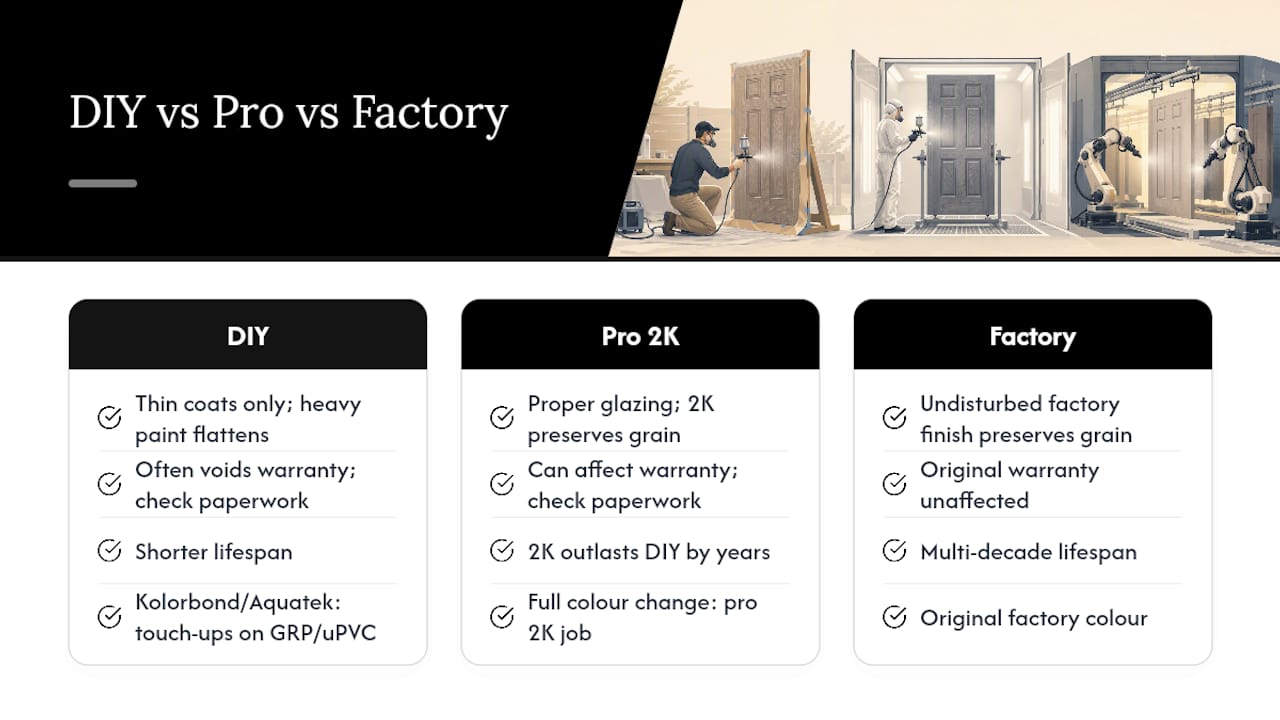
- A professional 2K respray commonly outlasts DIY paintwork by years, though it rarely matches the 25 to 30 years a well-maintained factory finish can achieve.
- Resprays commonly void the door manufacturer's original warranty, so check the terms in writing before booking anyone.
- Ask any installer for their own written guarantee, ideally a multi-year one, to replace the cover you may be giving up.
- Harsh cleaning products or aggressive sanding before coating can weaken adhesion and shorten the life of any new finish.
Why do DIY spray jobs on composite doors usually fail?
Most DIY failures trace back to the same handful of shortcuts: skipping proper degreasing, not keying the GRP surface enough for the new coat to grip, using standard exterior paint instead of a flexible system, or ignoring how much the door moves seasonally. Any one of these on its own can cause peeling within months.
- Poor degreasing leaves invisible residue that stops paint bonding properly.
- Insufficient scuffing means the coating sits on the surface rather than keying into it.
- Standard tins lack the flex 2K systems offer, so they crack along the door's stress points.
- Heavy coats flatten woodgrain texture almost immediately.
Safer DIY territory exists if you're realistic about scope. Purpose-made kits such as Kolorbond, built on the Aquatek formula, are designed to bond directly to GRP and uPVC without a separate primer, provided you follow the prep steps and apply two, sometimes three, medium coats. Small scuffs, tinted oils, or wax revival products are lower-risk options for minor refreshes rather than a full colour change.
Pro Tip: Whatever product you choose, test it on a hidden section first, a door's bottom edge is ideal, and wait a few days to check adhesion before doing the whole door.
What should you ask before hiring a professional?
A good installer will happily answer every question on this list before you sign anything:
- Do you use a 2K polyurethane system, and can you name it?
- What degreasing and scuffing process do you follow (SB400 or an equivalent)?
- What masking materials do you use (J Tape Orange or similar)?
- How many coats will the door get, and what are typical cure times?
- Will you provide a written warranty, and for how long?
A proper written quote should also spell out furniture removal and refitting, protection for surrounding brickwork and glazing, the timescale, and the exact RAL or BS colour code and sheen you've agreed on.
- No test patch offered: walk away.
- Vague answers about "prep" with no named products: red flag.
- No portfolio or previous customer examples available: red flag.
- No written guarantee, only a verbal promise: red flag.
- Reliance on standard household or trade paint rather than a 2K system: red flag.
Why choose Refinishing Studio for a composite door respray
Refinishing Studio sprays composite, uPVC, and timber doors by hand across South Wales, offering the full RAL and BS colour range alongside matt, satin, eggshell, and gloss finishes. Every job carries a five-year transferable warranty, and there are no subcontractors involved, just the same team from quote to completion.
- Hand-sprayed finish to factory standard, applied on site.
- Full RAL/BS colour choice and multiple sheen options.
- Five-year transferable warranty on every job.
- Over 1,000 completed projects across South Wales, including a sage green respray in Swansea.
A door respray should look like it left a factory, not a garage. That's the standard we hold every project to, whether it's a single front door or a full run of composite doors on a street.
Request a quote and Refinishing Studio will talk you through the colour, sheen, and prep process for your specific door before any spraying begins.
A note from the team
We favour 2K systems on composite doors because nothing else flexes properly with GRP through a Welsh winter. Preserving grain takes patience: thin passes, the right glaze work, no shortcuts. Browse the portfolio to see finished doors up close.
Ready to refresh your composite door?
If you're weighing painting against a full door replacement, a respray is almost always the cheaper route, and it's the one that keeps your existing door's grain and hardware intact. Refinishing Studio's hand-spray service covers composite, uPVC, and timber doors across South Wales, using the same 2K polyurethane systems and prep standards described throughout this guide.

Every job comes with a five-year transferable warranty, and the team always recommends a test patch before committing to a full colour change, no exceptions, regardless of the shade you've chosen. If you're weighing up options for a wider frame or garage door too, the same UPVC spraying service covers windows, fascias, and guttering in one visit.
Get a quote for your door today and find out what a factory-standard finish would actually look like on your property.
Frequently asked questions
Can you spray over a woodgrain composite door without losing the texture? Yes, but only with thin, controlled coats or a proper glazing technique. Heavy flat paint fills the grooves and flattens the grain almost immediately.
Will a DIY spray job void my door's warranty? Often, yes. Most manufacturers state that any aftermarket coating, DIY or professional, can affect the original warranty, so check your paperwork first.
How long does a professional respray last compared to the factory finish? A quality 2K respray typically outlasts DIY paintwork by years, though it rarely matches the multi-decade lifespan of an undisturbed factory finish.
Is Kolorbond or Aquatek suitable for a full colour change? These kits work well for smaller projects and colour touch-ups on GRP and uPVC, but a full front-door colour change with grain preservation usually calls for a professional 2K spray job.
What should I ask a sprayer before booking a woodgrain composite door respray? Ask whether they use a 2K polyurethane system, what degreasing and masking products they use, how many coats they'll apply, and whether they offer a written, multi-year warranty.
Sources
For readers who want to verify the technical detail before booking anyone, these are worth reading directly.
- How to respray a composite door - Total Installer
- Can you paint a composite door? | Rawlins Paints
- Wood graining steel doors | Old Masters