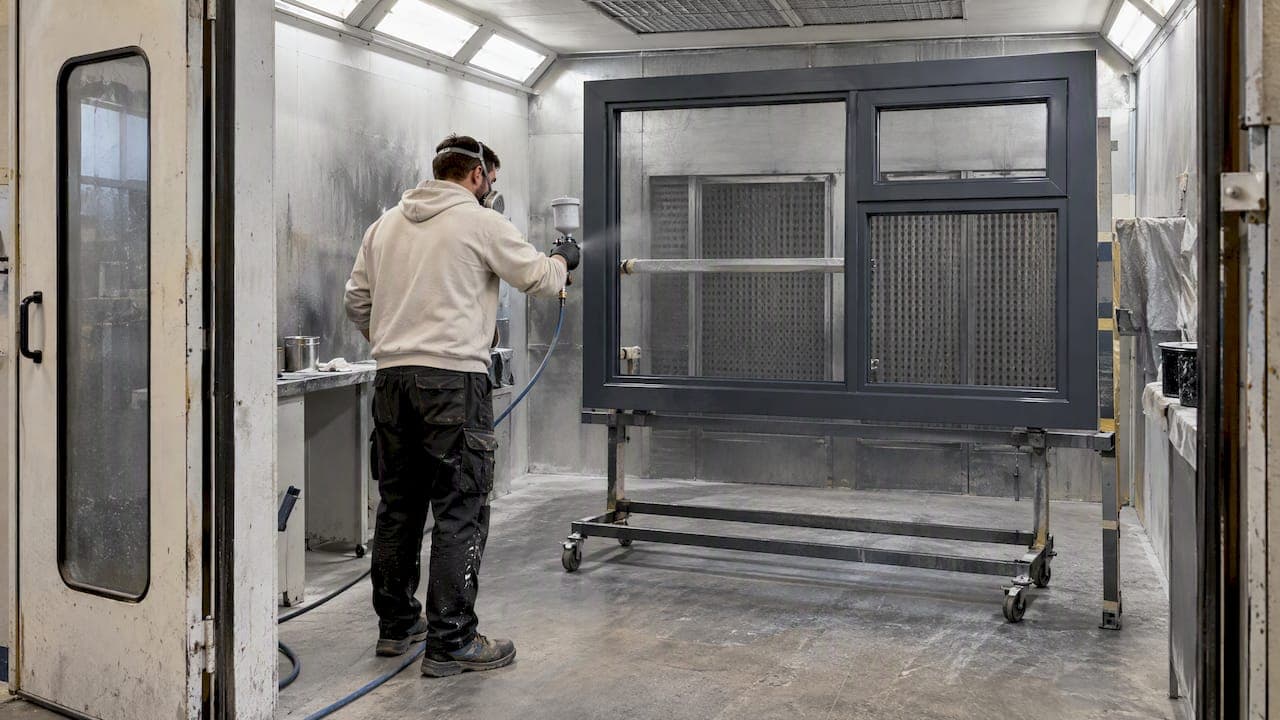
Respraying does create emissions, waste and some pollution risk, but the overall environmental impact can be kept low when the job uses water-based or low-VOC coatings and proper containment. The biggest differences come from choosing low-VOC systems over traditional solvent paints and working with contractors who run enclosed capture or local exhaust ventilation (LEV) and dispose of waste correctly. The HSE sets safety expectations for spraying, and life-cycle analysis (LCA) is the standard tool for judging true impact. We respray UPVC and kitchen surfaces at Refinishing Studio.
TL;DR:
- Water based and low VOC coatings reduce fumes and cleanup risks, but some UPVC jobs may still need solvent or two component systems for adhesion.
- Choose contractors who spray in an enclosed booth or use local exhaust ventilation, and confirm the clearance time before anyone reenters the work area.
- Leftover paint, used solvents, contaminated cloths, sanding dust, and spent filters require proper disposal; they should never go in household bins or down drains.
- Thorough degreasing, sanding, and coatings suited to the surface help finishes last; a durable respray can avoid the material, energy, and waste of repeat work.
- For coatings that contain isocyanates, confirm that trained sprayers use supplied air respiratory protection and enclosed capture, with safe clearance before reentry.
Table of Contents
- 1. Low-VOC and water-based paints: what they are and why they matter
- 2. Paint booths, LEV and capture: how application method controls emissions
- 3. Waste, runoff and disposal: managing leftover paint and contaminated materials
- 4. Lifespan and lifecycle thinking: why doing the job well can be more sustainable
- 5. Practical steps for homeowners to reduce environmental harm from a respray
- 6. Health and safety: isocyanates, PPE and protecting workers and occupants
- 7. How professional resprayers manage environmental impacts
- Pragmatic choices that reduce overall harm
- FAQ
- Sources
1. Low-VOC and water-based paints: what they are and why they matter
Water-based paints replace most of the solvent in traditional formulations with water, which cuts the volatile organic compounds (VOCs) released during application and drying. Low-VOC products follow the same principle with tighter chemical limits, and both reduce the fumes that affect indoor air quality and contribute to smog formation outdoors. Guidance from the HSE notes that solvent-based paints have measured the highest environmental impact across various life-cycle assessments, while water-based alternatives generate less hazardous waste during application and cleanup.
That said, not every job can switch straight to water-based systems. Some high-performance finishes, particularly on UPVC and certain metals, still rely on two-pack (2K) or solvent-based chemistries for adhesion and durability. The Royal Society of Chemistry warns against swapping one chemical for another without checking the full picture, since a change that lowers one impact can raise another, a pattern it calls a "regrettable substitution". Its researchers note that eliminating solvents entirely isn't yet feasible for every application, so the practical focus is mitigation: low-VOC waterborne formulations, high-solids coatings and filtration where solvent use can't be avoided.
Before committing to a product, it's worth asking a few direct questions:
- What VOC limit does this paint meet, and can you show the datasheet?
- Has this product been assessed with life-cycle data, or just marketed as "eco" without evidence?
- Does the finish need a solvent-based top coat for durability, and if so, why?
2. Paint booths, LEV and capture: how application method controls emissions
The paint itself is only half the story. How it's applied determines how much of it ends up in the air rather than on the surface. Overspray behaves like smoke: fine particles drift on air currents and can travel well beyond the immediate work area if nothing contains them. Professional spray booths and rooms are built to stop this, typically running at a slight negative pressure so air is drawn inward rather than escaping outward, with filtration catching the particulate before it leaves the enclosed space.
Booths and spray rooms differ mainly in scale and clearance procedure. Both need a measured clearance time, the interval after spraying during which mist settles and filters clear the air, before anyone re-enters safely. HSE guidance describes this clearance process alongside the training and respiratory protective equipment (RPE) needed for reactive coatings.
As a homeowner, it's reasonable to ask a contractor for:
- Evidence of an enclosed booth or LEV system, not just an open garage setup.
- A stated clearance time before the work area is safe to enter.
- Confirmation that the work area is sealed off from living spaces during spraying.
Pro Tip: Ask to see a smoke test or booth inspection record. It's a quick way to confirm an enclosure actually holds negative pressure rather than just looking sealed.
3. Waste, runoff and disposal: managing leftover paint and contaminated materials
A respray generates several waste streams beyond the finished surface: leftover paint, used solvents, contaminated rags and cloths, sanding dust, and spent filters or spray cartridges. None of these belong in a household bin or down a drain. NetRegs guidance sets out how professional operators are expected to manage this waste, relying on enclosed booths, regular filter maintenance and segregated cleaning systems rather than ad hoc disposal.
A few habits reduce the problem before it starts:
- Mix only what's needed by estimating quantities accurately against the surface area.
- Route leftover paint to hazardous waste collection or a community paint re-use scheme rather than storage or disposal at home.
- Choose high-solids products, which leave less solvent waste behind after application.
- Favour workshop spraying over on-site work where possible, since a controlled space captures overspray that would otherwise settle on nearby surfaces.
4. Lifespan and lifecycle thinking: why doing the job well can be more sustainable
Judging a respray's environmental cost by the spraying session alone misses most of the picture. Life-cycle analysis looks at manufacture, application, the years the finish actually lasts, and eventual disposal, and that "use life" stage often decides whether a respray was worthwhile. A finish that lasts and needs no touch-up has a very different footprint from one that fails early and has to be redone.
Published LCA research found that moving from legacy solvent-based systems to water-based coatings generally improved environmental indicators, though some substitution scenarios increased other impacts significantly, reinforcing the Royal Society of Chemistry's point that preservative and performance trade-offs need proper assessment rather than assumption.
What tends to matter more than the paint choice alone:
- Thorough surface preparation, including degreasing and correct keying or sanding, which determines how well any coating adheres.
- Selecting a coating suited to the substrate rather than the cheapest available option.
- Treating a respray as a long-term investment rather than a quick cosmetic fix, since getting the prep right reduces the chance of repeat work.
5. Practical steps for homeowners to reduce environmental harm from a respray
Homeowners have more influence over a respray's footprint than they might expect, mostly through the questions they ask before booking. Confirming paint chemistry, containment and waste routes upfront avoids problems that are hard to fix afterwards.
Worth raising with any contractor:
- Is the coating low-VOC or water-based, and why was it chosen for this job?
- What booth, LEV or enclosure will be used, and what's the clearance procedure?
- How is leftover paint, filter waste and contaminated material disposed of?
- Can training records or certification be shown for spray work?
Workshop spraying generally reduces environmental risk compared with in-situ work, since overspray and fumes stay inside a controlled space rather than drifting through a kitchen or garden. For kitchen cabinetry, that's often the deciding factor between spraying on-site and removing doors for workshop treatment. Preparation choices, particularly degreasing grease-laden kitchen surfaces thoroughly and sanding to create a key for the new coating, directly affect how long the finish lasts and how soon it needs redoing.
Pro Tip: Ask whether doors will be sprayed flat rather than vertically. Flat spraying lays down a more even coat, which tends to hold up longer and need fewer touch-ups.
6. Health and safety: isocyanates, PPE and protecting workers and occupants
Some high-performance 2K paints contain isocyanates, which can cause occupational asthma and skin irritation (dermatitis) with repeated exposure. HSE guidance treats these products as requiring strict controls precisely because the health risk is well established among professional sprayers.
The standard controls are:
- Enclosed capture or LEV to stop spray mist escaping the work area.
- Air-fed RPE for anyone spraying isocyanate-containing products.
- A measured clearance time before re-entry.
- Health surveillance and, where required, monitoring for isocyanate exposure.
Before booking a job involving these coatings, it's reasonable to confirm the contractor has relevant training, uses the correct RPE, and can show evidence of LEV and safe clearance practice rather than taking it on trust.
7. How professional resprayers manage environmental impacts
Professional operators lean on the same fundamentals throughout a job: enclosed capture systems, filters that are checked and changed on schedule, and cleaning routines kept separate from general waste streams. These aren't optional extras, they're what keeps fugitive emissions down and waste correctly routed.
Workmanship matters just as much as equipment. Spraying components flat, building up multiple thin coats rather than one thick one, and sealing edges fully all extend how long a finish lasts, which cuts the need for repeat jobs down the line. When choosing a contractor, proof points worth checking include training records, waste disposal receipts, and a written warranty that reflects confidence in the finish.

Pragmatic choices that reduce overall harm
A respray done well, with the right coating, proper containment and correct waste handling, is often a genuinely lower-impact choice than people assume. The variable isn't really the act of spraying, it's how carefully it's managed.
Readers are usually better served by prioritising a finish that lasts over whichever quote looks cheapest today. A job that needs redoing in two years costs more materials, more energy and more waste than one done properly the first time. Ask any contractor about their ventilation, training and disposal practices before asking about price.
— Mitchell
FAQ
Is it bad to breathe in the smell of spray paint?
Yes, inhaling spray paint fumes can irritate the airways, and with isocyanate-containing products the risk extends to occupational asthma with repeated exposure. HSE guidance recommends enclosed spraying, appropriate RPE and a proper clearance time before anyone re-enters the area.
When should you not paint your house?
Avoid spraying in poorly ventilated spaces, during extreme temperatures or humidity that affect cure times, or without confirming how overspray and fumes will be contained. If anyone in the household has respiratory sensitivities, it's worth timing the work around a period when they can stay elsewhere until clearance is complete.
What can I use instead of spray paint?
Brush or roller application avoids fine overspray but generally gives a less even factory-style finish than professional spraying. For kitchen cabinetry specifically, replacement doors are another route some homeowners consider, though a well-executed respray usually achieves a comparable look while avoiding the material use of full replacement.
Does spray paint harm the environment?
Solvent-based spray paints have been measured as having the highest environmental impact among coating types across various life-cycle assessments, largely through VOC emissions and hazardous waste. Water-based and low-VOC alternatives substantially reduce that impact when paired with proper capture and disposal.
Sources
For readers or contractors who want to check the regulatory and lifecycle detail behind this guidance, the primary sources are worth reading directly: HSE's guidance on spraying risks and coating environmental impact, the Royal Society of Chemistry's solvent sustainability research, NetRegs environmental guidance, and a published life-cycle assessment of architectural coatings.
- Development of a solvent sustainability guide for the paints and coatings industry† | Green Chemistry | The Royal Society of Chemistry
- Vehicle refinishing products | NetRegs | Environmental guidance for your business in Northern Ireland & Scotland