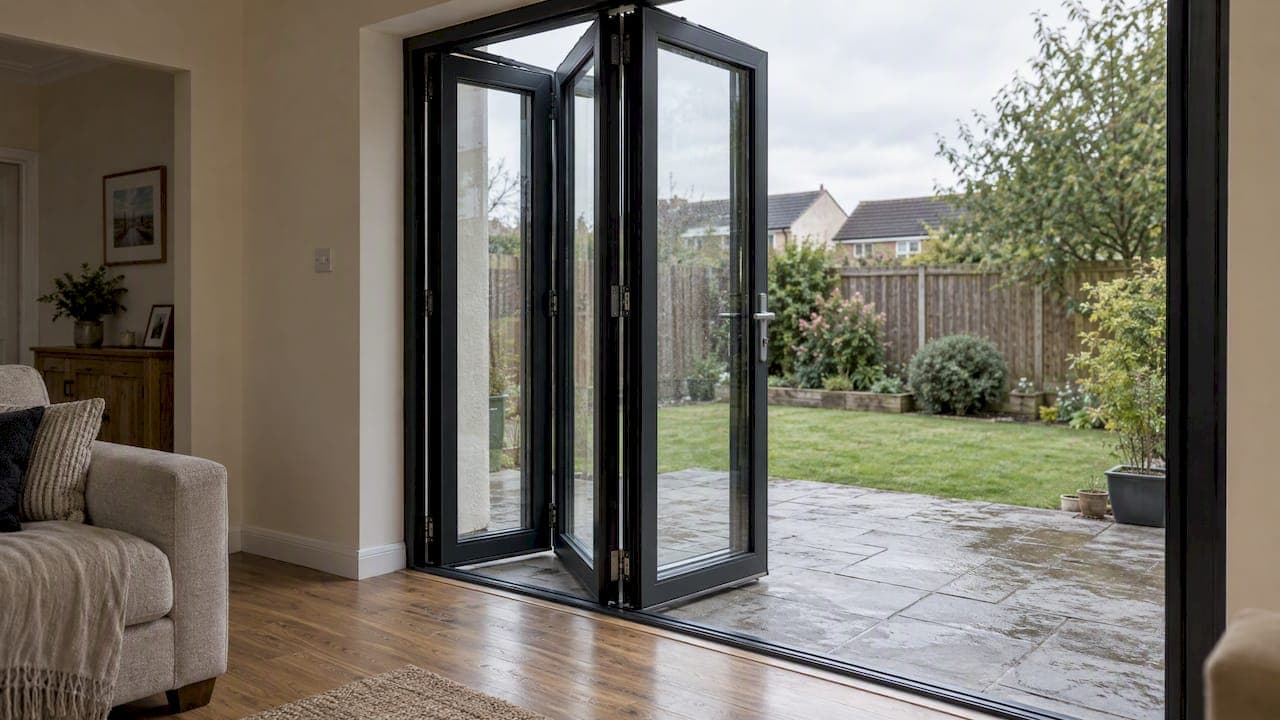
Yes, you can change the colour of bifold doors, and the right method depends entirely on the material. Internal timber doors are usually a straightforward DIY repaint, while external aluminium or uPVC doors need specialist preparation and spraying to last. Dual-colour finishes, a darker shade outside and lighter inside, are common when your exterior and interior need different looks. If you are planning exterior work, test your colour choice first and talk to a professional before you commit.
TL;DR:
- Anthracite grey, jet black, and white are common choices; some suppliers list over 150 RAL shades, while black shows watermarks and white needs frequent cleaning.
- Internal timber doors suit DIY repainting: sand, prime, and apply thin coats, then allow full curing before folding to prevent sticking, scuffs, or paint transfer.
- Foiled uPVC and powder coated or anodized aluminium need specific degreasing, abrasion, and primers; ordinary household paint often peels when preparation is skipped.
- For two tone finishes, place the colour boundary on a component seam and fully cure the first colour before masking to protect seals and rollers.
- Paint may feel dry within hours but remain vulnerable; wait at least 24 hours before light handling, and delay full folding until the finish hardens.
Table of Contents
- Popular colours and when to pick a dual-colour finish
- How substrate affects your approach: aluminium, uPVC and timber
- Step-by-step DIY repaint for internal timber or primed bifold doors
- Painting two colours or matching inside to outside: masking and movement checks
- Why and when to choose professional respraying
- Maintenance and durability expectations
- Best types of paint and finishes for bifold doors
- Necessary tools and safety precautions for painting bifold doors
- Common mistakes to avoid when painting bifold doors
- Drying and curing times for different paint types on bifold doors
- Environmental considerations during painting
- Choosing between DIY and a professional: my honest view
- How Refinishing Studio can help with your bifold doors
- FAQ
- Sources
Popular colours and when to pick a dual-colour finish
Three shades dominate bifold door choices: anthracite grey (RAL 7016), jet black (RAL 9005) and white (RAL 9016). Manufacturers typically offer these as factory-specified options alongside much wider RAL ranges, with over 150 RAL colours listed by some suppliers and finishes running from matt through to gloss and textured coatings.
Dual-colour finishes solve a common dilemma: a dark exterior that suits brick or render outside, paired with a lighter interior that matches your room's existing woodwork and walls. This is standard practice on many modern installations, not a compromise.
- Anthracite grey works with most brick tones and modern render.
- Jet black suits contemporary builds but shows dust and watermarks more.
- White keeps small rooms feeling brighter but needs more frequent cleaning.
Pro Tip: Hold physical swatches against your actual frame, glazing and interior finishes at different times of day before you decide. Paint chips and screen colours rarely match how a shade looks on your own door.
How substrate affects your approach: aluminium, uPVC and timber
The material your bifold doors are made from decides how much work is realistic for you to take on. Adhesion, the right primer and any pre-treatment all change depending on what you are painting.
- Aluminium: powder-coated, anodised or bare aluminium frames need specific primers and controlled application; factory powder-coating guidance notes that pre-treatment and consistent application conditions are essential, which is hard to replicate without equipment.
- uPVC: glossy or foiled surfaces need degreasing and abrasion before any coating goes on, and a proper specification for uPVC and powder-coated aluminium involves several prep stages most homeowners skip.
- Timber and internal doors: sanding, priming and a conventional paint system is usually enough for a lasting finish, which is why most DIY guides focus here.
If your doors are foiled uPVC or anodised aluminium, read our guide on repainting powder coated aluminium before buying any paint, since the wrong prep is the most common cause of early peeling.
Step-by-step DIY repaint for internal timber or primed bifold doors
Internal timber bifold doors are the most forgiving candidates for a DIY repaint. Climadoor's guidance sets out a sequence that works well if you follow it in order.
- Remove the doors from their track, or lay them flat across trestles, and take off handles and hinges where practical.
- Clean the surface thoroughly, then sand lightly with a fine or medium grit abrasive and wipe away all dust with a lint-free cloth.
- Apply a suitable primer suited to your timber and the door's location, letting it dry fully before moving on.
- Mask the glass panels and any remaining hardware with quality tape.
- Paint in thin, even coats using a latex or oil-based product appropriate for the substrate, working the edges and panel faces separately.
- Let each coat dry completely before adding the next, and check the doors fold and close without binding before refitting permanently.
Rushing the drying stage is the single most common reason a DIY repaint looks patchy within weeks.
Painting two colours or matching inside to outside: masking and movement checks
Dual-colour work on bifold doors needs more care than a single flat colour, mainly because of where the colours meet and how the panels move. Step-by-step guidance from Vibrant Doors recommends working to a genuine component boundary, such as the interior face versus the exterior face, rather than an arbitrary stripe across the panel.
- Paint and fully cure the first colour before you begin masking for the second.
- Use quality masking tape and protect seals, gaskets and rollers from overspray or brush contact.
- Avoid placing a colour break across a hinge or fold line, since this wears unevenly and looks obviously botched within a season.
- Test the folding action fully before final reassembly, checking for any binding, scraping or fresh paint transfer between panels.
A break that follows a real seam rather than a painted line also ages better, since there is no raw edge for moisture or movement to work against.
Why and when to choose professional respraying
Professional respraying reproduces a factory-like finish through a process that is difficult to match with a brush and roller: controlled abrasion, the correct primer for the substrate, specialist spray application and a proper curing period. Technical powder-coating documentation confirms that pre-treatment and applicator control matter as much as the product itself, particularly for metallic or effect finishes where even small inconsistencies in application show up clearly.
Powder-coating and wet-spray respraying are not the same process. Powder-coating is applied in a factory setting with heat-cured finishes, while professional wet-spray respraying is typically carried out on-site using hand-applied coatings designed for the substrate in question.
- Choose professional spraying for external aluminium or uPVC frames, where DIY preparation rarely matches the standard needed for longevity.
- Choose it for foiled or powder-coated surfaces, which need specific primers most DIY paints are not formulated for.
- Choose it for complex dual-colour jobs on moving hardware, where a clean, durable line matters.
- Choose it when a long warranty is important to you, since a professional application typically carries guarantees a DIY job cannot.
Substrate preparation is not optional: specification guidance for architectural refinishing shows that uPVC and powder-coated aluminium each need distinct abrasion, degreasing and priming steps, and skipping any one of them is a common cause of coatings failing early.
Maintenance and durability expectations
Once a bifold door is repainted, how it holds up depends heavily on preparation quality rather than the paint brand alone. A well-prepared timber door, properly primed and finished with a durable topcoat, should keep its appearance for several years with routine cleaning and the odd touch-up around high-contact areas like handles.
Exterior doors face a tougher test: UV exposure, rain and temperature swings all stress a coating in ways an interior door never experiences. Doors that were not properly degreased or abraded before painting tend to show peeling or flaking at the edges first, often within a single season, which is one reason a proper preparation checklist matters so much for exterior uPVC.
Routine maintenance is simple: wipe panels down with mild soapy water, avoid abrasive cleaners on painted finishes, and check seals and hardware periodically so moving parts do not drag paint off the frame edges.

Best types of paint and finishes for bifold doors
The right paint depends on the substrate and location. For internal timber doors, a water-based satin or eggshell is usually easier to apply evenly than full gloss, and it is more forgiving of small application errors. Oil-based paints give a harder, more durable finish but take longer to dry and yellow slightly over time.
For uPVC and aluminium, standard household paints are not designed to bond properly, which is why specification documentation for architectural refinishing specifies purpose-made coating systems rather than conventional wall or wood paint. Attempting a standard paint on these substrates without the correct primer system is a common cause of early failure.
Matt finishes hide surface imperfections well and suit contemporary interiors, while satin and gloss show more light and highlight panel detail but also show scuffs and fingerprints more readily.

Necessary tools and safety precautions for painting bifold doors
A basic timber repaint needs: sandpaper in a fine and medium grit, a tack cloth or lint-free rag, good quality masking tape, a primer suited to your timber, a brush or small roller, and a dust sheet to protect flooring.
Work in a ventilated space, since paint fumes build up quickly in an enclosed room, and wear a basic dust mask when sanding old paintwork, particularly if the door's age means the original coating could contain lead. Keep windows open throughout application and drying, and store solvents and paints away from any heat source.
If you are removing doors from their track, get a second person to help lift and support them, since bifold panels are often heavier and more awkward than a standard hinged door.
Common mistakes to avoid when painting bifold doors
- Skipping sanding or cleaning, which leaves old gloss or grease on the surface and stops new paint bonding properly.
- Using a standard wall or wood paint on uPVC or aluminium without a specialist primer system.
- Painting over a colour break on a hinge or fold line instead of a genuine component boundary.
- Refitting doors before paint has fully cured, which leaves soft paint vulnerable to scraping and sticking.
- Working in poor weather or high humidity, which stops paint curing evenly and can trap moisture under the finish.
Each of these mistakes shows up later rather than immediately, which is why a rushed job often looks fine on day one and starts failing within weeks.
Drying and curing times for different paint types on bifold doors
Drying and curing are not the same thing, and confusing them is a frequent cause of damage. A water-based paint may feel dry to the touch within an hour or two, but it can take considerably longer to cure fully enough to withstand handling, folding and cleaning without marking.
Oil-based paints dry more slowly to the touch, often needing several hours between coats, and need a longer curing window before the door is back in regular use. As a general rule, wait at least 24 hours before light handling and avoid folding the doors through their full range of movement until you are confident the final coat has properly hardened.
Rushing this stage is one of the most common reasons a freshly painted bifold door picks up marks, scuffs or fingerprints within the first week of use.
Environmental considerations during painting
Weather and humidity affect how paint dries and how well it bonds, which matters more for bifold doors than for most furniture because they are often painted in situ, partly exposed to the elements. Painting in direct sun can cause the surface to dry too quickly, trapping solvents underneath and leading to a finish that looks fine initially but fails early.
High humidity slows drying and curing considerably, and can cause a cloudy or uneven finish, particularly with water-based paints. Cold temperatures have a similar effect, slowing the chemical processes that let paint harden properly.
Aim to paint on a dry, mild day, ideally with good airflow but away from direct wind that can blow dust and debris onto wet paint. If you are working on an internal door that you have removed to a garage or workshop, control the room's temperature and ventilation as best you can rather than relying on the weather outside.
Choosing between DIY and a professional: my honest view
If your doors are internal timber, DIY is a sensible choice and the Climadoor-style process works well when you follow each step patiently. The moment you are dealing with exterior aluminium, foiled uPVC or powder-coated frames, I would always recommend a trial panel and a conversation with a local resprayer before buying paint. Weigh finish quality, how long it needs to last, and whether a warranty matters to you against what you would save doing it yourself.
— Mitchell
How Refinishing Studio can help with your bifold doors
If your bifold doors are external aluminium, uPVC or a foiled finish, our hand-spray respraying gets you a factory-like result without a full replacement. We handle preparation, spraying and finishing ourselves with no subcontractors involved.

This approach suits anyone with foiled uPVC frames, powder-coated aluminium, or a dual-colour job that needs a clean, durable finish rather than a DIY attempt with an uncertain lifespan. You can see pricing and get started on our UPVC door spraying page, or browse the full range of UPVC spraying services we offer across windows, doors and fascias. Request a quote and we will talk you through colour options before any work begins.
FAQ
How do you paint a door two colours?
Paint and fully cure the first colour before masking off the boundary with quality tape, then apply the second colour in thin coats. Place the colour break on a genuine component line, such as the interior versus exterior face, rather than an arbitrary stripe, and always test the door's movement before final reassembly, as sequencing guidance for bifold doors recommends.
What are the three colours not to paint your front door?
There is no single agreed list of colours to avoid, since the right choice depends on your property, local planning restrictions and personal taste. Extremely dark or highly reflective finishes can show dirt, fading and scratches more readily than mid-tone shades like anthracite grey or muted blues.
How do you upgrade your bifold doors without replacing them?
Repainting or professional respraying is the most common upgrade, letting you change colour, refresh a tired finish, or switch to a dual-colour design without the cost of new doors. For aluminium or uPVC frames, specialist spraying achieves a durable, factory-like result that a DIY paint job usually cannot match.
How do you paint an aluminium front door?
Aluminium needs thorough degreasing and light abrasion before any primer goes on, since the smooth factory finish resists ordinary paint adhesion. Powder-coated or anodised aluminium in particular needs a specific primer and controlled application, which is why many homeowners opt for a professional respray rather than a DIY attempt on this substrate.
Sources
- A guide to bi-fold door colours — Origin trade advice centre
- How to paint an internal bifold door — Climadoor advice
- Painting internal bifold doors — Vibrant Doors step-by-step guide
- Interpon D2525 Gloss technical document — AkzoNobel