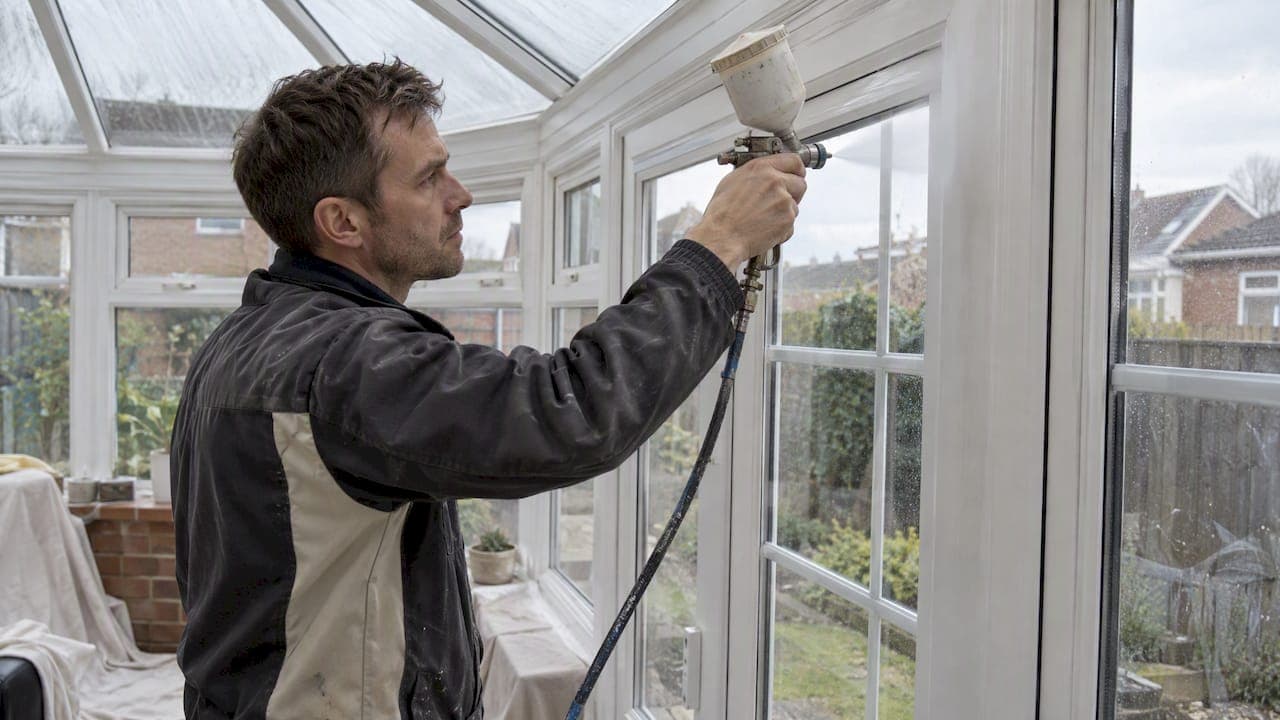
A single door or a handful of windows often sprays in a day, while a full house or conservatory usually needs one to three days depending on access and weather. Surfaces feel dry within hours, but that is not the same as cured: avoid heavy use or cleaning until the coating has had several days to harden fully, and expect application itself to depend on suitable temperature and humidity on the day.
TL;DR:
- A door often takes hours, a window elevation one to two days, and a whole house or conservatory two to three days or longer.
- At 23°C and 50% to 65% relative humidity, coatings can become touch dry within two hours, but full hardness takes several days.
- Spraying works best between 15°C and 25°C, with 10°C the absolute minimum; cold, damp weather slows drying and can undermine adhesion.
- Dark or textured finishes may need primer and another drying window; upstairs frames and conservatory roofs add time for access and masking.
- Book several weeks ahead in spring and summer, and confirm access, parking, and cleared work areas to reduce delays or rescheduling.
Table of Contents
- Timeline by fixture and project size
- What adds time: preparation, masking, colour and access
- Curing explained: from dust-free to fully hardened
- Scheduling and lead times: when to book and what to expect
- Day-of expectations: what happens when the sprayer arrives
- Why preparation and the right coating system set the timeframe
- A sprayer's view on rushing the schedule
- Refinishing Studio: how we plan your timeline and back it with a guarantee
- FAQ
- Sources
Timeline by fixture and project size
How long a job takes depends mostly on how much surface there is to prepare, mask and spray, not on the spraying itself. Most professional quotes break the work into prep, application, a check for tackiness, and a second coat where the colour or finish calls for one.
- Single door: often finished within a few hours, including masking glass and hardware.
- Single elevation of windows: typically one to two days once you include prep, two coats and drying time between passes.
- Whole house exterior or conservatory: usually two to three days or more, particularly where there are multiple elevations or large glazed areas.
Frames sprayed in place (on-frame) are quicker to schedule because there is no removal or refitting, but masking glass, brickwork and handles takes real time on a busy elevation. Off-frame work, where a unit is unclipped and sprayed away from the glass, can give a cleaner finish on fiddly profiles but adds time for removal and refitting, which usually pushes a job from a single day into two.
Upstairs windows, bay windows and conservatory roofs tend to stretch a schedule because of access. Our UPVC window spraying service, priced from £80 to £2,200 depending on the scope, reflects that variation: a small ground-floor job and a full upstairs elevation are not the same booking. A homeowner's guide to respraying covers what feasibility and access generally look like before a job is booked.
Conservatories and French doors often get lumped in with "windows" in a quote, but they behave more like a whole-elevation job because of the glazing bars and corner profiles involved; a dedicated look at French doors sets out what that extra complexity involves in practice.
What adds time: preparation, masking, colour and access
The spraying itself is usually the fastest part of the day. What stretches a schedule is everything around it.
- Surface preparation: cleaning, removing old silicone, degreasing and light abrading the uPVC so the coating bonds properly, which a professional crew builds into the day rather than treating as optional.
- Masking: protecting glass, brickwork, handles and locks takes longer on bay windows or elevations with lots of small panes than on a single flush door.
- Colour and finish: darker colours, textured finishes or a change from white to a strong RAL shade often need an extra coat or a primer pass, each with its own drying window before the next can go on.
- Access: upstairs frames, conservatories against a fence line, or awkward corners may need ladders or careful positioning, which slows the masking and spraying stages more than it slows drying.
A prep checklist is worth reading before booking, since poor adhesion almost always traces back to a surface that was not properly cleaned and abraded first.
Pro Tip: Ask your sprayer whether your colour choice needs a primer coat. If it does, build an extra half day into your expectations rather than assuming the quoted time covers a single top coat.
Curing explained: from dust-free to fully hardened
Manufacturer technical sheets for professional 2K coatings describe several distinct stages, and homeowners often confuse the early ones with the finished job. The Teknos HYDROPUR 2K technical data sheet sets out typical timings at +23°C and 50 to 65% relative humidity: dust free in 20 to 60 minutes, touch dry within 90 minutes to 2 hours, overcoatable after around 3 hours, and through dry often within 24 hours depending on film thickness.

Through dry in roughly 24 hours at +23°C sounds fast, but the same technical data also warns against waiting longer than 72 hours before applying a specified clear coat, which shows how tightly these windows are tied to temperature.
Cooler or damper UK conditions push every stage out. A late-autumn job at 12°C to 14°C with higher humidity will dry more slowly through each stage than the same job in a warm, dry July, and the TeknoCr yl 2K data sheet recommends keeping surface temperature at least 3°C above the dew point to avoid condensation spoiling the cure.
In practical terms: windows and doors can usually be closed gently and left overnight once they are touch dry, but avoid scrubbing, leaning tools against the frame, or heavy daily use until several days have passed and the coating has reached full hardness.
Scheduling and lead times: when to book and what to expect
Getting a date in the diary during busy months often takes longer than the job itself.
- Expect to book several weeks ahead during spring and summer, when most exterior spraying happens.
- Many sprayers avoid cold, damp or frosty months because application outside a suitable temperature range risks poor adhesion.
- Trades typically build a buffer day or two into longer jobs to absorb a rained-off morning or a slow-drying coat.
- Confirming access, parking and any removal of blinds or furniture in advance reduces the chance of a rescheduled visit.
Booking early in the season, rather than waiting for a heatwave, generally gives you more flexibility over dates.
Day-of expectations: what happens when the sprayer arrives
A typical visit starts with arrival and a final check of the surfaces, followed by masking, spraying, and a tack check before the crew leaves for the day.
- Expect masking of glass, nearby brickwork, hardware and any plants or furniture close to the work area.
- Clear access to driveways, side gates and any windows being sprayed, and keep pets away from the work area for the day.
- You may notice a mild solvent smell during spraying that clears quickly once ventilation resumes, and noise is minimal compared with most other trades.
- Freshly sprayed windows and doors are usually best left closed until the crew confirms they are touch dry enough to handle.
Why preparation and the right coating system set the timeframe
The timings above exist because 2K coating systems are chemically specific about temperature, humidity and recoat windows, not because contractors are being cautious for no reason. The SprayDirect guidance on application conditions recommends spraying between +15°C and +25°C, with +10°C as an absolute minimum, because colder or more humid conditions slow drying and increase the risk of adhesion failure. Pot life, mixing ratios and surface temperature all affect how long a sprayer has to work before a mixed coating starts to change, which is why experienced teams plan the day around conditions rather than a fixed clock.
A coating that looks touch dry within two hours can still take several days to reach the chemical resistance it needs to survive daily handling, weather and cleaning.
We back every job with a warranty and plan around cure conditions rather than the calendar.
A sprayer's view on rushing the schedule
Every callback I have seen traces back to someone spraying in the wrong conditions or skipping a prep step to save an afternoon. We plan masking and surface prep to cut down the number of visits a job needs, not to get the gun moving faster. If a supplier offers to spray in freezing fog or driving rain to hit your date, that is a warning sign, not a bonus.
— Mitchell
Refinishing Studio: how we plan your timeline and back it with a guarantee
We spray UPVC windows, doors, fascias and kitchen cabinetry by hand to a factory-standard finish, and we quote and prep every job ourselves.

- UPVC window spraying is priced from £80 to £2,200 depending on scope, see details.
- UPVC door spraying runs from £250 to £650, see details.
- Fascia and gutter spraying runs from £350 to £850, with whole-exterior pricing available on the same cost page.
- Kitchen respraying and cupboard spraying are quoted on request after we see your cabinets, get a kitchen quote.
| Project type | Typical timeframe | Price |
|---|---|---|
| UPVC window spraying | A few hours to two days | £80 to £2,200 |
| UPVC door spraying | A few hours | £250 to £650 |
| Fascia and gutter spraying | One to two days | £350 to £850 |
Every job comes with a warranty, and we have completed numerous projects using a consistent hand-spray process. To get a quote, send us a few photographs, the number of frames or doors involved, and any notes on access such as upstairs windows or a conservatory roof, and we will give you a realistic start date and duration before you book. If you are weighing up timing for a wider building project alongside your respray, this guide to realistic contractor hours is a useful companion read. Start your project with our UPVC spraying services page.
FAQ
Is 3 hours enough for spray paint to dry?
Three hours is usually enough for a professional 2K coating to become touch dry and even overcoatable, based on manufacturer drying data at around +23°C. It is not enough to reach full chemical resistance, so avoid heavy handling or cleaning for several days after spraying.
How much does it cost to have uPVC windows resprayed?
Our UPVC window spraying service is priced from £80 to £2,200 depending on the number of frames and the finish chosen. Door spraying is priced separately, from £250 to £650.
How long does it take for spray paint to dry on PVC?
Professional 2K coatings typically go dust free within 20 to 60 minutes and touch dry within 90 minutes to two hours at around +23°C, with through dry often reached within 24 hours. Cooler or more humid conditions, as noted in SprayDirect's application guidance, will extend every stage.
How soon can I put a second coat of spray paint?
Manufacturer data shows a typical coating becomes overcoatable after around three hours at +23°C, though this window narrows or widens with temperature and humidity on the day. Leaving it too long between coats, beyond roughly 72 hours in some cases, can mean the surface needs a light sand before the next pass.
Sources
- Teknos HYDROPUR 2K COLOR technical data sheet
- SprayDirect — optimal temperature and humidity for spray painting
- Checkatrade — uPVC spraying cost and typical timelines