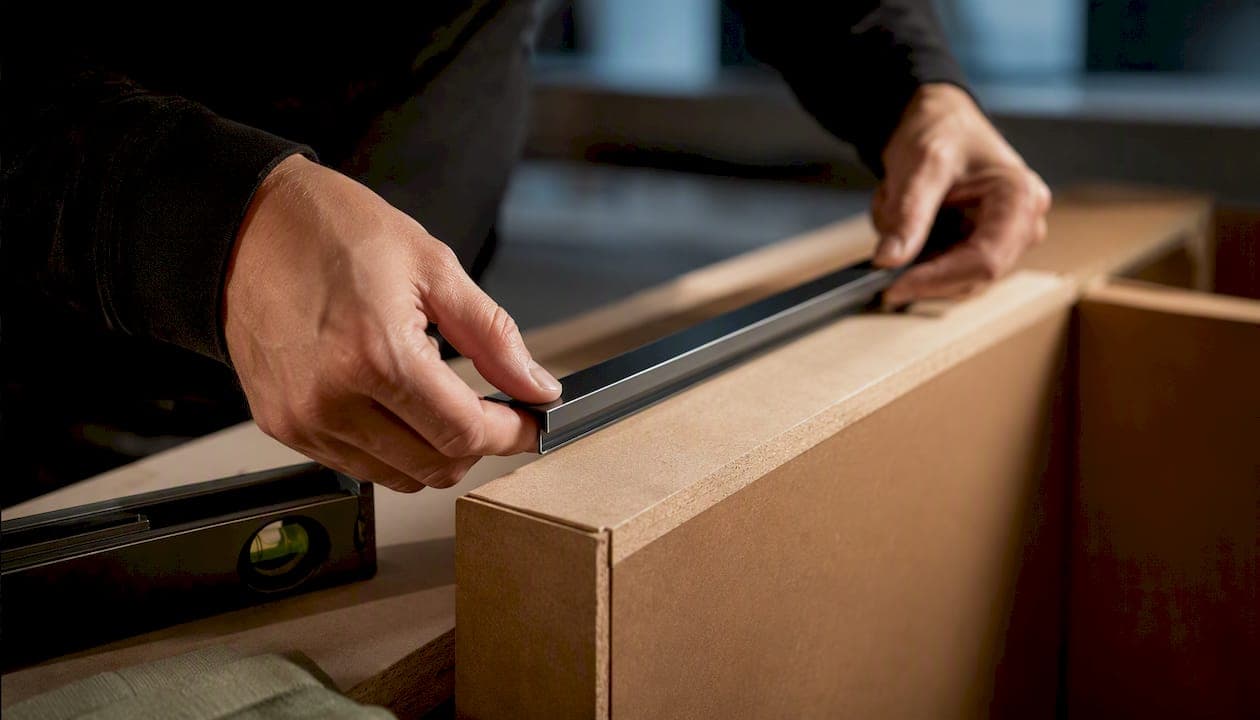
Most kitchens can be converted to a handleless look without ripping anything out. For the least disruption, add J-pull profiles or targeted push-to-open catches to your existing doors. For the cleanest, most uniform finish, budget for a Gola rail system or a professional respray combined with new fronts. The route you choose comes down to how much mess, money and time you're prepared to trade for a sharper finish.
TL;DR:
- J-pull profiles are the most retrofit-friendly option, work with most existing carcasses, and typically cost less than rail systems.
- Gola or rail systems offer a seamless, premium finish but require more precise installation and higher costs.
- A professional respray combined with targeted handleless hardware upgrades can achieve a 90% transformation at a lower cost and disruption than full cabinet replacement.
- Fingerprints and smudges are more visible on handleless surfaces, especially high-gloss finishes, but matt and anti-fingerprint laminates hide marks better.
- Testing grip depth and operation in showrooms is essential for households with limited grip strength before choosing shallow channels or push-to-open mechanisms.
Table of Contents
- Handleless kitchen conversion options at a glance
- How do you retrofit a handleless kitchen step by step?
- What does a handleless conversion cost, and how long does it take?
- Which finishes suit a handleless kitchen day to day?
- Are handleless kitchens harder to use if you have limited grip?
- What should you measure and check before ordering?
- Common installation mistakes and how to vet a fitter
- Why measured retrofit usually beats a full replacement
- Get a handleless finish without a full kitchen replacement
- Sources
- FAQ
Handleless kitchen conversion options at a glance
Handleless kitchens generally rely on one of three mechanical systems: true handleless (usually a Gola or aluminium rail), J-pull, or push-to-open catches. Each has a different retrofit path, and picking the wrong one for your budget is the most common regret homeowners report.
Lip and finger pulls are the cheapest entry point. A router cuts a groove into the top edge of an existing door, giving you something to grip without adding hardware. It works on solid timber and some MDF doors, but it can look agricultural on thin laminates.
J-pull profiles replace the top rail of a cabinet with an angled aluminium or laminate strip that runs the width of the run. This is the most retrofit-friendly system going and the one we recommend first for most kitchens, because it doesn't always need new carcasses.
Gola or rail systems sit above or below the door and use a continuous channel, often lit with LED strip, for a genuinely seamless run. This is the most engineered option and usually costs more and needs more precise installation than J-pull or push-to-open.
Push-to-open catches turn any flat door into a handleless one mechanically, with no visible groove at all. They suit selected zones rather than a whole kitchen.
Replacing fronts, with or without a respray, gives you a clean slate to fit any of the above and unifies wear and colour across the whole kitchen in one pass.
- Lip/finger pull: cheapest, quick, best on solid doors
- J-pull: most flexible retrofit, moderate cost, works with most existing carcasses
- Gola/rail: premium finish, highest precision needs, higher cost
- Push-to-open: invisible look, best for lighter doors and selected drawers
- New fronts + respray: resets the whole kitchen's finish and colour in one job
How do you retrofit a handleless kitchen step by step?
Before ordering anything, measure and record the basics: door thickness, hinge type and position, carcass condition, and the weight rating of your drawer runners. These four checks decide which systems will actually fit, and skipping them is the single biggest cause of expensive returns.
- Audit your doors and carcasses. Check whether doors are solid timber, veneered MDF, or laminate, because routing a groove for a J-pull or lip pull behaves differently on each.
- Confirm hinge compatibility. Concealed hinges usually cope fine with a new profile; older exposed hinges may need replacing first.
- Order or cut J-pull profiles. Most suppliers offer pre-finished aluminium or laminate J-pull strips cut to your run length. If you're routing solid doors yourself, a test cut on an offcut first is non-negotiable.
- Fit the Gola rail, if chosen. This usually means adding a false top or bottom rail to the carcass, wiring in LED strip if specified, and setting the door gap to a consistent 3 to 4mm shadow line across the whole run. Getting this gap wrong on even one door throws off the entire kitchen's sightline.
- Install push-to-open mechanisms on individual doors or drawers where a full rail isn't justified. These are best applied selectively rather than across every unit, because mechanical push catches can underperform on heavily loaded pan drawers.
Pro Tip: Order a single sample door or a short length of Gola profile before committing to a whole run. Colour and grip grooves read very differently under your own kitchen lighting than they do in a showroom.
DIY is realistic for lip pulls and straightforward J-pull fitting if you're confident with a router and a spirit level. Gola rail work, LED wiring, and anything involving structural changes to carcasses are worth handing to a fitter, particularly because alignment errors are hard to correct once fronts are hung.
What does a handleless conversion cost, and how long does it take?
Cost tracks disruption almost exactly. The less you disturb the existing kitchen, the less you'll pay, but also the less dramatic the transformation.
- Small tweaks (adding lip pulls or a handful of push-to-open catches): usually a one-day job, the lowest spend of any route on this list.
- Mid-range work (J-pull profiles across a full run, or a targeted respray of the most-used cabinets): typically a few days' work, with respray combined with hardware changes often landing as the best value option because it avoids a full strip-out.
- High-end conversion (Gola/true handleless rail systems, or full front replacement): the longest lead time of the three, since bespoke profiles and precision fitting take longer to source and install correctly.
A few add-ons reliably push costs up regardless of which route you pick: bespoke door sizes for awkward runs, appliance housings that need re-cutting for new fronts, and any worktop change needed to match a new upstand or end panel. If you're weighing full replacement against a respray, it's worth reading a direct cost comparison between respraying and a new kitchen before you commit either way, since the gap between the two is usually bigger than homeowners expect.
Which finishes suit a handleless kitchen day to day?
Handleless runs remove protruding hardware, which cuts down on the grease and dust that collect around handles. The trade-off is that flat door faces show fingerprints and smudges more readily, so you end up wiping doors more often than you would with traditional handled cabinets.
Finish choice decides how visible that trade-off actually is:
- Matt lacquer hides marks well and is the most forgiving choice for busy households.
- Anti-fingerprint laminates like Fenix are increasingly specified for family kitchens precisely because they resist smudging where a handleless run would otherwise show every touch.
- Timber veneer wears attractively and disguises fingerprints reasonably well, though it needs occasional oiling or resealing.
- High-gloss lacquer looks striking in photos but shows marks fastest of any finish, particularly around the sink and hob run.
Matt and textured finishes are recommended over high-gloss for exactly this reason: designers report they show fingerprints less and age better under daily use.
For cleaning, a microfibre cloth and a mild non-abrasive spray suit most lacquer and laminate finishes; avoid anything with grit or strong solvents on painted or sprayed surfaces, since they'll dull the sheen over time. If you're refreshing tired oak or timber cabinets rather than starting from scratch, there's a dedicated guide to modernising oak kitchen cabinets that covers finish choices specific to timber doors.
Are handleless kitchens harder to use if you have limited grip?
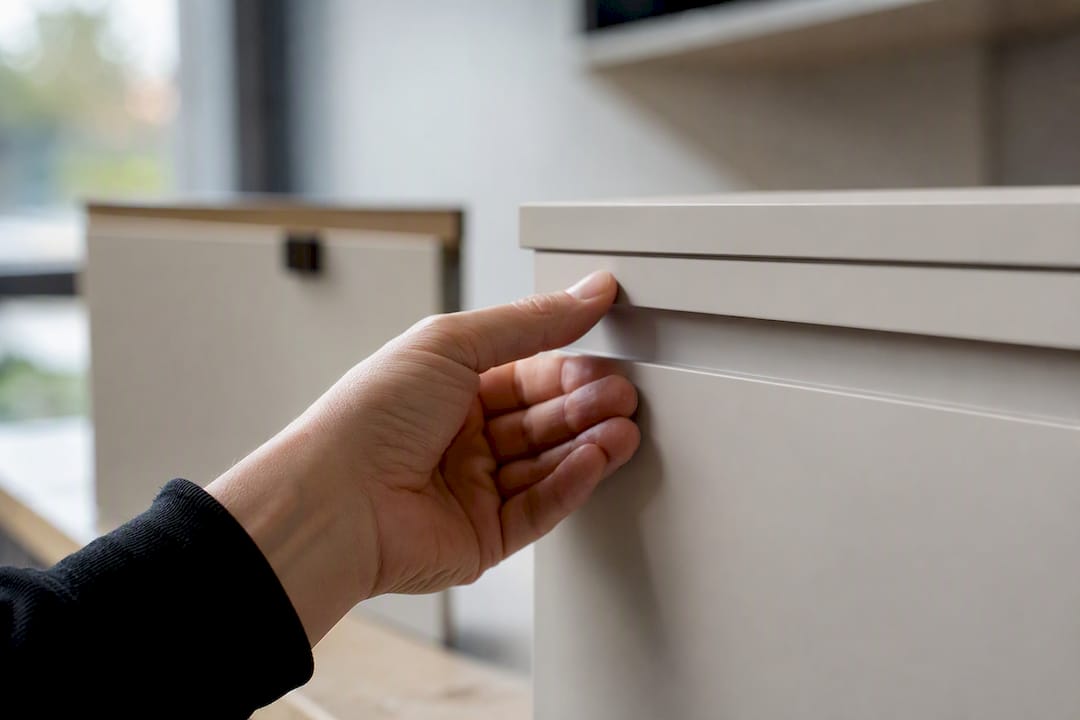
Shallow J-pull channels and spring-latch push mechanisms can be genuinely harder to operate for anyone with reduced grip strength, including older family members or anyone with arthritis or hand injuries. A groove that looks elegant in a showroom can be frustrating to use fifty times a day.
If that's a concern in your household, favour push-to-open on lighter doors, or look at assisted and motorised opening systems on heavier units like larder cupboards. Vertical rail pulls on tall units also tend to be easier to grip than a shallow horizontal channel.
Before you commit to any single system, test it properly. Visit a showroom and physically try the grip depth on a J-pull sample, push a few push-to-open doors that are loaded the way your own cupboards will be, and ask what a motorised option would add to the cost. Five minutes of hands-on testing tells you more than any spec sheet.
What should you measure and check before ordering?
A short audit now saves an expensive reorder later.
- Door and carcass dimensions, including thickness and current hinge positions, taken for every run you plan to convert.
- Hinge type and condition, since worn or non-standard hinges may need replacing before new fronts or profiles go on.
- Carcass condition, checking for water damage, chipboard swelling, or loose joints that would undermine a rail or J-pull fixing.
- Drawer runner type and weight rating, particularly for pan drawers where push-to-open or a heavier new front adds load.
- Worktop and appliance clearances, since a Gola rail or new upstand can change the gap above worktops and around integrated appliances.
When you brief a fitter or supplier, ask directly about alignment tolerances, whether they'll provide a sample door before the full order, what guarantee covers the finished work, and whether they can show previous handleless projects rather than just handled kitchens. Their answers tell you more about competence than any portfolio photo.
Common installation mistakes and how to vet a fitter
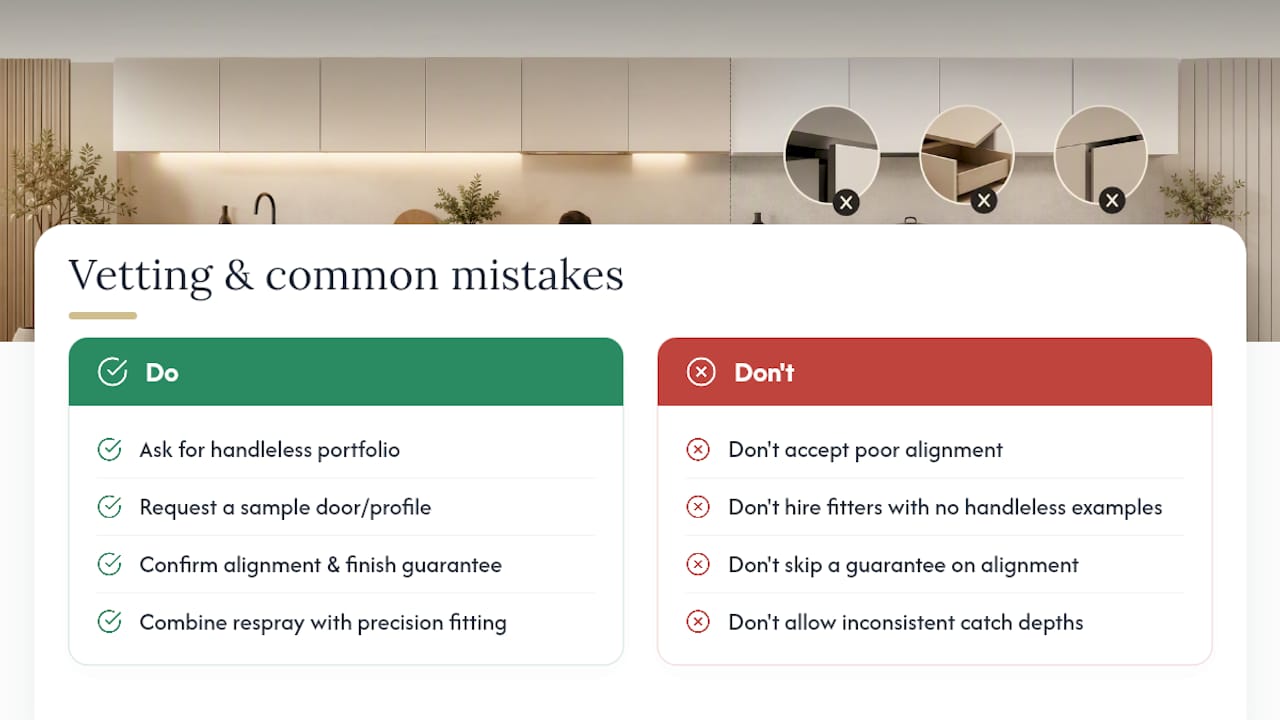
The most frequent complaints with handleless retrofits aren't about the mechanism itself, they're about precision. Uneven shadow lines along a Gola rail, J-pull profiles that don't sit flush at the end panels, and push-to-open catches fitted at inconsistent depths all wreck the clean look the whole point of going handleless was meant to deliver.
Precise alignment and consistent horizontal shadow lines are critical to a successful handleless outcome, and poor alignment is genuinely difficult to correct once fronts are hung and rails are fixed. This is the one area where cutting corners on installer choice costs you the most.
Vet any fitter properly before signing anything. Ask to see a portfolio of specifically handleless work, not general kitchen fitting. Request a sample door or profile section so you can check finish quality in your own light. Confirm what guarantee, if any, covers alignment and finish defects after completion. A fitter who's reluctant to show past handleless projects or won't commit to a guarantee is telling you something.
Combining a professional respray with precision hardware fitting tends to produce the best-looking retrofit of any single-step option, because it resolves colour, sheen and hardware alignment together instead of leaving the old finish to clash with new fittings. If you'd like a broader sense of what the respray side of that process involves, a guide to kitchen cabinet spraying costs and process walks through it in more detail. For anyone replacing doors entirely rather than resurfacing, it's also worth reading general guidance on choosing the right replacement door and profile before ordering.
Why measured retrofit usually beats a full replacement
The trade-offs in a handleless conversion rarely surprise anyone once they've weighed them properly: cost against disruption, finish quality against maintenance, and speed against precision. What surprises people is how often the "premium" option, a full Gola replacement, turns out to be the wrong call for a kitchen that's structurally sound but visually tired.
If your carcasses are solid and your doors just look worn or dated, a respray combined with J-pull profiles or selective push-to-open catches gets you 90% of the way to a true handleless look for a fraction of the disruption. Save the full Gola rail treatment for kitchens where the carcasses need replacing anyway.
If you're unsure which category yours falls into, look at local case studies or request a sample panel before deciding. It's the cheapest way to avoid an expensive mistake.
— Mitchell
Get a handleless finish without a full kitchen replacement
A professional respray service offers a practical alternative to a full kitchen replacement for anyone weighing up a handleless conversion: you can keep your existing carcasses and layout, and opt for a factory-standard respray rather than a strip-out and rebuild.
The service covers cabinet doors, drawer fronts, end panels and islands, and it's designed to work alongside hardware changes like J-pull profiles or new fronts rather than instead of them, so a respray plus targeted retrofit hardware can get you a genuinely uniform handleless look in one coordinated job. Many respray projects are backed by a five-year transferable warranty, with work completed using a hand-spray technique without subcontractors.
If your kitchen is a candidate for this route, start by requesting a quote and asking to see sample colours or nearby portfolio work. Visit the kitchen respraying service page to check current colour options and book a consultation, or look at the kitchen respraying cost guide first if you want a realistic price range before you commit to anything.
Sources
- Are handleless kitchens still in style for 2026? | Livingetc
- Handleless kitchens explained: true handleless vs J-pull | Kitchen Expert
FAQ
Can any kitchen be converted to handleless?
Most kitchens can, provided the carcasses are structurally sound. Doors that are too thin for routing or carcasses with water damage may need replacing first rather than retrofitting.
Is J-pull or Gola better for a retrofit?
J-pull is generally the more retrofit-friendly option, while Gola systems cost more and demand more precise installation, making them better suited to kitchens already being rebuilt.
Do handleless kitchens need more cleaning?
Yes, flat door faces show fingerprints and smudges more than handled doors, though matt and anti-fingerprint finishes reduce visible marks significantly compared with high-gloss.
Can I combine a respray with new handleless hardware?
Yes, a professional respray paired with J-pull or push-to-open upgrades is a common route that delivers the biggest visual change for the least disruption, and it's the approach Refinishing Studio offers for South Wales kitchens.
Are handleless kitchens harder to use for people with limited grip?
Shallow J-pull grooves and some push mechanisms can be harder to operate for anyone with reduced grip strength, so testing samples in a showroom and considering assisted opening systems is worth doing before you order.