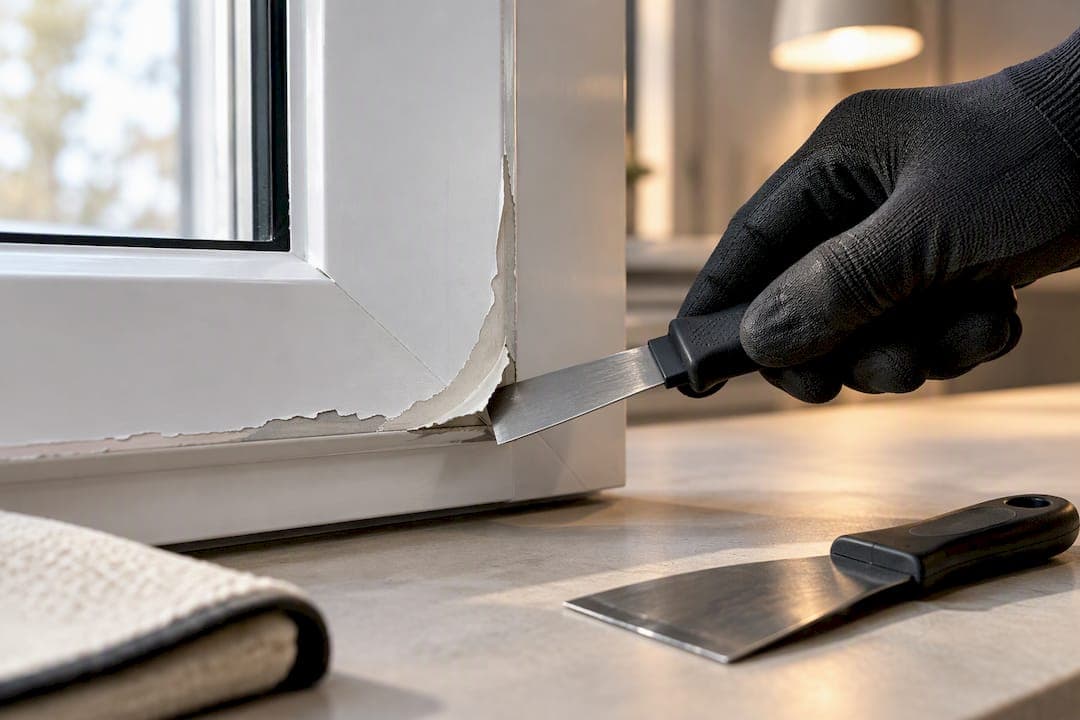
Do not paint over loose or flaking UPVC paint. Remove and prepare it first, because painting over lifting film is only a temporary cosmetic fix that will fail again within months, according to Checkatrade's cost guide. Done correctly, with full removal, degreasing and the right coating system, a respray can meet factory-standard durability, and firms such as Refinishing Studio back that standard with a five-year warranty.
TL;DR:
- Removing all loose or flaking paint before respraying ensures long-lasting durability and prevents early peeling or lifting.
- Widespread paint failure over more than a third of the surface typically requires full removal and spraying, not patch repairs, for better longevity.
- Proper surface preparation includes feathering edges, thorough degreasing, masking, and light keying, which are crucial for effective adhesion and finish quality.
- Specialist UPVC coatings, especially two-pack systems applied by professionals, provide superior long-term bonding and resistance compared to standard trade paints.
- Full professional resprays, costing between £120 and £350 per unit, offer a controlled environment, adherence to technical guidelines, and a warranty of up to five years.
Table of Contents
- Deciding whether respraying is the right move for your UPVC
- How to prepare flaking UPVC: a practical, ordered checklist
- Which paints and application methods actually bond to UPVC
- Health and safety essentials homeowners must know about professional spraying
- When to DIY and when to choose a professional
- Representative costs and what to expect from a project
- How long a correct respray lasts and simple aftercare
- What I have learned watching UPVC resprays go wrong and right
- Refinishing Studio: a practical service option
- Sources
- FAQ
Deciding whether respraying is the right move for your UPVC
Before you buy paint or book a contractor, work out how far the failure has spread. A quick lifting film test tells you most of what you need to know: press a fingernail or the edge of a scraper under any raised paint edge and see how far it travels. If it lifts in a continuous sheet rather than a small chip, the adhesion has failed across a wider area than it looks.
A cut-and-pull sample check confirms this. Score a small cross with a blade through the paint film, press tape firmly over it, then pull it away sharply. Paint that comes away in flakes rather than staying put means the whole coating is detaching from the substrate, not just the top layer you can see.
That distinction decides your next move.
- Localised flaking on an otherwise sound frame with intact seals is usually repairable with spot preparation and recoating.
- Widespread lifting, bubbling near seals or a failed protective foil layer often means the whole unit needs stripping back and respraying rather than patching.
- Cracked gaskets, swollen frames or hardware that no longer seats properly point towards replacement rather than a repaint, since a new coating cannot fix a mechanical fault.
- When more than a third of a frame's surface shows lifting, it is usually quicker and more durable to treat the entire unit as one job rather than chase individual patches.
Weigh the cost of a partial repair against a full respray of the unit. Patching a frame that is already showing wider failure often costs nearly as much as doing the whole thing properly, and it will not last as long.
How to prepare flaking UPVC: a practical, ordered checklist
Preparation is where a respray succeeds or fails. Skipping steps here is the single biggest reason DIY UPVC paint jobs peel again within a year.
Start with basic safety. Wear eye protection and gloves throughout, and control dust as you scrape and sand rather than letting it settle on sills, plants or nearby brickwork. Avoid aggressive solvents unless the coating manufacturer's data sheet specifically permits them: many general-purpose thinners and strippers attack UPVC's surface rather than just the old paint.
- Remove all loose paint first. Use a plastic or fine metal scraper at a shallow angle to lift failing paint, then run strips of tape over suspect areas and pull sharply to reveal how far delamination extends before you commit to a plan.
- Feather every edge. Work fine abrasive pads such as Scotch-Brite or Mirlon, or fine abrasive paper, around each exposed edge until the transition from bare UPVC to sound paint is smooth to the touch, not just visually even. A hard ridge left at the edge of an old paint line becomes the next failure point, however good the new coating is.
- Degrease thoroughly. Clean the whole surface with a degreaser recommended by the paint system you plan to use, following the preparation checks that professional sprayers rely on, then rinse and allow the surface to dry completely before touching it again.
- Mask carefully. Protect glass, seals, hinges and hardware with quality masking tape and film. Remove sashes only if you are confident you can refit them correctly, since a poorly reseated sash can affect the seal and let in draughts.
- Key the surface lightly. A light, even abrasion across the whole panel, not just the repaired patches, gives the primer a consistent surface to grip rather than a mix of glossy original UPVC and matt repaired sections.
- Apply the specified adhesion promoter or primer. Follow the paint system's technical data sheet exactly on coverage rate, flash-off time and recoat window. This is the step most DIY guides skip, and it is usually why generic trade paint fails on UPVC within a season.
Pro Tip: Test your chosen primer and topcoat on an offcut or an inconspicuous inside edge first, and leave it 24 hours before judging adhesion; a system that looks fine straight after application can still fail once fully cured.
Working through this sequence in order matters more than rushing to get paint on. A surface that is degreased before it is fully sanded, or masked before edges are feathered, tends to trap contamination under the new coating, and that shows up as bubbling or lifting again within weeks.
Which paints and application methods actually bond to UPVC
Standard trade paint is not designed to flex or bond with UPVC's smooth, slightly flexible surface, which is why it eventually cracks and lifts even on a well-prepared frame. Specialist UPVC or plastic coatings are formulated specifically for that surface and, applied as part of their full system rather than as a standalone product, are far more likely to hold long-term.
Within specialist coatings, there is a real performance gap between single-pack (1K) and two-pack (2K) systems.
- 1K coatings cure by air exposure alone, are simpler to apply and are more forgiving for small DIY touch-ups, but generally offer softer, less chemically resistant finishes.
- 2K systems cure through a chemical reaction between resin and hardener, giving the hard, factory-grade finish professional sprayers use, but they demand controlled application and careful handling.
- Aerosol touch-up paints can work for chip-sized DIY repairs on small, low-visibility areas, but they rarely match the sheen and colour of a sprayed finish across a whole frame.
- Fine brushes allow more control on small repairs than a roller, which tends to leave texture that a smooth UPVC surface will show up clearly.
Spraying gives the most even finish because it lays down a consistent, thin film across the whole surface rather than the ridges a brush or roller leaves behind, which is why professional preparation guides built around spraying remain the trade standard. On small areas, a careful DIYer can approximate this with a fine-tip aerosol and multiple light passes rather than one heavy coat, though matching a sprayed finish across a whole window run by hand is difficult.
Whatever method you use, respect the recoat and cure times on the data sheet. A heavy single coat applied to save time is the most common cause of runs, poor cure and early failure, whether it is brushed or sprayed.
Health and safety essentials homeowners must know about professional spraying
Two-pack, isocyanate-based coatings give the hardest, longest-lasting finish, and that is exactly why they come with strict handling rules. HSE guidance requires spraying to happen inside a controlled spray booth or room, run under negative pressure, because the process produces an invisible fine mist that behaves like smoke and lingers well after spraying stops.
Even small "SMART" repairs using 2K products create exposure peaks that must be controlled, according to HSE guidance on isocyanate spraying, and operators are required to wear air-fed respiratory protective equipment rather than a basic dust mask.
This is the core reason 2K spraying stays with trained contractors rather than becoming a weekend DIY job. A booth needs proper clearance time before anyone can safely re-enter without RPE, and getting that wrong risks occupational asthma from repeated exposure, not just a bad smell.

If you are booking a contractor, it is reasonable to ask what controls they use: whether they spray in a dedicated booth or enclosed area, what respiratory protection their operators wear, and how they manage clearance time. Keep household members and pets away from the work area during spraying and for the stated curing period afterwards.
When to DIY and when to choose a professional
Professionals handle the parts of this job that are hardest to get right at home: complete removal of failed coating rather than partial patching, spraying inside a controlled environment, strict adherence to the paint manufacturer's data sheet, and quality checks before they call a job finished.
- Complete surface preparation across every frame, not just visibly damaged patches.
- Controlled spray application that gives an even, factory-style finish.
- Compliance with the coating system's technical data sheet on primers, recoat windows and cure times.
- A written warranty that reflects confidence in the process, not just the paint.
Professional resprayers use hand-spray techniques to deliver factory-standard finishes on UPVC windows, doors, fascias and whole exteriors, backed by extensive project experience and warranties, with no subcontractors involved.
Pro Tip: If a frame has one or two small chips on an otherwise sound surface, a careful spot repair with a matched aerosol is a reasonable DIY job. Once flaking covers more than a patch here and there, or you are dealing with more than one or two units, book a professional who can spray the whole thing evenly rather than chase mismatched touch-ups.
Representative costs and what to expect from a project
Professional UPVC respray costs in most of the country fall into fairly predictable bands, though where you live changes the number.
- Individual window frames typically run about £120 to £200 each, according to Checkatrade's cost guide.
- A door with its frame typically costs £200 to £350.
- A full home respray covering multiple windows, doors and fascias typically costs within a broad range reflecting regional variation, generally higher in London and the South East and lower in the North East and Wales.
- Refinishing Studio lists UPVC window spraying from £80 to £2,200 per project and UPVC door spraying from £250 to £650, depending on scope.
Access, the extent of preparation needed, a colour change away from the original shade and the number of units on site all push the price up. A frame with heavy flaking across its whole surface costs more to prepare than one with a single chipped corner, regardless of how much paint either eventually needs.
Expect masking and preparation to take up more of the schedule than the spraying itself, with cure time afterwards before the surface can be handled normally.
How long a correct respray lasts and simple aftercare
A properly prepared and applied respray, using the right primer and topcoat system, is designed to perform for years rather than months, with UV exposure, abrasion and poor initial preparation being the factors most likely to shorten that lifespan. Refinishing Studio's own guidance on how long a UPVC respray lasts and this durability breakdown cover the specifics in more depth.
Cleaning is simple: wash frames with mild soapy water and a soft cloth a few times a year, avoiding abrasive pads that will dull the finish. Check seals and corners during each clean for early signs of lifting.

Small chips from knocks or garden tools are worth touching up as soon as you spot them, since bare UPVC exposed at a chip edge is where new lifting tends to start. Wait too long and a small touch-up becomes a full respray.
What I have learned watching UPVC resprays go wrong and right
The results are genuinely achievable when the preparation is done properly: I have seen frames that looked beyond saving come back looking factory-fresh once every flake was removed and feathered before a single coat went on. The most common mistake homeowners make is judging a job by how it looks straight after painting rather than how it holds up a year later, because poor adhesion always shows eventually. If you want to see what a correct respray actually looks like once finished, Refinishing Studio's portfolio project in Pontcanna is a useful reference point.
— Mitchell
Refinishing Studio: a practical service option
If your frames have widespread flaking, or you would rather not spend a weekend sanding and masking, a professional respray gets you a controlled spray environment, strict adherence to the coating system's data sheet, and a written five-year warranty rather than a guess. Refinishing Studio sprays UPVC windows, doors, fascias and whole exteriors by hand across South Wales, with no subcontractors between you and the person quoting and finishing the job.

You can request a quote directly through the UPVC window spraying or UPVC door spraying service pages, or see full pricing and scope for larger projects on the whole exterior respray page.
Sources
- Checkatrade – UPVC spraying cost guide
- HSG276 – Isocyanate paint spraying: safely managing spray booths and rooms
- PaintTech Training Academy – How to spray UPVC like a pro
FAQ
Can I paint over flaking exterior paint?
No. Loose or flaking paint must be scraped away and the edges feathered smooth before any new coat goes on, or the new paint will lift with the old layer beneath it. Painting straight over lifting film is only a short-term cosmetic fix.
Does UPVC paint peel off?
Standard trade paint often peels from UPVC because the surface is smooth and slightly flexible, which ordinary paints are not designed to grip or move with. Specialist UPVC coatings, applied with proper degreasing and light abrasion first, are built to bond to that surface and resist peeling for far longer.
How much does it cost to have UPVC windows sprayed?
Professional UPVC window spraying typically costs £120 to £200 per frame, according to Checkatrade, while a full home respray usually runs £900 to £3,500 depending on scope and region. Refinishing Studio lists window spraying from £80 to £2,200 depending on the project.
Is it ever okay to paint over peeling paint?
Painting over peeling paint is never a lasting fix, since the new coat has nothing solid to bond to where the old paint has already lifted. The correct approach is always to remove the loose material, feather the edges flush and degrease the surface before applying a new primer and topcoat.