Open windows, run an exhaust fan facing outward, and place activated-carbon absorbers in the room. That combination — ventilation plus adsorption — clears most spray paint smell in a house faster than any other approach. Remove wet paint sources and move children, pets, and anyone with a respiratory condition out of the affected space immediately.
If you or anyone in the home feels dizzy, nauseous, or has difficulty breathing, leave the room now and call NHS 111.
Immediate actions to take right now:
- Open at least two windows on opposite sides of the room to create cross-ventilation
- Place a box fan in one window facing outward to exhaust fumes outside
- Seal the gap under doors leading to other rooms with a towel
- Remove or tightly seal any open paint cans and take them outside
- Keep children, pregnant people, and anyone with asthma out of the room until the smell clears
Spray paint fumes contain volatile organic compounds (VOCs) that off-gas rapidly in enclosed spaces. The fastest, safest response is always to remove the source and increase airflow — not to mask the smell with candles or air fresheners.
Key takeaways
Ventilation combined with activated-carbon filtration clears spray paint smell in a house faster than any other approach, and choosing low-VOC products prevents the problem from arising in the first place.
| Point | Details |
|---|---|
| Ventilate immediately | Open windows for cross-ventilation and run an exhaust fan facing outward as the first response. |
| Remove the source | Seal or remove open paint cans; wet paint continues off-gassing until fully cured. |
| Use carbon filtration | Activated-carbon absorbers and purifiers adsorb VOCs; HEPA filters and masking agents do not. |
| Clean soft furnishings | Wash fabrics, apply bicarbonate of soda to carpets and use charcoal sachets for persistent odour. |
| Choose low-VOC next time | Water-based, low-VOC spray formulations off-gas far less and reduce the problem at source. |
Table of Contents
- Why does spray paint smell so strongly indoors?
- How long does spray paint odour typically last?
- What to do in the first 24 hours to reduce the smell
- Which air-cleaning options actually remove spray-paint fumes?
- How to clean fabrics and soft furnishings that have absorbed the smell
- How to prevent spray paint odour before it starts
- When should you be worried about spray paint fumes?
- When to hire a professional: what to expect from a respray service
- The advice most guides get backwards
- Sources
Why does spray paint smell so strongly indoors?
Spray paint produces a sharper, more persistent odour than brush-applied paint because aerosol formulations carry a higher concentration of solvents. When the paint leaves the can, those solvents evaporate almost instantly — a process called off-gassing — and fill the air with volatile organic compounds (VOCs). VOCs are carbon-based chemicals that exist as gases at room temperature; they are what you smell, and they are what cause health effects.
Common solvents in spray paints include acetone, toluene, and xylene. These evaporate quickly, which is why the smell hits hard in the first hour. Oil-based spray formulations also contain heavier hydrocarbons that linger far longer than their water-based equivalents.
Short-term health effects from spray paint fumes indoors include:
- Headaches and dizziness
- Eye, nose, and throat irritation
- Nausea
- Fatigue or light-headedness with prolonged exposure
Children, pregnant people, and anyone with asthma or other respiratory conditions are more sensitive to these effects at lower concentrations. According to practical homeowner guidance, even brief exposure to strong spray-paint VOCs can trigger headaches and nausea in healthy adults.
For medical advice on symptoms, call NHS 111. For workplace incidents or serious exposures, the Health and Safety Executive (HSE) publishes guidance on solvent safety at work.
Statistic: VOCs are among the most common indoor air pollutants in UK homes, with concentrations indoors often running several times higher than outdoors when solvents are in use.
How long does spray paint odour typically last?
The strongest smell usually peaks in the first few hours and, with good ventilation, fades noticeably within a couple of days. That is the optimistic timeline. Several factors push it well beyond that.
How-to guidance from Woodiwiss Painting notes that humidity and paint thickness both affect curing times significantly. A thin coat of water-based spray paint in a well-ventilated room on a dry day can be largely odour-free within about a day. A heavy application of oil-based spray in a damp, poorly ventilated room can smell for several days longer.
Factors that make the smell linger longer:
- Oil-based solvents: These off-gas more slowly than water-based formulations. Consumer guides confirm that oil-based spray paints typically take longer to clear than water-based ones.
- High humidity: Moisture in the air slows solvent evaporation and extends the curing window.
- Poor ventilation: Without airflow, VOCs accumulate rather than disperse.
- Porous surfaces: Bare timber, plaster, and unprimed surfaces absorb solvents and release them slowly over days.
- Soft furnishings: Curtains, carpets, and upholstered furniture act as sponges, trapping VOCs and re-releasing them gradually.
If the smell persists beyond a week despite ventilation, the odour has likely penetrated soft furnishings, carpets, or even the HVAC system. At that point, cleaning those surfaces becomes as important as airflow.
What to do in the first 24 hours to reduce the smell
Follow these steps in order. The first three matter most.
- Create cross-ventilation immediately. Open windows on opposite sides of the room or building. Air needs a path in and a path out.
- Set a box fan to exhaust. Place it in a window facing outward so it pulls fumes out of the room rather than just circulating them. Professional guidance confirms mechanical air exchange is the most effective single method for clearing spray-paint fumes quickly.
- Seal off other rooms. Push a rolled towel against the gap under the door to stop fumes migrating into living spaces.
- Remove or seal the paint source. Wet spray paint continues off-gassing until it cures. Take open cans outside; seal lids tightly on any you must keep indoors.
- Place activated-carbon absorbers. Bowls of baking soda or activated-charcoal sachets placed around the room will adsorb some VOCs. They are not a substitute for ventilation, but they help — particularly overnight when windows may need to be closed.
- Run an air purifier with an activated-carbon filter if you have one. More on choosing one below.
What helps versus what does not:
| Approach | Effect |
|---|---|
| Exhaust fan + open windows | Removes VOCs from the air — most effective |
| Activated-carbon absorbers | Adsorbs VOCs — useful supplement |
| Air purifier with carbon filter | Removes VOCs actively — good for overnight use |
| Scented candles or air fresheners | Masks odour only — does not remove VOCs |
| Vinegar bowls | Replaces one smell with another — no VOC removal |
| Burning incense | Adds combustion products to the air — counterproductive |
Pro Tip: To create negative pressure, place the exhaust fan in the window of the painted room and open a window in a room on the opposite side of the house. Air will be drawn through the painted space and pushed outside, rather than recirculating through the rest of the home.
If you must re-enter a room where fumes are still strong, wear at minimum an FFP3 respirator with an organic vapour cartridge. A standard dust mask offers no protection against solvent vapours.
Which air-cleaning options actually remove spray-paint fumes?
Not all air-cleaning technologies work on VOCs. Understanding the difference saves money and avoids a false sense of security.
HEPA filters capture particles — dust, pollen, mould spores — down to 0.3 microns. They do not capture gas-phase VOCs. A HEPA-only purifier will not meaningfully reduce spray-paint odour.
Activated carbon (activated charcoal) works through adsorption: VOC molecules bond to the enormous surface area of the carbon material and are held there. This is the technology you need. DIY guides document activated charcoal and carbon-filter box fans as genuinely useful household techniques, while noting that masking agents such as vinegar and candles mainly replace one odour rather than removing VOCs.
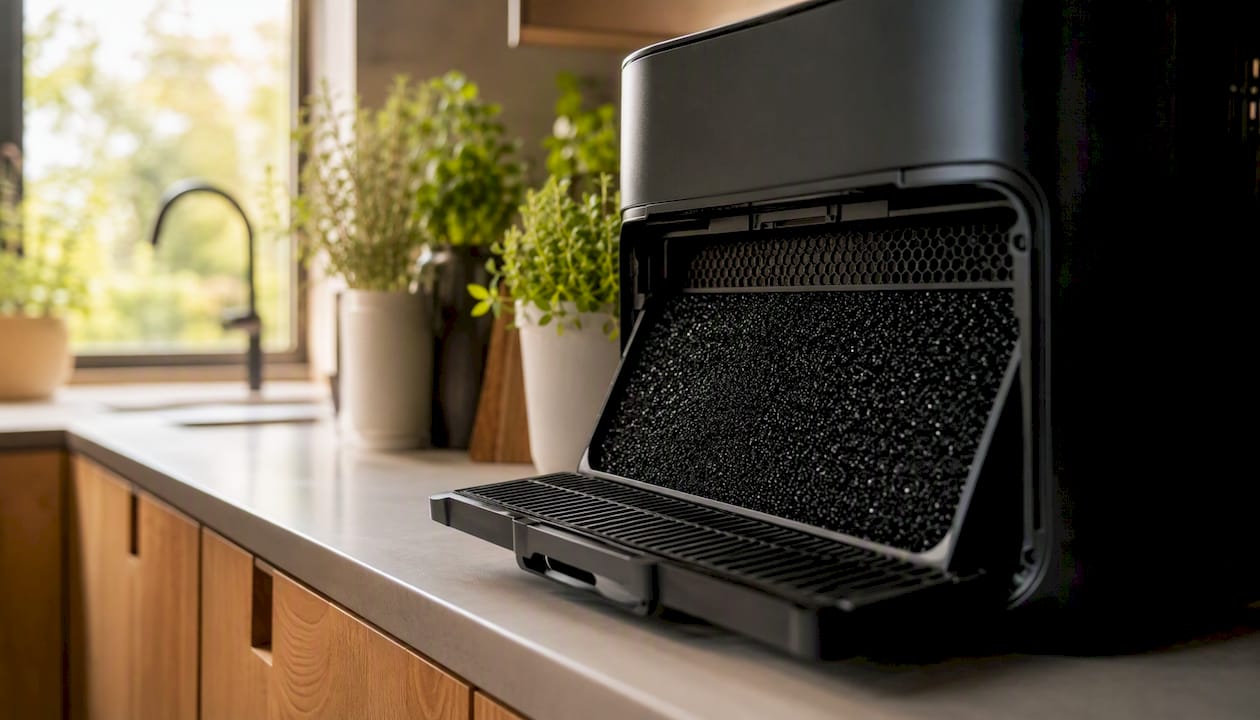
Passive absorbers (charcoal bags, baking soda bowls) work slowly and suit small spaces or overnight use. They are not powerful enough to clear a freshly painted room on their own.
Active air purifiers with a substantial activated-carbon stage are more effective. When buying one for this purpose, look for:
- A large carbon bed (weight matters more than surface area claims — look for units with at least several hundred grams of carbon)
- A stated CADR (Clean Air Delivery Rate) for gases, not just particles
- Replaceable carbon filters, since saturated carbon re-releases adsorbed compounds
A word on ozone generators: Some products marketed for odour removal generate ozone to oxidise VOCs. Ozone is itself a respiratory irritant and is not recommended for use in occupied domestic spaces. The HSE advises against ozone-generating equipment in areas where people are present.
Key point: Combining exhaust ventilation with an activated-carbon purifier shortens odour duration more effectively than either method alone. Humidity and paint thickness are the two variables most likely to extend the timeline beyond what any purifier can compensate for.
How to clean fabrics and soft furnishings that have absorbed the smell
Soft furnishings are the main reason spray paint odour persists after the room has been ventilated. Fibres trap VOCs and release them slowly for days.
Washable items (clothing, curtains, removable covers):
- Launder on the hottest cycle the fabric tolerates
- Dry outside in fresh air rather than in a tumble dryer, which recirculates the smell
- Repeat the wash if the odour remains after the first cycle
Non-washable upholstery and carpets:
- Vacuum thoroughly first to remove any particulate residue
- Sprinkle a generous layer of bicarbonate of soda over the surface, leave for several hours (overnight is better), then vacuum again
- Place activated-charcoal sachets inside cushion covers or near affected furniture to continue adsorbing residual VOCs
Hard surfaces and painted items:
- Wipe down with a mild detergent solution and allow to dry fully in a ventilated space
- Avoid aggressive solvents on freshly painted surfaces unless the manufacturer's guidance explicitly permits it, as these can damage the finish
- Continue ventilating the room during the full curing period, which can run several days for oil-based products
Disposal of leftover paint:
Partly used spray cans and paint tins should not go in household recycling or general waste. Check your local council's website for household hazardous waste collection points — most Welsh councils run periodic collection events. Oil-based paints and solvent-based aerosols are subject to special disposal rules under UK waste regulations.
How to prevent spray paint odour before it starts
The most effective strategy is source control: choose the right product before you pick up a can. Industry experts Anna Hill and Victoria Yardley are clear that low-VOC paints combined with good ventilation are the two most effective strategies, and that household hacks afterwards are a poor substitute for getting the product choice right at the start.
Product selection:
- Choose water-based spray formulations for indoor projects wherever possible
- Look for products labelled low-VOC or ultra-low-VOC; these off-gas significantly less than standard solvent-based aerosols
- Check the product's technical data sheet for VOC content — EU Directive 2004/42/CE sets limits that most UK-sold paints still follow post-Brexit
Application practice:
- Spray outdoors or in a dedicated spray booth whenever the project allows
- If spraying indoors is unavoidable, isolate the room completely, run extraction throughout, and avoid spraying near open-plan living areas
- Apply thin coats rather than heavy ones; thicker applications take longer to cure and off-gas for longer
- Time the work to allow a long ventilation window — starting in the morning on a dry day gives the maximum hours of airflow before evening
PPE during application:
- Wear an organic vapour respirator (not just a dust mask) whenever spraying indoors
- Use nitrile gloves and eye protection
- Never spray in an enclosed space without active extraction running
Leftover oil-based paint and solvent-based aerosols require specialist disposal. Contact your local council or check the Recycle Now locator for the nearest household hazardous waste facility.
When should you be worried about spray paint fumes?
Most people experience mild irritation that clears once they leave the room and ventilate. Some symptoms, however, signal a more serious exposure that needs medical attention.
Seek help if you or anyone in the home experiences:
- Persistent or severe headache that does not ease after leaving the room
- Vomiting or pronounced nausea
- Significant dizziness or loss of balance
- Difficulty breathing, chest tightness, or wheezing
- Loss of consciousness, even briefly
Call NHS 111 for guidance on symptoms that concern you but are not immediately life-threatening. Go to A&E or call 999 for difficulty breathing, loss of consciousness, or any symptom that feels serious.
Vulnerable groups need a lower threshold for action:
- Children should be removed from any room with detectable spray-paint fumes and kept out until the smell has fully cleared
- Pregnant people should avoid all exposure to spray-paint VOCs, including re-entering a room that still smells
- People with asthma, COPD, or other respiratory conditions should treat even mild fume exposure as a potential trigger
If a workplace incident involves significant solvent exposure, the HSE's RIDDOR (Reporting of Injuries, Diseases and Dangerous Occurrences Regulations) framework may require the employer to report it. Employees can contact the HSE directly on 0300 003 1747 or via hse.gov.uk for guidance on reporting and rights.
When to hire a professional: what to expect from a respray service
DIY ventilation and cleaning resolve most spray-paint odour problems within a few days. There are situations where a professional is the right call.
Consider hiring a professional when:
- The smell persists beyond a week despite thorough ventilation and cleaning
- Fumes have penetrated HVAC ductwork, requiring specialist cleaning
- You need a guaranteed, long-term finish on UPVC windows, doors, or kitchen cabinetry and want to avoid the odour and disruption of a DIY respray altogether
Questions to ask any contractor before they start:
- What paint system do you use, and what is its VOC content?
- How do you contain overspray and fumes during application?
- What ventilation or extraction do you run during the job?
- How long before the space is safe to re-occupy after spraying?
- What warranty do you offer on the finish?
A competent contractor should be able to answer all of these without hesitation. For guidance on choosing a painting contractor, a pre-work checklist covering materials, containment, and credentials is a reasonable starting point.
What a professional hand-spray respray looks like in practice:
Refinishingstudio carries out professional hand-spray respraying of UPVC windows, doors, conservatories, fascias, and kitchen cabinetry across South Wales. Every project uses a controlled application process with proper surface preparation, containment, and curing time built in. The result meets factory-standard durability and comes with a five-year transferable warranty. With over 1,000 completed projects across Cardiff, Swansea, and the surrounding area, the process is well-established: preparation and application typically take one day, with a curing window before the space is fully back in use.
For homeowners whose kitchen units or UPVC surfaces have aged beyond what a clean and repaint can fix, a professional respray is a cost-effective alternative to full replacement. You can see examples of completed work, including a sage green UPVC respray in Swansea, to get a sense of the finish quality. The kitchen respraying cost guide gives a realistic pricing framework for South Wales homeowners.

If you are in South Wales and want a professional finish without the disruption of replacement, Refinishingstudio's respraying service covers UPVC and kitchen surfaces with a five-year warranty and no subcontractors involved.
The advice most guides get backwards
Most articles about eliminating paint odours spend half their word count on vinegar bowls and vanilla extract. It is understandable — those tips are easy to write and satisfying to read. They are also largely useless for VOC removal, and leaning on them gives homeowners a false sense that the problem is solved when the air still contains compounds that irritate airways.
The more important point is one that most guides bury at the end, if they mention it at all: the time to solve a spray-paint smell problem is before you open the can. Choosing a water-based, low-VOC formulation and spraying outdoors or with proper extraction running eliminates most of the problem before it starts. Source control is not a niche professional tip — it is the single most effective lever available to any homeowner.
The second thing guides consistently underweight is the role of soft furnishings. Ventilating the room is necessary but not sufficient if curtains, carpets, and upholstered furniture have absorbed VOCs. Those surfaces will keep releasing the smell for days after the air itself has cleared. Treating them directly — washing what you can, using bicarbonate of soda and charcoal sachets on what you cannot — is what actually ends the problem rather than just reducing it.
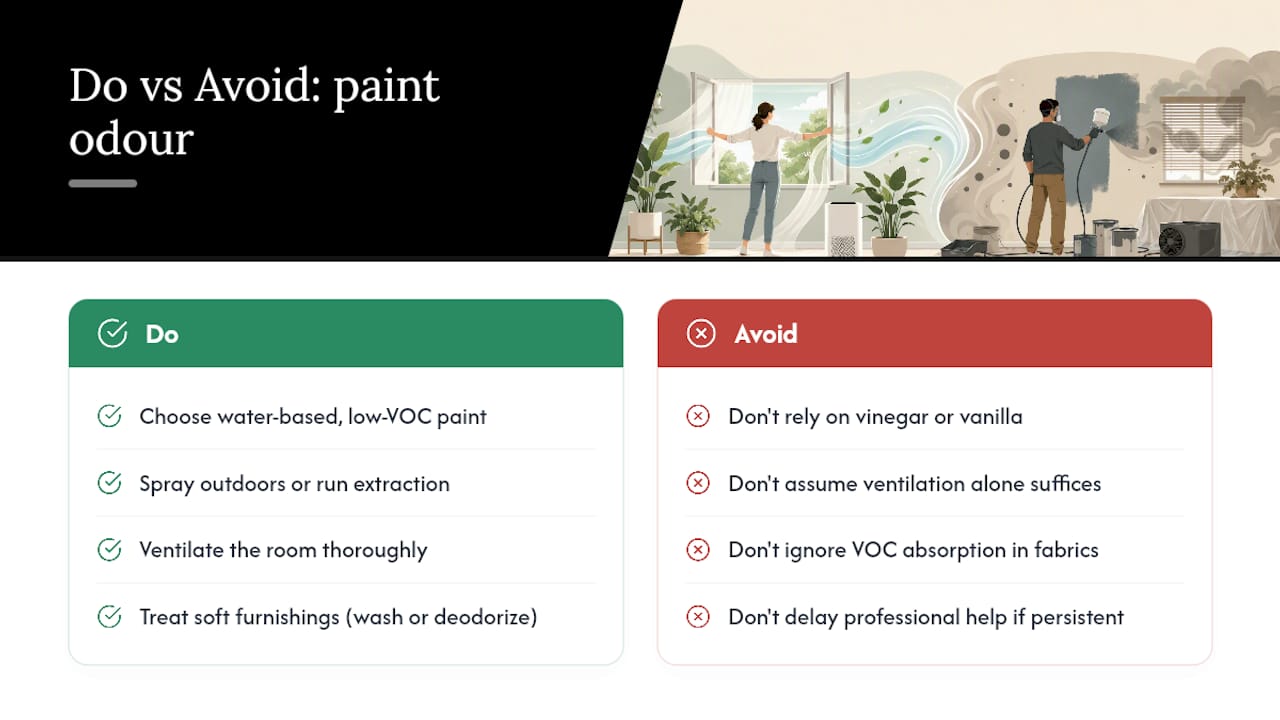
For persistent odour that survives a week of ventilation and cleaning, the honest answer is that something has gone wrong: either the paint has penetrated a porous surface deeply, or the HVAC system is recirculating contaminated air. At that point, professional help is not an extravagance. A contractor who uses low-VOC materials, runs proper containment, and backs their work with a warranty is a better long-term solution than another round of baking soda.
Sources
- How to Remove Paint Smell from a Room Without Waiting Days for It to Clear - Woodiwiss Painting
- How to Get Rid of Spray Paint Smell - Great Home Depot