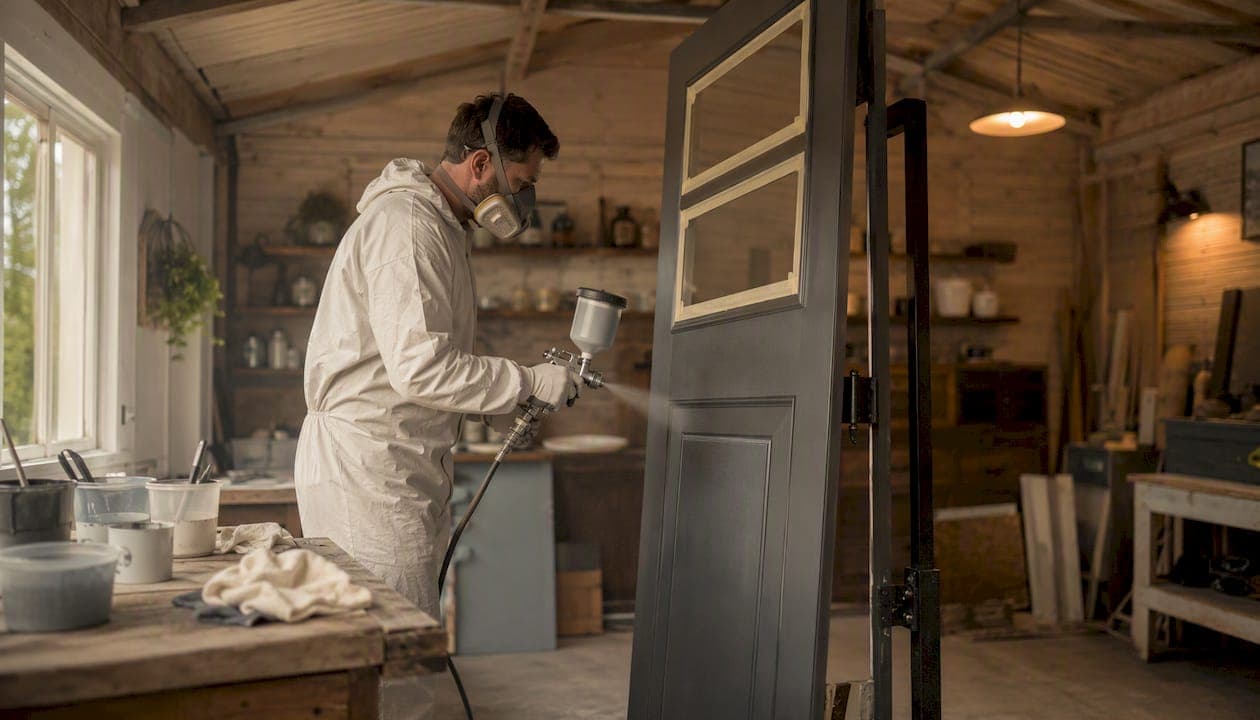
Yes, you can spray a composite door — but only if the right system is used. Standard exterior paints will fail on a GRP-skinned door, often within months. What works is an industrial two-component (2K) polyurethane coating, applied by a skilled technician with proper surface preparation. Refinishingstudio uses exactly this system across South Wales, delivering a factory-standard finish backed by a five-year transferable warranty.
A few things to know before you book anything:
- Composite doors have a smooth, non-porous GRP skin that ordinary paints cannot grip without specialist preparation.
- Thermal movement of up to approximately 3mm in summer means any rigid coating will eventually crack.
- Respraying can void your manufacturer's warranty; a reputable refinisher replaces that protection with their own written guarantee.
- Expect a professional composite door respray to cost between £250 and £500 per door, depending on scope and finish.
Pro Tip: Ask any refinisher upfront whether they carry a written, transferable warranty. If they cannot produce one, walk away.
Table of Contents
- Why composite (GRP) doors need specialist coatings
- What professional composite door spraying actually involves
- What the job looks like: timeline, cost, and durability
- Can you spray a composite door yourself?
- How to choose a professional in South Wales
- Common mistakes and red flags to watch for
- Refinishingstudio: professional composite door respraying across South Wales
- Key takeaways
- Why professional respraying often beats replacement
Why composite (GRP) doors need specialist coatings
The GRP (glass-reinforced plastic) skin on a composite door is factory-cured, smooth, and almost entirely non-porous. That is what gives it its durability and low-maintenance appeal. It is also what makes it so unforgiving when someone tries to paint it with the wrong product.
Household exterior paints are formulated for timber, masonry, or metal. Applied to a GRP surface without the correct primer, they sit on top rather than bonding to it. The result is peeling, usually within three to six months, sometimes sooner on south-facing doors that take the full force of UV and temperature swings.
The thermal movement issue compounds this. A composite door is not a single material — it combines a GRP skin, a timber or engineered core, and insulating foam. Each expands and contracts at a different rate. In summer, the assembly can move by around 3mm. A rigid coating applied across that assembly has nowhere to go. It cracks at the stress points, typically around the edges and any moulded detail, and moisture gets underneath.
A 2K polyurethane system is formulated to flex with the substrate. It also offers UV stability that retail paints cannot match, which matters considerably on a front door that faces south-west Welsh weather year-round.
What professional composite door spraying actually involves
The coating systems that hold up
Industrial 2K polyurethane is widely regarded as the trade standard for composite door respraying. It is a two-part product: base coat mixed with a hardener immediately before application. That chemical cure produces a finish that is harder, more flexible, and more UV-resistant than typical retail paints. The alternative — a quality exterior paint from a DIY retailer — simply does not have the flexibility or adhesion chemistry to last on GRP.
In situ versus off-site spraying
| Dimension | In situ hand-spray | Off-site (sash removed) |
|---|---|---|
| Finish system | 2K polyurethane | 2K polyurethane |
| Application method | Hand-spray, technician on-site | Spray booth or trestles |
| Turnaround | Same day, typically | Longer; transport and refit add time |
| Durability / warranty | Five-year transferable (professional) | Five-year transferable (professional) |
| Substrate compatibility | UPVC, GRP, composite, aluminium | UPVC, GRP, composite, aluminium |
| Finish options | Full RAL/BS range, multiple sheens | Full RAL/BS range, multiple sheens |
A skilled in situ operator using appropriate masking tools can match factory-standard results without removing the sash. The masking quality is what separates a clean job from one with overspray on the glass or brickwork. Off-site spraying offers a controlled environment but adds disruption and time.
Preparation steps that professionals follow
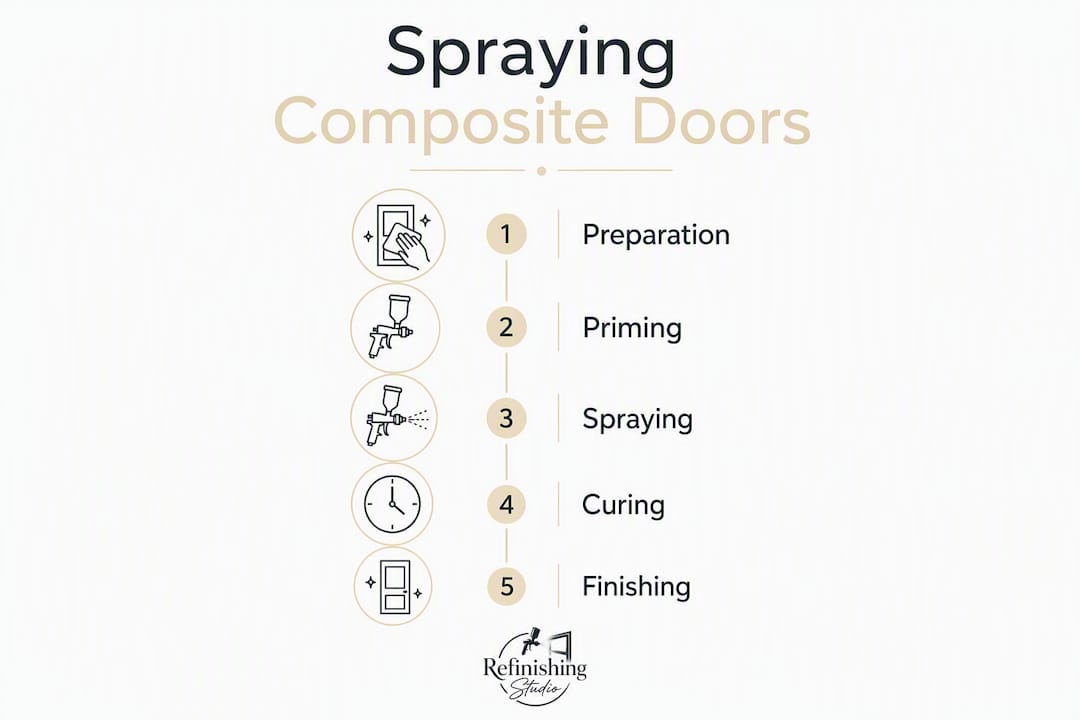
Good preparation is where most of the durability comes from. The sequence professionals use:
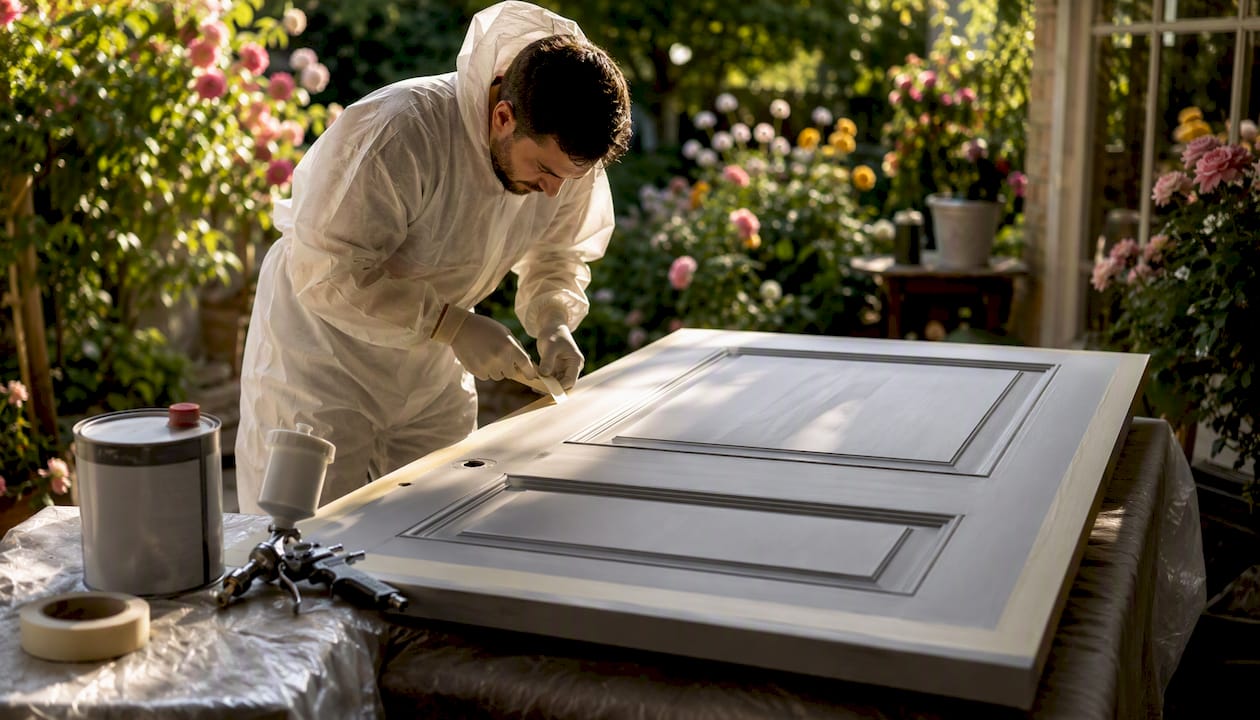
- Mechanical abrasion with Maroon Scotch-Irish pads to create a key on the GRP surface.
- Chemical degreasing with a product such as ColorSpray SB400 to remove all contamination.
- Application of an adhesion or etch primer suited to the substrate.
- Mixing the 2K topcoat with hardener in the correct ratio immediately before spraying.
- Test spray to verify gun set-up and colour match before committing to the door.
Pro Tip: When a technician arrives, watch whether they degrease and abrade before priming. If they go straight to paint, the finish will not last.
What the job looks like: timeline, cost, and durability
A typical in situ composite door respray follows this sequence: site survey, furniture and handle removal or masking, abrasion and degreasing, primer coat, two 2K polyurethane topcoats, cure time, refit and final walkthrough. Most in situ jobs complete within a short timeframe, typically on the same day.
Typical cost and cure data:
| Factor | Typical range |
|---|---|
| Professional respray cost (per door) | £250–£500 |
| Expected finish life (2K system, professional) | 5+ years with warranty |
| DIY finish life (retail paint, no specialist prep) | six to twelve months |
Cost drivers include door complexity (moulded panels, glazing bars), whether the sash is removed, the colour chosen, and the finish level. A plain flat door costs less than a heavily detailed one with side panels.
Durability depends partly on exposure. A north-facing door in a sheltered position will outlast a south-facing one in direct sun, even with the same coating. That said, a properly applied 2K system on a well-prepared surface routinely lasts five or more years before any maintenance is needed.
Can you spray a composite door yourself?
Technically, yes. Practically, it rarely ends well. DIY spray jobs commonly result in drips, poor adhesion, and peeling within six to twelve months. The failure modes are predictable:
- Inadequate abrasion leaves the GRP surface too smooth for primer to grip.
- Retail paints lack the flexibility to survive thermal movement.
- Colour mismatch is common without professional tinting equipment.
- Orange peel texture appears when spray technique or gun pressure is wrong.
- 2K paints require correct hardener ratios and ventilation — the isocyanate hardeners in 2K systems are hazardous without proper respiratory PPE and airflow.
The VOC and health considerations alone make 2K systems unsuitable for most DIY situations. These are industrial products that require a spray mask rated for isocyanates, not a dust mask from a hardware shop.
A DIY approach can make sense for minor touch-ups on small, well-prepared areas using a composite-compatible paint system rather than a full 2K kit. For a full colour change or a door in a prominent position, the risk of a failed finish and wasted spend is high. Reviewing common pitfalls of DIY door work before you start is worthwhile.
Pro Tip: If you want to test a paint system, apply it to a small, out-of-sight panel first. Leave it for two weeks and check adhesion by pressing and peeling a strip of tape. If paint lifts, the system is wrong.
How to choose a professional in South Wales
Checklist before you book
- Confirm they use an industrial 2K polyurethane system, not retail exterior paint.
- Ask to see a portfolio of completed composite door resprays, not just UPVC.
- Check that masking includes specialist tools (3M M300 or equivalent) to protect glass and frames.
- Request a written, transferable warranty of at least five years.
- Verify that technicians are directly employed, not subcontracted.
Questions worth asking on the quote call
- Will the job be in situ or will the sash be removed?
- Which specific products and primers will you use?
- What are the cure times and aftercare instructions?
- What is your remediation policy if the finish fails within the warranty period?
- Can you provide references or before-and-after photos from local South Wales jobs?
When comparing quotes, price alone is a poor guide. A £150 quote using retail paint will cost more in the long run than a £400 job with a 2K system and a five-year warranty. Check the scope, the products, and the warranty wording before you decide.
Common mistakes and red flags to watch for
The most frequent errors professionals see are skipping abrasion, using retail paints, rushing cure times, and inadequate masking that leaves overspray on glass or adjacent brickwork. On the provider side, the red flags are equally clear:
- No portfolio or only vague references to "previous work."
- A warranty offered verbally but not in writing.
- Unwillingness to name the products they will use.
- Asking for full payment before the job starts.
- Using subcontractors without disclosing it.
Refinishingstudio: professional composite door respraying across South Wales
If you want the job done properly without the risk of a failed DIY attempt, Refinishingstudio offers composite door spraying across South Wales using industrial 2K polyurethane systems, applied in situ by directly employed technicians. No subcontractors, no guesswork on products.

Every job comes with a five-year transferable warranty, a full RAL and BS colour range, and multiple finish options from matt through to gloss. With over 1,000 completed projects and a before-and-after portfolio covering locations from Cardiff to Swansea, Refinishingstudio has the track record to back the claim. Turnaround for a standard in situ door respray is typically one day. To get a written quote, request a local survey via the South Wales respraying service page — the process runs from survey to completion walkthrough, with no payment required until you are satisfied.
Key takeaways
Professional composite door respraying works when an industrial 2K polyurethane system is used with proper GRP preparation; retail paints and DIY attempts typically fail within twelve months.
| Point | Details |
|---|---|
| 2K polyurethane is non-negotiable | Only flexible, industrial-grade systems survive GRP thermal movement of up to ~3mm. |
| Preparation drives durability | Abrasion, degreasing, and correct priming matter more than the topcoat brand. |
| Typical cost band | Professional resprays run £250–£500 per door; DIY savings are usually lost to early failure. |
| Manufacturer warranty impact | Respraying can void the original warranty; always secure a written transferable warranty from your refinisher. |
| Refinishingstudio | Offers 2K hand-spray resprays across South Wales with a five-year transferable warranty and 1,000+ completed projects. |
Why professional respraying often beats replacement
The case for a professional respray over a full door replacement is stronger than most homeowners realise. A new composite door costs several hundred to well over a thousand pounds once supply, fitting, and any frame work is included. A professional respray at £250–£500 delivers a factory-standard finish, a five-year warranty, and zero disruption to the frame or surrounding structure.
Where replacement genuinely makes sense is structural failure: a warped core, a failed seal, or a door that no longer closes squarely. Cosmetic dissatisfaction with colour or a tired finish is almost always better addressed with a respray. The environmental case is also worth noting — keeping an existing door and refinishing it avoids the waste of a full replacement.
The one thing I would stress to any South Wales homeowner is this: the quality of the outcome is almost entirely determined by the preparation and the coating system, not the colour or the finish level. Hire someone who can name their products, show their work, and put a warranty in writing. That is the whole decision.
Useful sources and technical references
- Can You Spray Composite Doors — Axiom Eco Homes: covers GRP thermal movement, 2K system requirements, and cost guidance.
- How to Respray a Composite Door — Total Installer: detailed trade-level process including prep products, masking tools, and application steps.
- Can Composite Doors Be Repainted — Axiom Eco Homes: explains manufacturer warranty implications and the case for a refinisher's transferable warranty.
- Can You Paint a Composite Door — Rawlins Paints: practical guidance on composite-compatible paint systems and surface preparation.
- Can You Paint a Composite Door — Homebuilding: accessible overview of painting options, durability expectations, and application methods.
- Composite Door Spraying South Wales — Refinishingstudio: service detail, warranty terms, and booking for South Wales homeowners.