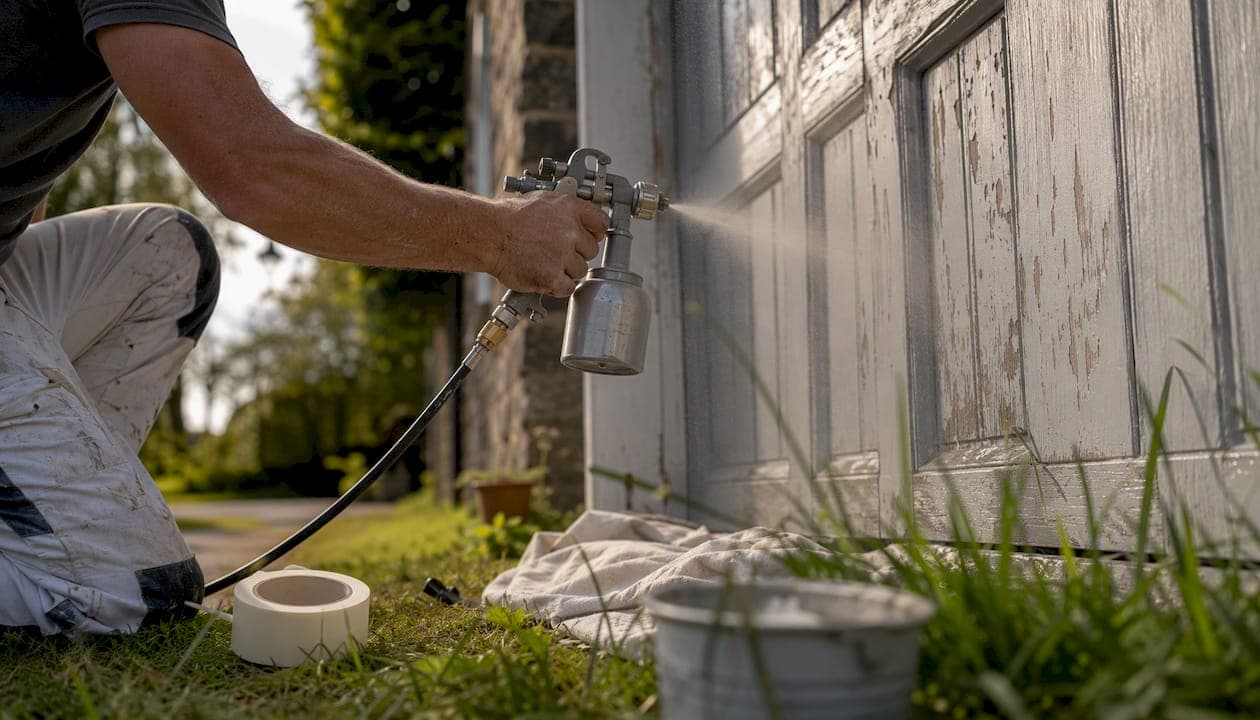
A professional garage door respray in the UK typically costs £250–£600 for a single door and £350–£700 for a double door, with most jobs landing around £350 on average. Before you call anyone, ask for two written quotes, confirm the paint specification, and check whether a warranty is included. A respray that comes without a written guarantee is rarely worth the saving.
-
Most single-door jobs complete in one day on site; double doors or heavy prep work take two days
-
A professional respray typically costs a fraction of a full door replacement, which can run to £1,500 or more for a standard up-and-over
-
A fresh coat protects against weathering and corrosion while restoring kerb appeal without any structural work
The typical UK cost for a professional single-door respray averages around a mid-level figure, according to current trade price guides.
Key takeaways
A professional garage door respray in the UK costs £250–£700 depending on door size, substrate, and preparation, and typically saves homeowners over £1,000 compared with full replacement.
| Point | Details |
|---|---|
| Typical cost range | Single doors: £250–£600; double doors: £350–£700; average around £350. |
| Main cost drivers | Door condition and prep time matter most; substrate type determines primer and paint spec. |
| Spray beats brush | Spraying gives a factory-like finish on panelled or textured doors and is often faster overall. |
| Warranty is non-negotiable | Always get the warranty in writing; a five-year guarantee is the benchmark for professional work. |
| Refinishingstudio | South Wales provider with over 1,000 completed projects, five-year warranty, and no subcontractors. |
Table of Contents
- How is the total garage door respray cost built up?
- What does a respray cost by door type and material?
- Spraying versus brushing: which gives a better result?
- What does a professional respray job include?
- How long does a garage door respray take, and how long will it last?
- What does a DIY garage door respray actually cost?
- How to choose a garage door respray contractor
- Refinishingstudio: a South Wales case study
- Why the cheapest quote is rarely the right one
- Refinishingstudio's garage door spraying service in South Wales
- Useful sources
How is the total garage door respray cost built up?
Understanding what you are actually paying for makes it far easier to judge whether a quote is fair. A professional respray is not just paint and a brush; it involves several distinct cost components, each of which can shift depending on the condition of your door.
| Cost component | Typical range |
|---|---|
| Labour (day rate or hourly) | £15–£20 per hour |
| Surface preparation (cleaning, degreasing, rust treatment, filler) | £30–£80 |
| Masking, sheeting and waste disposal | £15–£30 |
| Primer coat | £20–£60 |
| Two topcoats (professional spray paint) | £30–£80 |
| Specialist finish (metallic, textured, custom RAL colour) | £20–£60 extra |
| VAT (20%) | Applied to the total |
Labour rates for tradespeople typically sit around £15–£20 per hour for painting work, though day rates vary by region and experience. The preparation stage is where costs diverge most sharply: a door with surface rust, dents, or multiple old paint layers needs significantly more time than a clean, well-maintained surface. Masking and site protection are relatively fixed costs regardless of door size.
Pro Tip: If your door has textured or embossed panels, always choose spraying over brushing even if the quote is slightly higher. Brush marks collect in the recesses and are impossible to correct without stripping back to bare metal.
What does a respray cost by door type and material?
Door size and substrate are the two biggest variables after condition. A standard single up-and-over in steel is the simplest job; a wide double sectional in timber at the top end of the scale can cost nearly three times as much.
| Door type | Typical price range |
|---|---|
| Single up-and-over (steel or uPVC) | a moderate cost range |
| Single sectional or side-hinged | a slightly higher cost range |
| Double up-and-over or double sectional | a higher cost range |
| Timber or composite (any size, add for prep) | additional cost for preparation |
These figures reflect a standard two-coat respray with basic preparation. Heavily corroded steel or a door with peeling old paint will sit at the top of each range or beyond it.
Substrate differences matter more than most homeowners expect:
- Composite doors have a GRP (glass-reinforced plastic) skin that bonds well with the right primer but is unforgiving of poor prep; see Refinishingstudio's composite door spraying guidance for substrate-specific detail
For uPVC doors specifically, the preparation and paint chemistry differ enough from metal that it is worth confirming the contractor has experience with plastic substrates before booking. Refinishingstudio's uPVC spraying service covers this in detail.
Spraying versus brushing: which gives a better result?
For most modern garage doors, spraying wins. Spray application is faster, produces a smoother finish, and handles angled panels and textured surfaces far better than a brush or roller. On a panelled up-and-over door, a brush leaves visible stroke marks in the recesses; a sprayer lays an even, factory-like coat across every surface in a single pass.
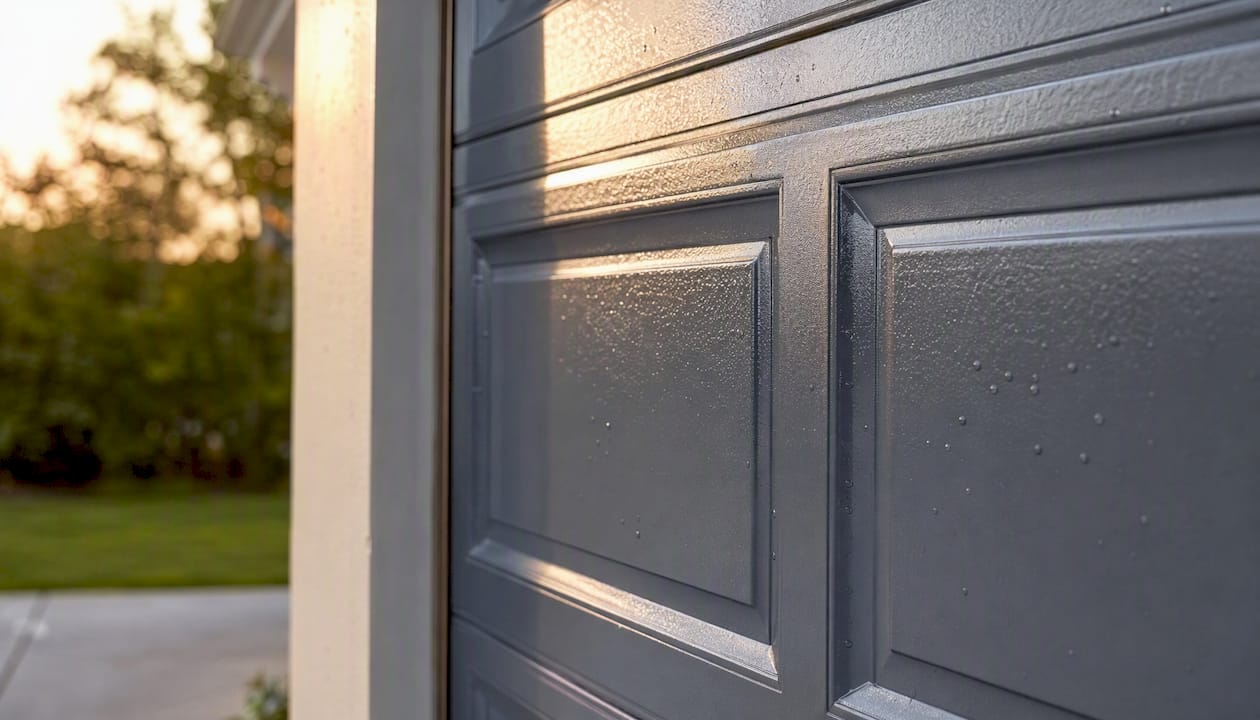
Brushing still makes sense in a narrow set of circumstances: very small touch-up areas, flat flush doors with no panelling, or situations where overspray risk makes a sprayer impractical (a garage with no masking space, for example). For anything more complex, the extra setup time a sprayer requires pays for itself in finish quality.
The cost difference is smaller than people assume. Brushing a panelled door takes longer because each recess needs individual attention; the labour saving from skipping the sprayer setup is often cancelled out by the extra brush time. On a complex door, spraying can actually be the cheaper option once total labour hours are counted.
Pro Tip: Ask your contractor whether they will spray or brush before accepting a quote. A professional who plans to brush a textured or panelled door is not necessarily cutting corners, but it is worth asking why, and what finish standard they are guaranteeing.
What does a professional respray job include?
A well-scoped professional respray covers more than paint. Knowing the standard inclusions helps you spot a quote that is missing something important.
Standard inclusions you should expect:
- Full site protection: floor sheeting, masking of adjacent brickwork, frames, handles and seals
- Degreasing and cleaning of the door surface
- Rust treatment and spot filler where needed
- Application of a suitable primer (metal, plastic or wood, matched to substrate)
- Two topcoats of professional-grade spray paint
- Curing guidance (when the door can be used and when to avoid washing it)
- Site clearance and waste removal
Optional extras that add to the cost:
- Custom RAL or BS colour matching (£20–£60 extra)
- Anti-rust treatment systems for heavily corroded steel (£30–£80 extra)
- Replacement of worn or damaged door seals (£20–£50 extra)
- Removal and re-fitting of the door for extreme prep cases (£80–£150 extra)
- Specialist finishes: metallic, satin, or textured topcoats (£20–£60 extra)
Checklist to include in your quote request:
- What primer will be used, and is it substrate-specific?
- How many topcoats are included?
- What brand and grade of paint?
- Is rust treatment included or quoted separately?
- What site protection is provided?
- What is the warranty period and is it in writing?
Sending this list to two or three contractors before they visit ensures you receive comparable, like-for-like quotes rather than comparing a full-prep job against a paint-only price.
How long does a garage door respray take, and how long will it last?
Most single-door resprays complete in one day on site. Double doors, or any door needing significant rust treatment or filler work, typically take two days. That timeline is consistent with standard trade guidance for this type of job.
Drying times matter as much as the on-site schedule. Professional spray paints are typically touch-dry within 15–30 minutes, but recoat windows and full cure times are longer. The Innov8 Coatings garage door spray paint specification, for example, gives touch-dry at 5–15 minutes and hard-dry at 45–60 minutes between coats; full chemical cure takes longer still. A good contractor will tell you when the door is safe to use normally and when to avoid pressure washing or abrasive cleaning.
A professionally applied respray on a well-prepared surface typically lasts 5–10 years before it needs attention, depending on exposure and maintenance. South-facing doors and those in coastal areas tend to fade faster. Simple maintenance extends the life considerably: wash the door with warm soapy water two or three times a year, avoid abrasive cleaners, and touch up any stone chips before moisture gets underneath.
Pro Tip: Book your respray for late spring or early summer if you can. Cold temperatures slow cure times and damp conditions can cause adhesion problems. Most professional contractors will reschedule if the forecast is poor, but giving yourself a warm-weather window reduces the risk.
For more on how long a respray finish holds up in practice, Refinishingstudio's guide on how long a uPVC respray lasts covers the key factors in detail.
What does a DIY garage door respray actually cost?
DIY is cheaper upfront, but the gap between a DIY finish and a professional one is wider than most homeowners expect. Here is a realistic material cost breakdown for a single door:
- Aerosol spray paint (door-grade): approximately £15.95 per 400 ml can; a standard single door needs 4–6 cans for two coats, so £64–£96 in paint alone
- Primer aerosol (substrate-matched): £10–£20
- Filler and sandpaper: £10–£15
- Masking tape and protective sheeting: £10–£20
- PPE (respirator, gloves, eye protection): £15–£25
- Waste disposal: £5–£10
Total DIY materials: roughly £115–£185 for a single door, not including any equipment hire.
That is a meaningful saving against a professional quote, but it comes with trade-offs. Aerosol cans are designed for touch-ups and small repairs rather than full resprays; manufacturer touch-up sprays are explicitly small-format products for minor repairs, not whole-door coverage. Getting even, run-free coverage across a full door with aerosols takes practice. Common DIY problems include runs and sags from holding the can too close, poor adhesion from inadequate degreasing, and uneven colour from inconsistent spray distance.
DIY makes sense for a flat, flush door in good condition where you are comfortable with the prep work and happy with a finish that is good rather than perfect. For panelled, textured, or corroded doors, the professional result is usually worth the extra cost, particularly when you factor in the time a DIY job takes: a full single-door respray done properly takes most of a weekend.
How to choose a garage door respray contractor
The right contractor gives you a clear itemised quote, a written warranty, and examples of finished work on the same substrate as your door. Anyone who cannot provide all three is a risk.
Questions to ask before booking:
- Are you insured for public liability, and can I see the certificate?
- How long is your warranty, and is it in writing?
- What surface preparation is included in this quote?
- Which primer and topcoat will you use, and are they substrate-specific?
- How many coats are included?
- What are the cure times, and when can I use the door normally?
- How will you protect the surrounding area from overspray?
- How do you handle waste and used materials?
- Can you show me examples of completed work on a similar door type?
- Do you use subcontractors, or will the same person who quotes the job complete it?
Red flags to watch for:
- No site visit before quoting (a phone-only quote cannot account for prep requirements)
- Vague or verbal-only pricing with no written breakdown
- No mention of primer or surface preparation
- Warranty offered verbally but not confirmed in writing
- No examples of previous work, or examples only on different substrates
- Pressure to pay a large deposit before work begins
Comparing two quotes side by side: check that both include the same number of coats, the same prep scope, and the same warranty length. A quote that is £80 cheaper but excludes rust treatment on a corroded door is not actually cheaper.
Refinishingstudio: a South Wales case study
Refinishingstudio has completed over 1,000 respray projects across South Wales, covering garage doors, uPVC windows, fascias, and kitchen cabinetry, all backed by a five-year transferable warranty.
A recent project in the Cardiff area involved a double steel up-and-over door that had developed surface rust across the lower panels and was showing significant paint fade on the south-facing face. The scope included full rust treatment, spot filler on three areas, a metal primer, and two topcoats in RAL 7016 Anthracite Grey in a satin finish. The door was completed in two days, with the second day allowing for the recoat window and a final inspection. The finished result matched the anthracite window frames on the property, giving the frontage a coherent, contemporary look that the homeowner had been trying to achieve for two years. The total cost fell within the £400–£600 band for a double door with prep work.
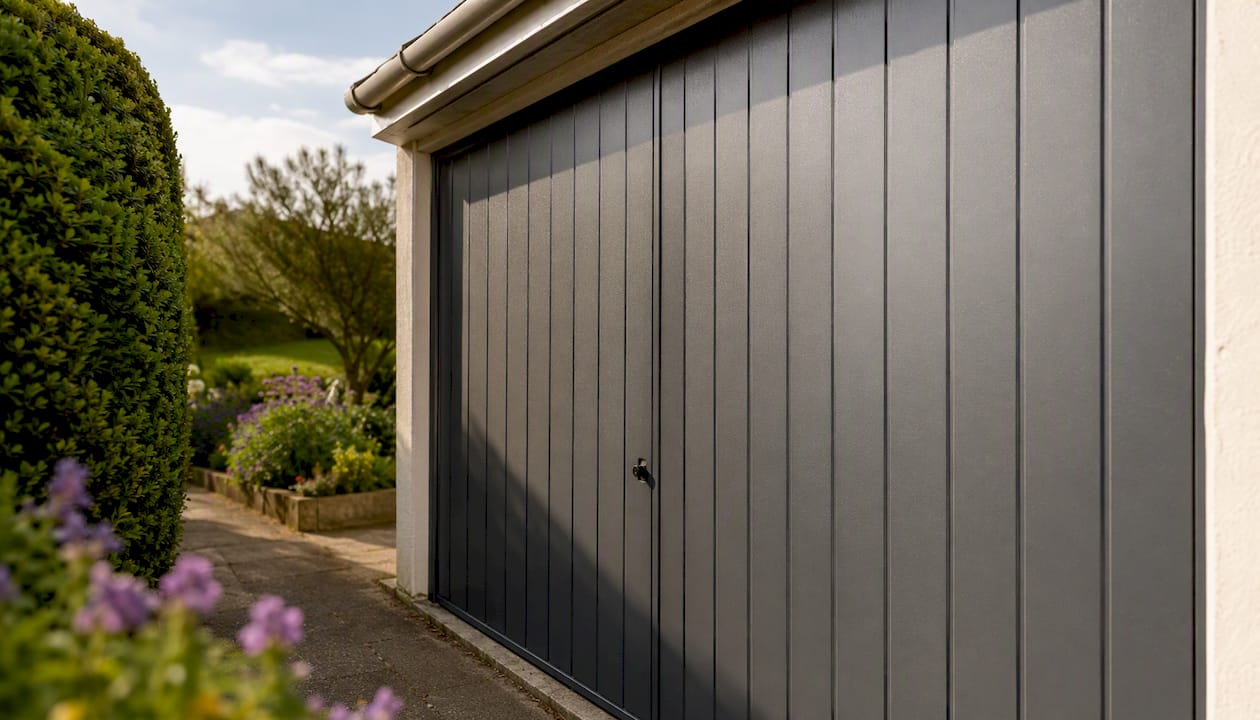
Every Refinishingstudio job is carried out by the same person who quotes it. No subcontractors, no handoffs. If you want to see finished work before committing, the project portfolio includes before-and-after examples from local properties.
Why the cheapest quote is rarely the right one
The most common mistake homeowners make when seeking a garage door respray is treating it like a commodity purchase and choosing on price alone. A quote that is £100 lower than the others is almost always missing something: preparation scope, a substrate-specific primer, or a written warranty. Those omissions do not show up until six months later when the paint starts lifting at the edges.
The second mistake is assuming a brush finish is "just as good" on a modern panelled door. It is not. The recesses in a typical up-and-over panel are exactly where brush marks collect and where moisture later finds a way in. Spraying is not a premium option on these doors; it is the correct method.
What homeowners actually value, once the job is done, is not the price they paid but the finish they got and whether it held up. A five-year warranty from a contractor who does not subcontract the work is the clearest signal that the person quoting the job is confident in the result.
Refinishingstudio's garage door spraying service in South Wales
If your door is structurally sound but looks tired, faded, or simply the wrong colour, a professional respray is the most cost-effective route to a result that lasts. Refinishingstudio offers a garage door spraying service across South Wales covering steel, aluminium, uPVC, and composite doors in any RAL or BS colour, with a choice of matt, eggshell, satin, or gloss finishes.

Every job includes full site protection, substrate-specific primer, two professional topcoats, and a written five-year transferable warranty. The same person who quotes your job carries it out; no subcontractors are involved at any stage. Prices for a single door range from £250–£600, with a free written quote provided after a site visit.
To get a written quote for your garage door, visit refinishingstudio.co.uk or go directly to the garage door spraying page to see examples and request a callback.
Useful sources
The price estimates and technical claims in this guide draw on the following sources. Use them when comparing quotes or checking paint specifications.
- Painting a Garage Door Cost (2026) | Price Guide & Estimates
- How Much Does Garage Painting Cost in 2026?
- Innov8 Coatings garage door spray paint 400 ml — product listing (Checkatrade shop)
- Garage Door Spray Paint 400ml — Available in any colour - Aerosols R Us
- Garage Door 170/180 Series Touch-Up Spray Paint 12oz — Express Garage Doors