A transferable warranty is coverage that can move from the original buyer to a later owner instead of expiring the moment a product, home, or vehicle changes hands. Whether it actually transfers depends on the small print, and most providers demand a specific process, sometimes with a deadline or a fee. Transferability can genuinely boost resale value, but only when the remaining cover is worth having and the transfer itself is straightforward.
TL;DR:
- Transferable warranties are only valuable when a long remaining term and broad coverage are combined with a straightforward transfer process.
- Most warranties linked to serial numbers or VINs transfer more seamlessly, while name-based warranties often require manual registration and fees.
- Missing transfer deadlines or not completing the paperwork can result in losing all remaining coverage, even if the warranty is technically transferable.
- Restrictions such as one-time transfer limits, coverage reductions, and exclusions for modifications or commercial use often reduce the value of a supposedly transferable warranty.
- Always review the specific transfer clauses in the warranty and gather proof before buying or selling to ensure the warranty will pass to the next owner and provide value.
Table of Contents
- Transferable warranty meaning: product-tied versus buyer-tied cover
- How does a transferable warranty work in practice?
- What limits and exclusions catch people out?
- Why transferability matters when you're buying or selling
- How to check if your warranty transfers before you buy or sell
- A contractor-issued example: how a transferable warranty gets supported
- When a transferable warranty is worth relying on
- Sources
- FAQ
Transferable warranty meaning: product-tied versus buyer-tied cover
Not every warranty behaves the same way when ownership changes, and the difference comes down to what the coverage is actually attached to. Some warranties follow the item itself, tracked by a serial number or a Vehicle Identification Number (VIN). Others are tied to a person's name on a registration form and simply stop applying once that person sells up.
According to Citizens Advice, whether a warranty transfers often depends on this exact distinction, and product-tied coverage tends to move far more smoothly than purchaser-tied cover. A few real-world examples make this clearer:
- Vehicle warranties: most manufacturer warranties are linked to the VIN, so cover typically carries over to whoever buys the car next, sometimes automatically.
- Home and installer warranties: a builder's or contractor's guarantee is often written around the property or the job itself, though some insist the original homeowner registers any change.
- Appliance warranties: many stay with the original purchaser only, especially budget models, which is why the paperwork rarely gets passed on at resale.
- Refurbished goods: cover here is frequently shorter and stated as non-transferable from the outset, so it is worth checking before assuming otherwise.
Marketing language adds another wrinkle. A "lifetime" warranty sounds permanent, but the small print usually defines "lifetime" as the original owner's lifetime of ownership, not the product's. Read that clause before you rely on it.
How does a transferable warranty work in practice?
Moving cover from one owner to the next is rarely automatic, even when the warranty is technically transferable. Most providers expect the new owner, or sometimes the seller, to actively complete a process rather than assume the paperwork sorts itself out.
- Find the transfer clause. Look for wording like "transfer," "assignment," or "subsequent owner" in the original warranty document.
- Gather your proof. This usually means the original invoice, any installation certificate, and the serial number or VIN.
- Complete the transfer form or registration. Some administrators run this online; others still want a signed paper form.
- Pay any transfer fee. Not every provider charges one, but plenty do, and the amount varies by manufacturer.
- Submit within the deadline. Providers commonly set a window measured in weeks or months from the date of sale.
Miss that window and you can lose the remaining cover entirely, even if the warranty was genuinely transferable on paper. This is one of the most common ways buyers get caught out: they assume the cover followed the product automatically, only to find the registration lapsed months earlier.
That deadline pressure is exactly why serial and VIN-linked warranties tend to cause fewer disputes. When the coverage is registered against the unit itself, the provider's own records confirm the transfer without much back-and-forth. Name-based warranties, by contrast, create manual exceptions that slow everything down and increase the chance of a claim being refused later.
Pro Tip: Ask the manufacturer or administrator for written confirmation once a transfer is processed. A verbal "yes, that's sorted" from a call centre is worth far less than an email or certificate you can produce if a claim gets disputed.
What limits and exclusions catch people out?
Even a warranty labelled transferable rarely passes on unchanged. Providers write in restrictions that shrink the cover for anyone but the original buyer, and missing these is one of the two biggest reasons an extended warranty ends up disappointing a second owner.
- One-time transfer limits: some warranties allow exactly one transfer, ever, so a product's third owner may find there is nothing left to claim on at all.
- Reduced terms for later owners: cover length or scope sometimes shrinks automatically once ownership changes, even within an otherwise transferable policy.
- Exclusions for modifications or commercial use: unauthorised repairs, non-standard parts, or switching a product to business use can void cover regardless of who owns it.
- Non-transferable clauses: some warranties state outright that rights belong solely to the original purchaser, which overrides any hope of passing them on.
Legal protections around unfair trading practices still apply regardless of what the warranty document says, as outlined in Gov. Statutory rights sit alongside, not instead of, whatever the manufacturer's paperwork promises, so a restrictive clause does not strip away every avenue a buyer has if goods turn out faulty.
Why transferability matters when you're buying or selling
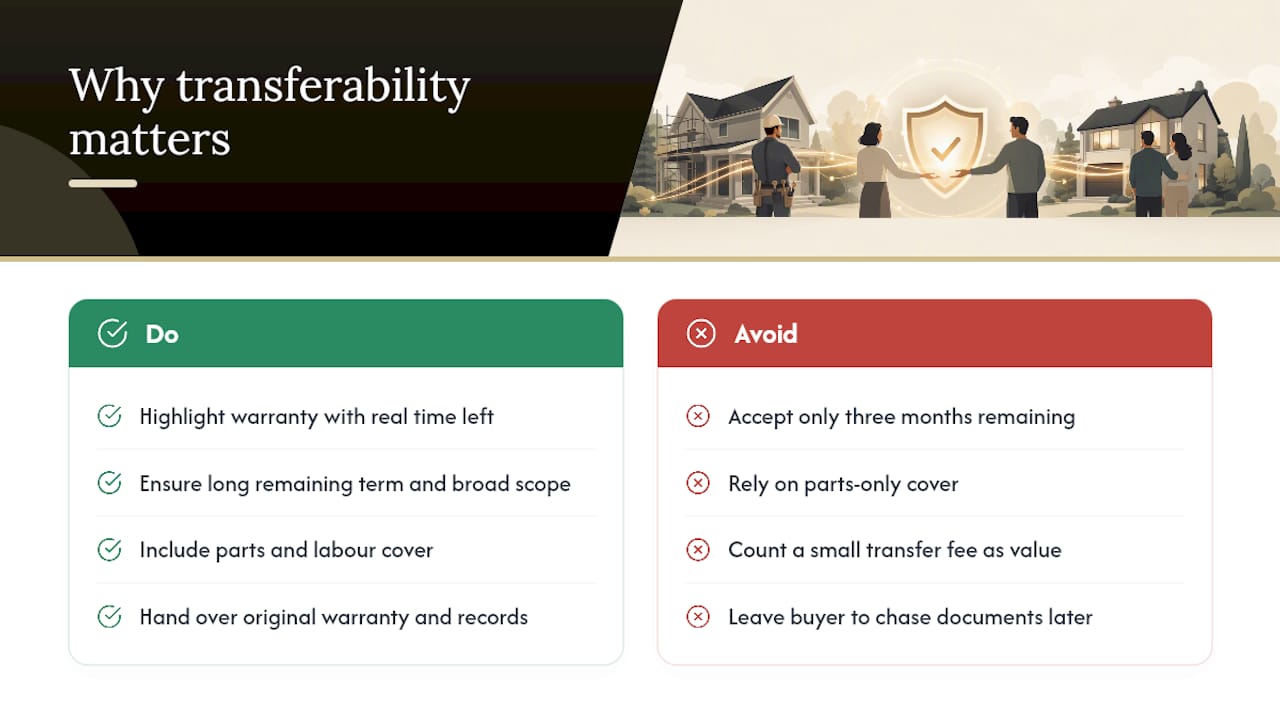
For a seller, a transferable warranty with real time left on it is a genuine selling point. Buyers pay more readily for a used car, home, or set of appliances when they know a problem in year two won't come entirely out of their own pocket. That confidence shows up in negotiations, not just in headline price.
The catch is that transferability only matters when there is meaningful cover left. A warranty with three months remaining and a £50 transfer fee attached does very little for either party. What actually moves the needle is a longer remaining term and broad scope, such as parts and labour rather than parts alone.
If you're selling, hand over the original warranty document, proof of purchase, and any service records at the point of sale rather than leaving the buyer to chase them down later. That single step often does more for buyer confidence than the warranty terms themselves.
How to check if your warranty transfers before you buy or sell
Before assuming a warranty will follow the product, read the document itself rather than relying on what a salesperson tells you. Search specifically for the words "transfer," "assignment," "original purchaser," and "subsequent owner." These phrases tend to sit in a short clause near the end of the terms, and they settle the question far more reliably than the marketing copy on the box.
Keep these documents together, ideally before you need them, not after:
- Original invoice or receipt showing the purchase date
- Installation certificate, where relevant (kitchens, UPVC, boilers, and similar fitted work)
- The product's serial number or VIN
- Any settlement or transfer statement, for property-linked warranties
Contend Legal's guidance on making a claim using a warranty or guarantee makes clear that manufacturers and administrators routinely ask for exactly this paperwork before honouring a claim. If anything is unclear, call the manufacturer, installer, or warranty administrator directly and ask two questions: is this warranty transferable at all, and what is the exact deadline for registering a change of ownership?
A contractor-issued example: how a transferable warranty gets supported
Refinishingstudio backs every UPVC and kitchen respray with a five-year warranty, and it keeps a project record for each job, covering the invoice, the finish and colour specification, and the completion date. That record is exactly the kind of documentation a second homeowner would need if they wanted to confirm remaining cover after buying a property.

If you're selling a home with resprayed UPVC or a resprayed kitchen, that paperwork becomes part of the sale pack. It answers the buyer's most obvious question immediately: how much cover is left, and does it apply to them.
Whatever contractor did the original work, get their transfer policy in writing before agreeing any job, rather than assuming a warranty will simply pass along with the house.
When a transferable warranty is worth relying on
A transferable warranty earns its keep when three things line up: a long remaining term, broad coverage rather than a narrow exclusion list, and a transfer process that doesn't involve chasing paperwork for weeks. Short on any of those, discount it in negotiations rather than treating it as a given. Before relying on someone else's warranty, ask them to answer three questions in writing: how long is left, what exactly does it cover, and what does transferring it actually involve?
— Mitchell
Sources
GOV.UK's page on consumer protection from unfair trading regulations sets out the legal baseline that sits behind warranty promises, regardless of what a contract says. Citizens Advice's guide to guarantees and warranties explains the practical difference between product-tied and purchaser-tied cover in plain terms. Contend Legal's guidance on claiming under a warranty or guarantee covers exactly what documentation providers tend to demand. Readers weighing up a builder's or installer's warranty on a property purchase may also find House A-Z's guide to how builder warranties work useful background before signing anything.
If you're considering a UPVC or kitchen respray and want cover that's genuinely built to transfer with the property, Refinishingstudio's UPVC service across South Wales comes with clear, documented warranty terms from the outset.
FAQ
What is a transferable warranty?
It's coverage on a product, home, or vehicle that can pass from the original owner to a later one, rather than ending automatically when ownership changes.
Does a warranty transfer to a new or second owner automatically?
Sometimes, but not always. Serial number or VIN-linked warranties often transfer with far less friction, while name-based warranties usually need a manual application, form, or fee before they apply to a new owner.
What are two reasons not to buy an extended warranty?
Extended warranties frequently carry exclusions for unauthorised repairs or modifications, and many allow only one transfer ever, meaning a later buyer could inherit a warranty with almost nothing left to claim on.
Does a warranty transfer to a second owner if I miss the deadline?
Usually not. Most providers set a specific window for registering a transfer, and missing it commonly means forfeiting whatever cover remained, even on a policy that was genuinely transferable.