
Professional kitchen respraying delivers near-factory results and can save thousands compared with full cabinet replacement, provided the carcasses are structurally sound. Refinishingstudio has completed over 1,000 projects across South Wales, and the four case studies below draw from that portfolio to show exactly what homeowners in Llanelli, Cardiff, and Swansea achieved: a transformed kitchen, a five-year transferable warranty, and a fraction of the disruption a full refit brings.
Here is what the numbers typically look like across a standard project:
- Cost band: most kitchen resprays in South Wales fall between £800 and £3,500 depending on scope, substrate, and finish
- Timeline: 2–5 days on site, with a full cure period of 7–14 days before heavy use
- Warranty: five-year transferable warranty on every Refinishingstudio project
- Disruption: doors are removed and sprayed off-site or in a controlled environment, so the kitchen remains partially usable throughout
Browse the full project gallery and kitchen services or read on for the detailed case studies below.
Key takeaways
Professional kitchen respraying in South Wales delivers near-factory results for £800–£3,500, backed by a five-year transferable warranty, when the cabinetry is structurally sound.
| Point | Details |
|---|---|
| Cost range | Most South Wales kitchen resprays cost between £800 and £3,500 depending on scope and substrate. |
| Timeline | Expect 2–5 days on site and 7–14 days cure time before heavy use. |
| Durability | A correctly applied 2K finish lasts 8–15 years; Refinishingstudio backs every project with a five-year transferable warranty. |
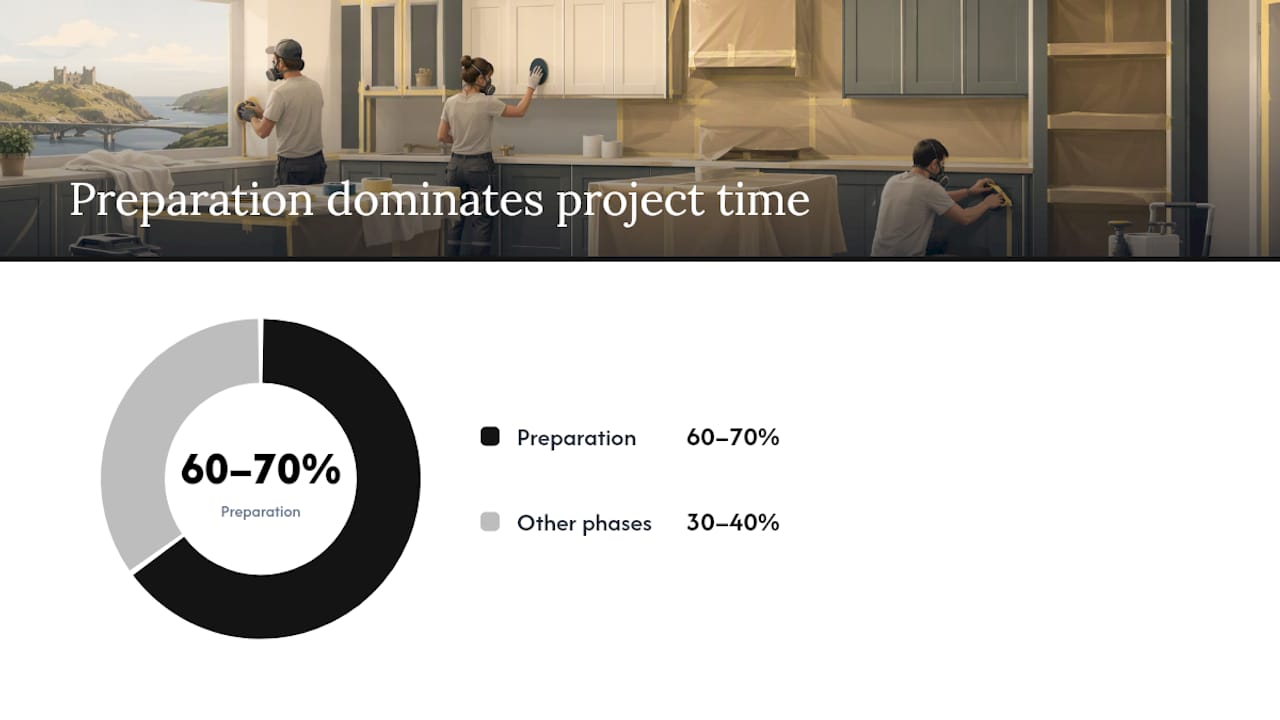
| Prep is decisive | Preparation accounts for 60–70% of project time and determines how long the finish holds. |
| Refinishingstudio | Over 1,000 completed projects across South Wales; free survey, fixed quote, no subcontractors. |
Table of Contents
- 1. Four sprayed kitchen case studies at a glance
- 2. Anthracite eggshell kitchen respray in Llanelli
- 3. Forest green custom kitchen respray in Cardiff
- 4. Jet black UPVC kitchen respray in Llanelli
- 5. Sage green handleless kitchen conversion in Swansea
- 6. How Refinishingstudio achieves factory-standard results
- 7. What does a kitchen respray typically cost, and what moves the price?
- 8. Is a kitchen respray the right choice for your home?
- 9. Why Refinishingstudio recommends respraying over replacement in most cases
- Refinishingstudio's kitchen respraying service across South Wales
- Sources
1. Four sprayed kitchen case studies at a glance
Before diving into the detail, here is a quick comparison of the four featured projects so you can identify which is closest to your own situation.
Project snapshots:
- Anthracite eggshell, Llanelli — timber-frame doors resprayed in RAL 7016 eggshell; island included; strong visual contrast against light worktops
- Forest green custom, Cardiff — colour-led refresh on a mid-range kitchen; precision colour match to a custom green; satin finish
- Jet black UPVC, Llanelli — UPVC substrate with specialist adhesion prep; eggshell finish for low reflectivity in a high-traffic kitchen
- Sage green handleless conversion, Swansea — combined respray with hardware modification; custom sage green. This was the most complex of the four projects
Independent research confirms that preparation accounts for 60–70% of total project time and is the single biggest determinant of how long the finish lasts. Refinishingstudio's process reflects that: the spray itself is the shorter part of the job.
2. Anthracite eggshell kitchen respray in Llanelli
This is the project that best illustrates what a colour change alone can do to a dated kitchen. The client had solid timber-frame doors in a pale cream finish that had yellowed over roughly a decade. The brief was simple: go dark, go modern, and keep the existing carcasses.
Project scope: 18 doors, 6 drawer fronts, 2 end panels, and a central island. All components were removed from the kitchen before any work began.
Prep and spray method
Every door was degreased with a specialist solvent cleaner to strip cooking residue, then hand-sanded to a fine key. Any chips or dents were filled and feathered before a high-adhesion primer coat was applied. Two topcoats of an eggshell finish in RAL 7016 Anthracite Grey followed, applied by hand spray in a controlled environment to avoid dust contamination. The eggshell sheen level was chosen specifically because it reads as contemporary without showing fingerprints the way a satin or gloss would on dark cabinetry.
Paint system: water-borne 2K topcoat in eggshell. The 2K (two-component) system cross-links as it cures, producing a hardness and chemical resistance closer to a factory-applied finish than a standard single-component paint.
Cost and timeline
The island added roughly half a day to the schedule because of its size and the number of faces involved. No structural repairs were needed on this project, which kept the cost toward the lower end of the band.
Challenge: colour consistency across the island and wall units. Because the island sits in stronger natural light, a slight tonal shift between batches is visible to a trained eye. Refinishingstudio mixed all topcoat from a single batch and sprayed the island first, then the wall units, to keep the colour reading identically under different light conditions.
View the full before and after photography on the Anthracite kitchen Llanelli portfolio page.
3. Forest green custom kitchen respray in Cardiff
The Cardiff client wanted something specific: a deep, muted forest green that did not match any standard RAL or BS colour. This project is a good example of what custom colour matching adds to a job, both in complexity and in the final result.
Project scope: 14 doors, 4 drawer fronts, and 3 end panels on a timber and laminate kitchen in the Pontcanna area. The laminate surfaces required additional prep compared with solid timber.
Colour matching and prep
The client brought in a fabric swatch and a paint chip from a different room in the house. Refinishingstudio mixed a custom colour to match, then produced a sample board for approval before any spraying began. That sample board step is worth noting: it eliminates the risk of a colour landing differently on a vertical kitchen door than it looked on a flat chip.
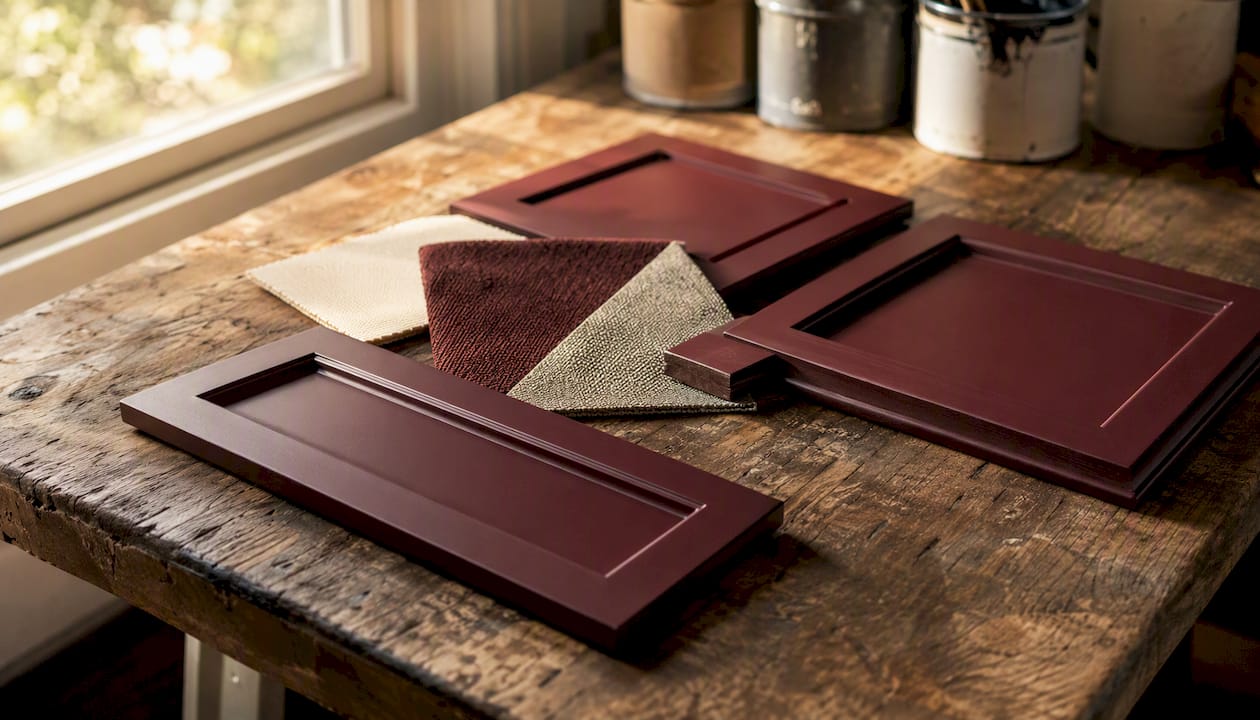
Laminate surfaces were scuff-sanded more aggressively than timber to create a mechanical key, then primed with a bonding primer formulated for low-porosity substrates. Skipping this step on laminate is the most common cause of peeling within the first year.
Paint system: water-borne primer, followed by two topcoats of a custom-mixed satin finish. Satin was chosen over eggshell here because the client's kitchen has north-facing windows and needed the slight additional light reflection to prevent the green from reading too dark in winter.
Cost and timeline
The colour-matching process added a short lead time before the job start date, as the sample board needed client sign-off. On site, the job ran to three days because of the laminate prep requirements.
See the finished project at the Forest green Cardiff portfolio page. For colour inspiration, the 2026 kitchen respray colour guide covers the shades performing best in Welsh homes this year.
4. Jet black UPVC kitchen respray in Llanelli
UPVC is a different substrate entirely, and it demands a different approach. This Llanelli project involved kitchen cabinet doors with UPVC facings, a material that is notoriously difficult to bond to without the right primer system.
Project scope: 16 UPVC-faced doors and 4 drawer fronts. The client's brief was a jet black finish, RAL 9005, in a kitchen that sees heavy daily use from a family with young children.
Substrate prep and adhesion
UPVC cannot simply be sanded and primed the way timber can. The surface was first cleaned with an isopropyl alcohol wipe-down to remove all grease and plasticiser residue, then treated with a dedicated adhesion promoter before any primer was applied. The adhesion promoter chemically bonds to the UPVC surface and gives the primer something to grip. Without it, even a high-quality topcoat will begin to peel within months.
Paint system: adhesion promoter, followed by a high-build primer, then two coats of a 2K eggshell topcoat in RAL 9005. Eggshell was chosen over gloss because jet black gloss amplifies every surface imperfection and shows every fingerprint. Eggshell gives the depth of the colour without the maintenance burden.
A firsthand DIY account on Popular Mechanics using a Wagner Flexio 5000 turbine sprayer found that near-factory results on 23 doors required a dedicated spray booth and strict cleaning routines to avoid contamination. Professional setups replicate that controlled environment as standard.
Cost, timeline, and warranty
The cure time on this project was extended to 10 days because 2K coatings on UPVC take slightly longer to reach full hardness than on timber. The client was advised not to use abrasive cloths or harsh cleaners during that period.
For more on UPVC respraying across South Wales, the UPVC spraying service page covers windows, doors, fascias, and garage doors alongside kitchen applications.
5. Sage green handleless kitchen conversion in Swansea
This project was the most involved of the four. The client wanted to move from a traditional handled kitchen to a handleless layout, which meant modifying the door edges and frame clips before any spraying could begin. The colour choice, a custom sage green, added a further layer of complexity.
Project scope: 20 doors, 6 drawer fronts, 4 end panels, and a peninsula unit. The handleless conversion required routing new J-pull profiles into the door edges and replacing the existing hinge hardware.
Modification and prep
The door modifications were completed before the spray process began. Routed edges were filled and sanded smooth so the spray finish would read as factory-made rather than retrofitted. End panels were treated as a separate phase because they remained fixed to the carcass and required masking of the surrounding wall and worktop.
Colour matching followed the same sample-board process as the Cardiff project. The sage green was mixed to a custom specification, lighter and more grey-toned than a standard RAL sage, and approved on a physical board before spraying started.
Paint system: bonding primer on all surfaces, followed by two coats of a 2K eggshell topcoat in the custom sage green. Eggshell was the right call for a handleless kitchen: the recessed J-pull channels catch light differently from a flat door face, and a satin or gloss finish would have made those channels read as a different colour.
Cost and timeline
The handleless conversion added roughly a day to the schedule. The extra cost reflects the routing work, new hinge hardware, and the additional prep time on the modified edges.
View the project at the Sage green Swansea portfolio page.
6. How Refinishingstudio achieves factory-standard results
The four case studies above share a common process. Understanding it helps homeowners evaluate any respray quote, not just Refinishingstudio's.
Step-by-step process:
- Survey — a technician visits to assess substrate condition, identify repairs, confirm colour and finish, and produce a fixed quote
- Removal — all doors, drawer fronts, and removable panels are taken off and transported to a controlled spray environment
- Degrease — every surface is cleaned with a solvent degreaser to remove cooking residue, grease, and wax
- Repair and fill — chips, dents, and edge damage are filled, sanded, and feathered flush
- Sand — surfaces are keyed to the correct profile for the primer system being used
- Prime — one or two coats of the appropriate primer (bonding primer for laminate and UPVC; standard high-adhesion primer for timber)
- Spray topcoats — two coats of the chosen finish, applied by hand spray with flash-off time between coats
- Cure — components are left in a dust-free environment to reach handling strength before transport
- Reinstall and walkthrough — doors are rehung, hardware refitted, and the client walks through the finished kitchen with the technician
Refinishingstudio uses no subcontractors. The same technicians who survey the job complete it, which matters for colour consistency and quality control. With over 1,000 completed projects across South Wales, the process is refined rather than experimental.
The five-year transferable warranty covers the finish against peeling, flaking, and adhesion failure under normal domestic use. Transferable means it passes to a new owner if the property is sold, which has a measurable effect on buyer confidence during a sale.
Pro Tip: When evaluating any spray finish during a survey, run your fingernail lightly across an inconspicuous edge. A factory-quality 2K finish will not flex or lift. If it does, the primer system or cure time was insufficient.
The preparation phase is where the quality of a respray is decided, not the spray itself. Independent guidance consistently confirms that 60–70% of project time is preparation — and that ratio holds across every project in the Refinishingstudio portfolio.
7. What does a kitchen respray typically cost, and what moves the price?
Cost is the question most homeowners arrive with, and the honest answer is that it depends on four variables: the number of doors, the substrate, the complexity of the colour, and whether any repair or modification work is needed.
These ranges are illustrative. A detailed South Wales price guide gives per-door and per-project estimates based on current material and labour costs.
Timeline breakdown for a typical medium kitchen:
| Phase | Time |
|---|---|
| Removal and transport | Half a day |
| Prep (degrease, fill, sand, prime) | 1 day |
| Spray topcoats and flash-off | 1 day |
| Cure before reinstallation | Overnight minimum |
| Reinstallation and walkthrough | Half a day |
Factors that increase cost or duration:
- UPVC or laminate substrate (additional primer system and prep time)
- Custom colour matching (sample board production and mixing)
- Repair work on damaged edges or delaminated surfaces
- Island or peninsula units (additional faces and access complexity)
- Handleless conversions (routing, hardware, and edge prep)
- Gloss finish (requires a finer surface prep to avoid amplifying imperfections)
- Number of end panels fixed to the carcass (masked in situ rather than removed)
A professional survey is the only reliable way to produce a fixed quote. Variables like substrate condition and the extent of repair work are not visible from photographs. Industry examples show that combining a respray with worktop refinishing can produce savings of around £14,000 compared with a full replacement quote, though the actual saving depends entirely on the scope and the replacement quote being compared.
For a direct cost comparison between respraying and a new kitchen, the kitchen respray vs new kitchen analysis sets out the numbers in detail.
8. Is a kitchen respray the right choice for your home?
Not every kitchen is a good candidate. Here is a straightforward decision framework.
Three-point quick check:
- Structural condition — are the carcasses solid, dry, and free from rot or water damage? If yes, proceed. If not, replacement is the safer route.
- Style objective — do you want a colour change, a finish upgrade, or a layout modification? All three are achievable with a respray. If you want a completely different door profile or a new layout, replacement is necessary.
- Budget — is your budget under £5,000? A respray almost certainly fits. Over £5,000 and a partial replacement may offer better long-term value depending on the kitchen's age.
Questions to ask at survey:
- Can I see a sample board in my chosen colour and finish before you start?
- What primer system do you use on my substrate type?
- What does the warranty cover, and is it transferable?
- How do you handle colour consistency across different lighting conditions?
- Will the doors be removed or sprayed in place?
Red flags — when a respray is the wrong answer:
- Water-damaged carcasses or swollen MDF behind the doors
- Delaminated laminate that is lifting at the edges (the spray finish cannot bridge a delaminating substrate)
- Structural rot on timber frames
- Warped doors that no longer hang square (spraying will not correct a warp)
- A kitchen where the layout itself is the problem, not the finish
When the substrate is sound, kitchen cupboard spraying is consistently the more cost-effective route. When it is not, a respray is a short-term fix on a long-term problem.
9. Why Refinishingstudio recommends respraying over replacement in most cases
The financial case for respraying is straightforward when the cabinetry is structurally sound. A full kitchen replacement in the UK typically runs from £8,000 to well over £20,000 once fitting, worktops, and appliances are included. A professional respray delivers a comparable visual result for a fraction of that, with a five-year warranty and no skip outside the house.
There is also a sustainability argument that does not get made often enough. Solid timber and well-made composite doors represent real embodied energy and craftsmanship. Sending them to landfill because the colour is dated is genuinely wasteful when a 2K spray finish can extend their life by a decade or more. The longevity estimate from independent spray guides of 8–15 years when work is done correctly aligns with what Refinishingstudio sees in practice: clients who follow the aftercare guidance and avoid abrasive cleaners routinely get well beyond the warranty period without any finish failure.
The clients who get the most from a respray are those who treat it as a considered decision rather than a stopgap. They have checked the carcasses, chosen a colour they genuinely want to live with, and asked the right questions at survey. This profile fits all the documented projects here.
Refinishingstudio's kitchen respraying service across South Wales
Refinishingstudio offers a fixed-price, no-subcontractor kitchen respraying service across South Wales, covering Cardiff, Swansea, Llanelli, and the surrounding areas. Every project includes a free home survey, a sample board in your chosen colour and finish, and a five-year transferable warranty on the completed work.
The service covers all common substrates: timber, UPVC, laminate, composite, and aluminium. Colour options span the full RAL and BS ranges, plus custom mixes. Finishes include matt, eggshell, satin, and gloss. For projects that include UPVC windows, doors, or fascias alongside the kitchen, both can be quoted together.
To see the full portfolio or to book a free survey, visit the kitchen respraying South Wales service page or the main Refinishingstudio homepage. A survey takes around 30 minutes and produces a fixed written quote with no obligation.
Sources
Independent guidance and project examples for homeowners researching kitchen respraying:
- Spraypainterguide