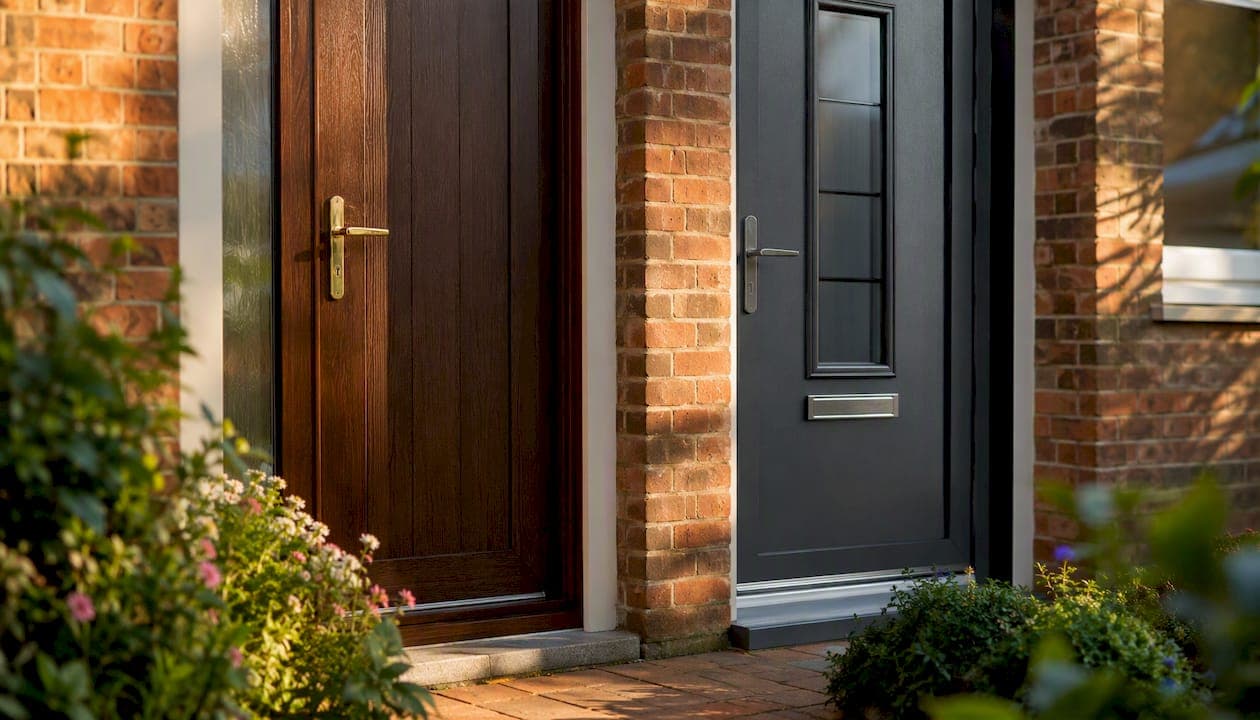
For most front doors, a quality composite door is the better choice. It outperforms uPVC on security, thermal efficiency, and kerb appeal, and its longer lifespan means the higher upfront cost tends to even out over time. The trade-off is straightforward: pay more now, or pay less now and replace sooner.
The quick case for composite on a front door:
- Security: A thicker, denser core resists forced entry more effectively than a standard uPVC profile
- Lifespan: Composite doors last around 30–35 years; uPVC typically 20–25 years
- Thermal performance: A dense foam core reduces heat loss through the doorway more consistently than multi-chambered uPVC profiles
- Appearance: GRP skins hold colour and texture far better than foiled uPVC over a decade of UV exposure
The exception: uPVC makes complete sense for back doors, side gates, or any door where budget is the primary constraint and high-traffic kerb appeal is not a factor. A well-specified uPVC door with multi-point locking is still a secure, practical choice.
Table of Contents
- How do composite and uPVC doors compare at a glance?
- What does a fitted composite or uPVC door cost in the UK?
- How do the two materials compare on security?
- What do composite and uPVC doors deliver on thermal efficiency and noise?
- How much styling choice do you actually get?
- Pros and cons: the short version
- What questions should you ask before you buy?
- When does respraying make more sense than replacing?
- Key takeaways
- The real question most homeowners miss
- Refinishingstudio: professional door respraying across South Wales
- Sources and further reading
How do composite and uPVC doors compare at a glance?
| Dimension | Composite door | uPVC door |
|---|---|---|
| Typical fitted cost (UK) | composite doors typically cost more upfront | uPVC doors generally cost less upfront |
| Security | Better: thicker core, reinforced frame | Good when correctly specified with multi-point locking |
| Thickness / build | 44–48mm; GRP skin over foam or timber core | ~28mm; multi-chambered PVC profiles with steel reinforcement |
| Thermal efficiency (U-value) | Better: dense core provides continuous thermal barrier | Good: multi-chamber profiles perform well but typically slightly behind composite |
| Maintenance | Very low: wipe clean; hardware service every 10–15 years | Very low: wipe clean; hardware service every 10–15 years |
| Lifespan | ~30–35+ years | ~20–25 years |
| Aesthetics / customisation | Wide: timber-effect GRP skins, deep colours, textured finishes | Wide: foils, woodgrain, modern matt palettes |
| Noise insulation | Better: denser core absorbs sound more effectively | Moderate: chambered profiles offer some reduction |
| Installation lead time | Typically 3–6 weeks from survey to fit | Typically 2–4 weeks from survey to fit |
| Warranty (typical) | 10 years on door; check colour/hardware coverage | 5–10 years; check foil and hardware terms |
The single most decisive metric for front-door buyers: If security and kerb appeal are your priorities, composite wins on both counts. If you are replacing a back door or working to a strict budget, a correctly specified uPVC door delivers solid performance at a lower price.
What does a fitted composite or uPVC door cost in the UK?
Typical supply-and-fit prices in the UK run from £500 to £1,100 for a uPVC front door and £900 to £1,800 or more for a composite, depending on specification, glazing, hardware, and whether the existing frame needs replacing. Those ranges are a starting point, not a ceiling: a composite door with bespoke glazing, a multipoint lock upgrade, and a full frame replacement can push well past £2,000.
| Item | uPVC (typical range) | Composite (typical range) |
|---|---|---|
| Door and frame, supply and fit | £500–£1,100 | £900–£1,800+ |
Getting a comparable quote means making sure every proposal includes the same items. Ask each installer to confirm:
- Whether the quote covers supply and fit or supply only
- Whether a new frame is included or assumed to be reused
- What threshold, trims, and seals are included
- Which lock brand and cylinder grade is fitted
- Whether VAT is included (most residential installers charge 20%)
- Whether a pre-installation survey is part of the price
Lead times vary: uPVC doors are often available within 2–4 weeks; composite doors, which are typically made to order, usually run 3–6 weeks from survey to installation. Frame replacement adds a day to the installation itself but rarely extends the lead time significantly.
How do the two materials compare on security?
Composite doors hold a clear advantage in raw forced-entry resistance. The combination of a thick, dense core, a reinforced subframe, and a GRP skin that does not flex under impact makes them harder to kick in or lever open than a standard uPVC door. That said, a well-specified uPVC door fitted with multi-point locking and steel reinforcement remains a genuinely secure option and meets the security needs of most homes when installed correctly.
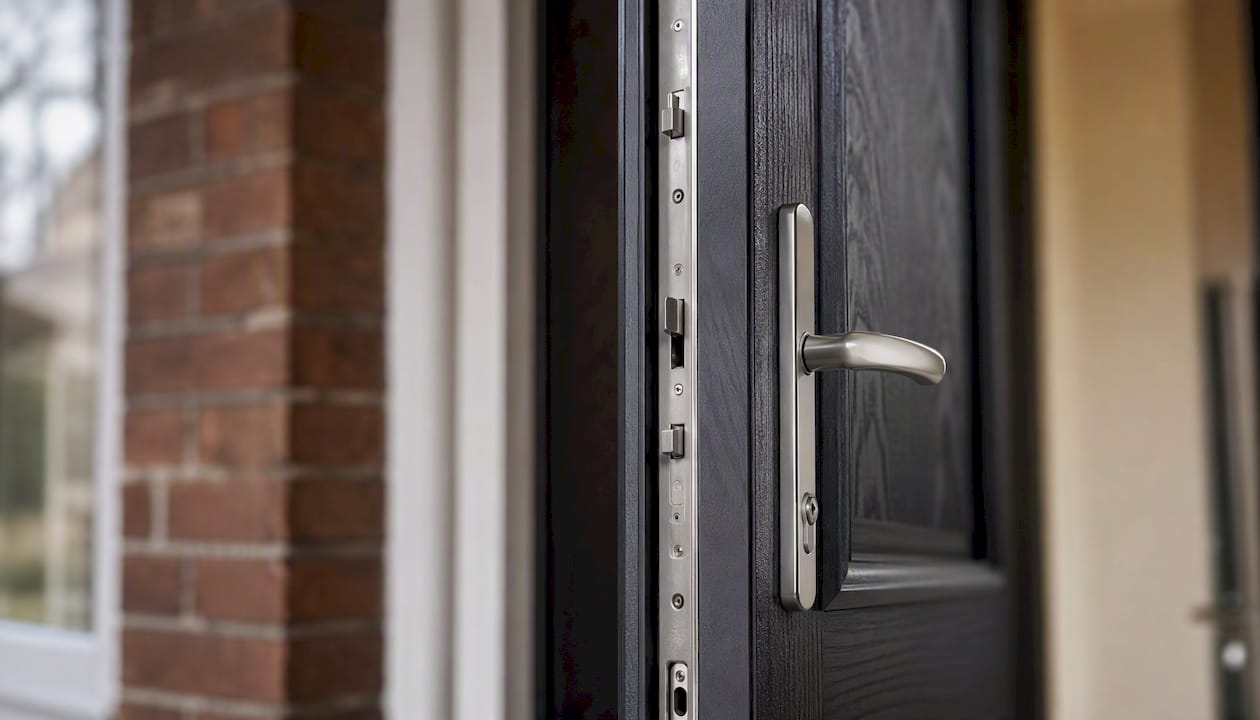
The standards to ask about are PAS 24 and Secured by Design. PAS 24 is the British Standard for enhanced security performance of doors and windows; Secured by Design is the police-backed scheme that certifies products meeting that standard and above. Any installer quoting a "secure" door should be able to confirm which standard the product meets and provide documentation. Accredited installers registered with FENSA or Certass can self-certify compliance with Building Regulations, which is a separate but related assurance.
Practical upgrades worth specifying on either material:
- A TS007 3-star rated cylinder or a 1-star cylinder with a 2-star handle
- Anti-snap, anti-pick, anti-drill protection on the cylinder
- Hinge bolts or dog bolts on the hinge side
- A door chain or night latch for secondary security
Red flags during a survey: a frame that flexes when pushed, hinges that are loose or misaligned, or a threshold gap that lets light through all indicate that the frame itself needs replacing before a new door is fitted. No door, however well specified, performs to standard in a compromised frame.
What do composite and uPVC doors deliver on thermal efficiency and noise?
Composite doors with dense foam cores can reduce heat loss through the doorway by up to around 25% compared with older single-material doors. The mechanism is straightforward: closed-cell foam has very low thermal conductivity, and because it fills the door continuously rather than in separate chambers, there are fewer paths for heat to escape. Modern uPVC multi-chamber profiles also perform well, but the air cavities in the profile are smaller thermal barriers than a solid foam core, so composite doors generally achieve a lower U-value in practice.
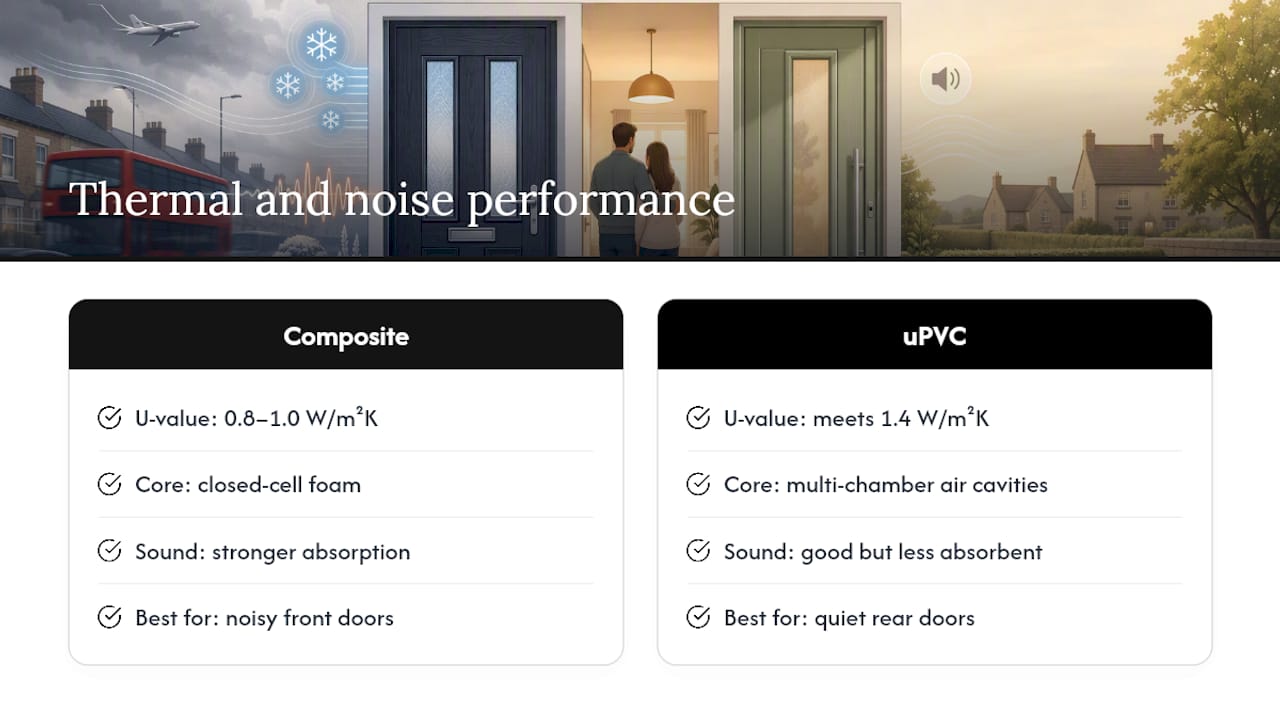
For context, current Building Regulations for England and Wales require replacement doors to achieve a U-value of 1.4 W/m²K or better. Both composite and modern uPVC doors can meet this threshold; the better composite models push down to around 0.8–1.0 W/m²K, which is a meaningful difference if you are heating a draughty hallway.
Sound insulation follows the same logic. A denser core absorbs sound more effectively than hollow-chambered profiles, and the difference is noticeable if your front door faces a busy road, a car park, or close neighbours. For a rear door in a quiet garden, the gap between the two materials on noise is unlikely to be something you notice day to day.
How much styling choice do you actually get?
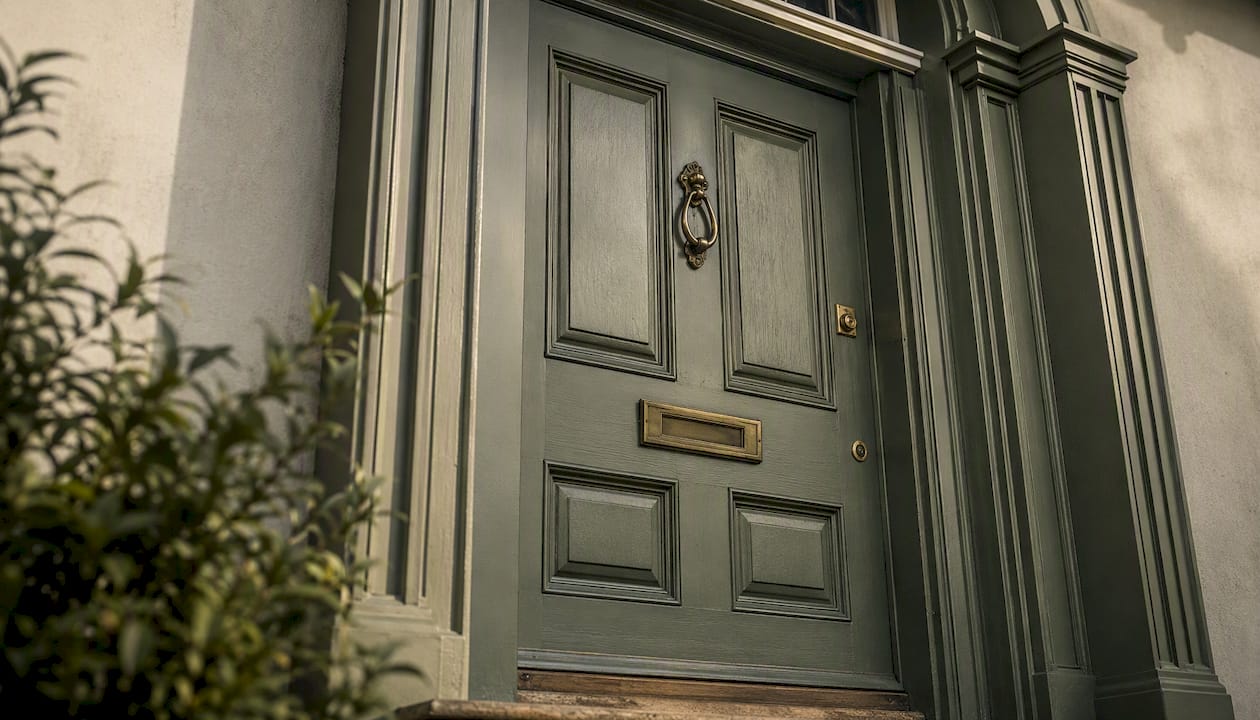
Composite doors have the edge on traditional and period styling. The GRP skin is moulded from real timber doors, so the grain texture and panel depth look convincingly authentic in a way that printed foil on uPVC does not. Deep colours, such as heritage greens, navy blues, and charcoal greys, hold their depth on a composite skin for years longer than on a foiled uPVC surface.
uPVC has closed the gap considerably on contemporary styles. Modern product lines carry a broad palette of foils and finishes, and a flush-panel uPVC door in anthracite grey can look sharp on a new-build or a recently renovated semi. For homeowners who want to match existing uPVC windows without a visible colour mismatch, sticking with uPVC for the door is often the simpler route. Popular colour choices like anthracite grey are available across both materials.
Pro Tip: Hardware choice has a disproportionate effect on how a door looks. A composite door with a brushed gold or satin chrome lever handle, a matching letterbox, and a period knocker reads as a considered, quality finish. Specify the ironmongery at the same time as the door, not as an afterthought, and factor it into your budget from the start.
Glazing options, including decorative leaded lights, obscure glass, and full-length side panels, are available on both materials and add meaningfully to kerb appeal. They also add to cost, so treat glazing as a separate line item when comparing quotes.
Pros and cons: the short version
Composite doors
Pros:
- Greater resistance to forced entry due to thicker, denser construction
- Longer lifespan (~30–35 years) means better long-term value
- Superior thermal performance with a continuous foam core
- Better noise insulation on busy streets
- More convincing traditional and heritage styling
- Colour retention is excellent; GRP skin does not peel or yellow
Cons:
- Higher upfront cost (typically £900–£1,800+ fitted)
- Longer lead time (3–6 weeks, made to order)
- Heavier door requires well-aligned frame and quality hinges
uPVC doors
Pros:
- Lower entry price (typically £500–£1,100 fitted)
- Shorter lead times (often 2–4 weeks)
- Secure when correctly specified with multi-point locking
- Good thermal performance from multi-chamber profiles
- Wide range of modern finishes and foil colours
Cons:
- Shorter lifespan (~20–25 years)
- Foiled finishes can fade or lift, particularly on south-facing elevations
- Slightly less resistant to forced entry than a well-built composite
Use-case summary: composite for front doors where security and kerb appeal matter; uPVC for back and side doors, rental properties, or any situation where budget is the overriding factor.
What questions should you ask before you buy?
A good installer will welcome these questions. One who deflects them is a red flag in itself.
- Confirm your priorities: security, thermal performance, aesthetics, or budget? Rank them before you speak to anyone.
- Set a realistic budget including frame replacement, glazing, hardware, and VAT.
- Ask about accreditation: is the installer FENSA or Certass registered? Can they self-certify Building Regulations compliance?
- Request PAS 24 or Secured by Design evidence for the specific door model being quoted, not just a general claim.
- Ask which lock cylinder is included and whether it meets TS007 3-star or equivalent.
- Confirm the survey process: will they check the existing frame for alignment, rot, or movement before ordering?
- Check the warranty terms in writing: duration, what is covered, whether it is transferable.
- Ask who signs off the installation and what the process is if you identify a defect after fitting.
Questions to ask specifically about the survey:
- Will the surveyor check the threshold and sill condition?
- Is frame replacement included in the quote or priced separately?
- What happens if a problem is found during installation that was not visible at survey?
Red flags that should pause the purchase:
- No written quotation or itemised breakdown
- Warranty described verbally but not provided in writing
- Installer refuses to survey the existing frame before ordering
- No mention of Building Regulations compliance or accreditation
- Pressure to sign on the day of the survey
When does respraying make more sense than replacing?
Replacing a door is not always the right answer. If the frame is structurally sound, the hardware is working correctly, and the main issue is that the colour looks tired or the finish has faded, professional respraying is a cost-effective alternative to full replacement. A quality respray on a uPVC or composite door delivers a factory-standard finish in any RAL or BS colour, at a fraction of the cost of a new door and frame.
Circumstances where respraying makes clear sense:
- The door colour is outdated but the door itself is performing well
- Minor surface scuffs or UV fade that do not affect structural integrity
- You want to match new windows or a freshly painted render without replacing the door
- You are a landlord refreshing a property between tenancies without a full capital spend
When respraying is not the right call:
- The frame is warped, rotten, or misaligned
- The door no longer seals properly against the frame
- Hardware (hinges, lock mechanism) has failed or is near the end of its life
- There is structural damage to the door panel itself
Pro Tip: Before booking a respray, open and close the door slowly and check the gap around the frame. An even, consistent gap all the way round means the frame is still true. An uneven gap, particularly at the top or bottom corner, suggests movement in the frame that a respray will not fix.
Refinishingstudio's composite door respraying service and uPVC door respraying both carry a five-year transferable warranty, use factory-standard application techniques, and are carried out entirely by Refinishingstudio's own team with no subcontractors. Over 1,000 projects completed across South Wales.
Key takeaways
Composite doors are the stronger choice for most UK front doors on security, lifespan, and thermal performance; uPVC remains the practical option for budget-led replacements and secondary doors.
| Point | Details |
|---|---|
| Composite costs more upfront | Fitted composite doors typically cost £900–£1,800+; uPVC runs £500–£1,100, but composite's longer lifespan narrows the per-year cost gap. |
| Composite lasts longer | Composite doors last around 30–35 years versus 20–25 years for uPVC, making them better long-term value for front doors. |
| Security standards to request | Ask for PAS 24 or Secured by Design certification and a TS007 3-star rated cylinder on any door, composite or uPVC. |
| Maintenance is low for both | Both materials need only occasional cleaning; hardware on either door type typically needs servicing after 10–15 years. |
| Refinishingstudio respray option | If the frame is sound, a professional respray by Refinishingstudio refreshes colour and finish at a fraction of replacement cost, with a five-year warranty. |
The real question most homeowners miss
The composite vs uPVC debate tends to get framed as a straight cost comparison, and that framing leads a lot of homeowners to underspec their front door. The upfront saving on uPVC is real, but the decision that matters more is whether the frame itself is worth keeping. A new composite door in a failing frame performs no better than the old one. A new uPVC door in a solid, well-aligned frame can serve a household well for two decades.
What I see repeatedly in South Wales is homeowners who have spent money on a new door and then discovered the frame was the problem all along. The survey is not a formality. It is the most important part of the process, and any installer who skips it or treats it as a box-ticking exercise is saving their own time at your expense.
The other thing worth saying plainly: for a lot of doors, replacement is not necessary at all. A uPVC or composite door that is structurally sound but visually tired can be transformed with a professional respray. The colour options are the same as a new door, the finish is durable, and the cost is a fraction of replacement. That is not a consolation prize. For the right door in the right condition, it is the smarter choice.
Refinishingstudio: professional door respraying across South Wales
Not every door needs replacing. If your uPVC or composite door is structurally sound but the colour has faded, the finish looks dated, or you simply want to match new windows or a freshly rendered exterior, Refinishingstudio offers a lower-cost route to a near-new result.

Refinishingstudio hand-sprays uPVC and composite doors to a factory-standard finish across South Wales, with a choice of matt, eggshell, satin, and gloss in any RAL or BS colour. Every job is carried out by Refinishingstudio's own team, with no subcontractors, and backed by a five-year transferable warranty. The service covers front doors, back doors, conservatories, fascias, and garage doors, as well as kitchen cabinetry.
To find out whether your door is a good candidate for respraying, or to get a quote for uPVC door respraying in South Wales, contact Refinishingstudio directly. A survey takes around 20 minutes and gives you a clear answer on whether a respray or a replacement is the right call for your property.
Sources and further reading
The following sources were used to compile this guide and are worth reading if you want to go deeper on any specific area:
- Composite vs UPVC Doors: Pros, Cons & Which Is Best for Your Home - Fixaglaze
- Composite vs UPVC Doors: Which Is Best? | Ken Rhodes
- Composite Doors vs uPVC Doors: Complete Comparison Guide
- Composite Door vs uPVC - Which Is Best? - Checkatrade
- UPVC respraying vs replacement: the honest comparison · Refinishing Studio
- Aluminium Windows vs UPVC Windows: The Full Comparison for Homeowners in 2026 - Birmingham Glass
For service enquiries in South Wales, the Refinishingstudio landing page at refinishingstudio.co.uk covers the full range of respraying services, finish options, and contact details.
Recommended
- Anthracite grey vs jet black UPVC: which should you choose? · Refinishing Studio
- UPVC respraying vs replacement: the honest comparison · Refinishing Studio
- Anthracite grey UPVC: why every UK home is doing this in 2026 · Refinishing Studio
- How much does UPVC respraying cost in 2026? (UK pricing guide) · Refinishing Studio