
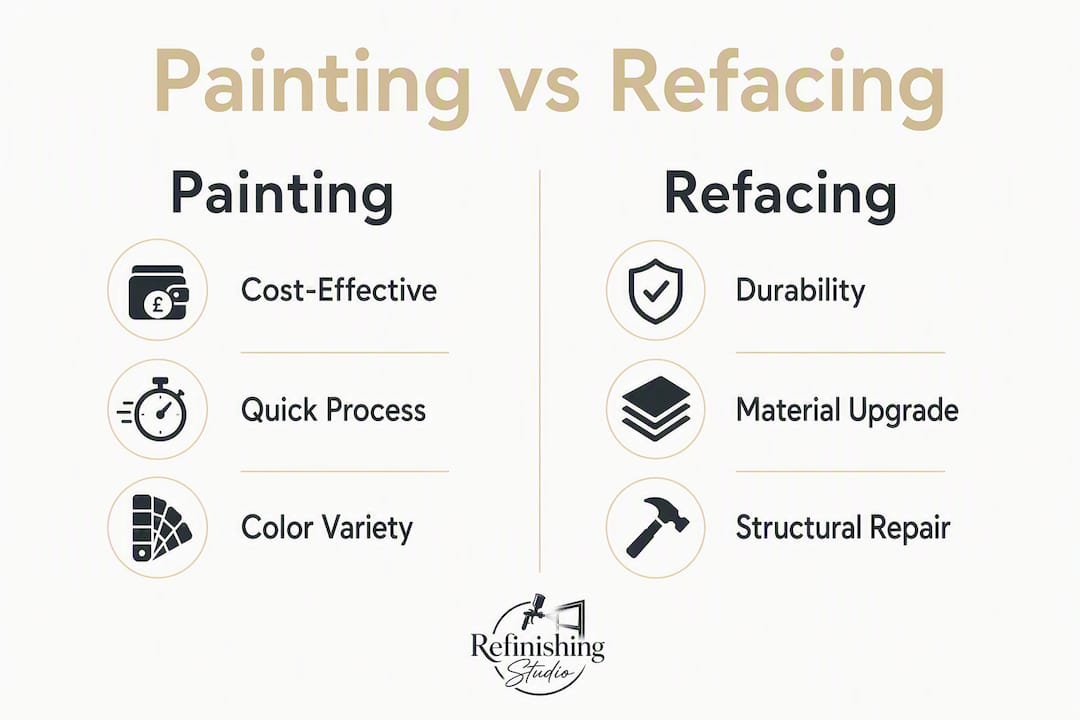
For most South Wales homeowners with structurally sound cabinet boxes, a professional cabinet respray is the better choice. It usually costs significantly less than refacing, completes in a few days, and delivers a factory-standard finish that holds up in a working kitchen. Refacing, which replaces visible exterior components while keeping the carcasses, earns its higher price tag when you want a different door profile or when door surfaces are too damaged to paint well. Refacing typically lasts 15–25 years; a professionally sprayed 2K finish from a specialist like Refinishingstudio carries a five-year transferable warranty and performs far beyond what a tin of trade paint ever could.
Table of Contents
- How do cabinet painting and refacing compare?
- What does a professional cabinet respray actually involve?
- What does cabinet refacing involve, and when is it the right call?
- How do you decide between painting and refacing?
- What should you expect from a professional respray?
- Key takeaways
- Why the "just paint it" mindset misses the point
- Refinishingstudio: professional kitchen respraying across South Wales
- Sources and further reading
How do cabinet painting and refacing compare?
| Dimension | Professional respray (painting) | Refacing |
|---|---|---|
| Typical cost | Significantly lower than refacing | Higher upfront investment |
| Durability / lifespan | Several years (standard); longer with 2K sprayed systems | Many years |
| Visual change | Colour and finish only; door profile stays the same | New doors, drawer fronts, hardware; full profile change possible |
| Work process / timeline | 3–7 days; kitchen often usable throughout | Longer; new doors manufactured and fitted |
| When it suits | Cabinet boxes sound; finish worn or dated | Doors damaged, profile change wanted, long-term ownership |
| Warranty / maintenance | Five-year transferable warranty (Refinishingstudio); gentle cleaning | Varies by supplier; depends on material |
| Resale value impact | Strong ROI for sellers needing a quick visual uplift | Higher perceived value for long-term owners |
Professional painting is frequently recommended for sellers who need a fast, credible visual upgrade before going to market. Refacing suits owners who plan to stay and want a genuinely different kitchen feel.
What does a professional cabinet respray actually involve?
A professional respray changes the colour and finish of your cabinets using factory-standard sprayed coatings, not a brush and a tin of emulsion. The result looks and performs like a manufactured finish because the process mirrors how cabinets are finished in production.
The sequence runs like this:
- Assessment — the specialist checks box condition, door material, and existing finish for compatibility.
- Degrease and clean — all surfaces are stripped of grease, cooking residue, and contaminants.
- Door removal — doors and drawer fronts are removed for offsite or controlled in-situ spraying.
- Bonding primer — an adhesion primer is applied to create a stable base on the substrate.
- Sprayed topcoat — a factory-grade system such as 2K polyurethane is applied by hand-spray for an even, durable finish.
- Cure and rehang — doors cure fully before rehanging, avoiding surface damage from premature handling.
Finish options include matt, satin, eggshell, and gloss, with colours matched across the full RAL and BS ranges. Refinishingstudio offers custom colour matching so you are not limited to a manufacturer's standard palette.
Pro Tip: Degreasing is the step most DIY attempts skip or rush. Kitchen grease is invisible once dried into a surface, and even the best coating will fail on a contaminated substrate. Ask any contractor to describe their prep process in detail before you agree to a quote.
Refinishingstudio backs every kitchen respray with a five-year transferable warranty, covering the sprayed finish against peeling, flaking, and adhesion failure under normal use.
What does cabinet refacing involve, and when is it the right call?
Refacing replaces the visible exterior of your cabinets — doors, drawer fronts, and the veneer or laminate applied to the face frames — while leaving the internal carcasses exactly where they are.
The process starts with a survey and precise measurements, followed by the manufacture of new doors and drawer fronts to fit your existing openings. The exposed frame surfaces are then covered with a matching veneer, high-pressure laminate (HPL), or thermofoil sheet, and new hardware is fitted throughout. Because the doors are made to order, there is usually a lead time before installation begins.

Material choice matters here. HPL and quality 3D laminates offer strong moisture resistance and suit high-use kitchens or homes in coastal areas of South Wales where humidity accelerates paint degradation. Wood veneer gives a warmer, more traditional look but needs more care in damp conditions. Thermofoil sits between the two on cost and maintenance.
Refacing is the right call in three specific situations: your doors are warped, cracked, or delaminating beyond what a respray can fix; you want to switch from a raised-panel door to a flat slab or shaker profile; or you plan to stay in the property for 15 or more years and want the lowest per-year maintenance cost over that horizon. What refacing cannot do is fix damaged cabinet boxes, change the kitchen layout, or improve interior storage. Those problems need a different budget line entirely.
How do you decide between painting and refacing?
Start with the cabinet boxes. If the carcasses are solid, square, and free of water damage, a respray is almost certainly the right answer. If the boxes themselves are failing, neither painting nor refacing solves the problem.
Work through these criteria in order:
- Box condition — tap and press the carcasses; soft spots, swelling, or visible water damage point toward replacement, not refinishing.
- Door condition — minor surface wear suits a respray; warped, cracked, or delaminating doors suit refacing.
- Profile change — if you want a different door style, only refacing delivers it.
- Budget — if cost is the primary constraint, a professional respray is significantly cheaper and still produces a durable result.
- Ownership horizon — selling within five years? A respray gives the best return. Staying 15 or more years? Refacing's longer lifespan may justify the spend.
- Kitchen intensity — high-use kitchens in coastal or humid locations may benefit from refacing's laminate options.
When speaking to contractors, ask these questions directly:
- Do you remove doors for spraying, or spray in situ?
- What primer and topcoat system do you use (2K, waterborne, oil-based)?
- Do you offer a transferable warranty, and what does it cover?
- Can you show offsite curing photos from recent projects?
- Do you assess under-sink or base damage as part of the survey?
Watch out for quotes that skip door removal, use vague prep descriptions, offer no warranty, or rely on standard trade or DIY paints rather than an industrial sprayed system. Those are the jobs that peel within a year. For broader affordable kitchen makeover ideas that sit alongside a respray, it is worth reading around the full scope of low-cost upgrades before committing to any single route.
What should you expect from a professional respray?
A professional respray is fast and far less disruptive than refacing or full replacement. In most cases, the kitchen remains accessible throughout, with only the doors temporarily absent.
A typical South Wales project runs like this:
- Survey day — the specialist visits, assesses condition, confirms colour and finish, and provides a fixed quote.
- Prep (day 1) — surfaces are degreased, sanded, and primed; doors are removed.
- Spraying (days 1–2) — doors are sprayed offsite or in a controlled environment; carcasses are masked and sprayed in situ.
- Curing (2–4 days) — the finish cures before doors are rehung; rushing this stage risks surface damage.
- Rehang and walkthrough — doors are refitted, hardware checked, and the client signs off.
Total project time: 3–7 days depending on kitchen size and scope. Refacing typically runs longer because new doors must be manufactured to order before installation can begin, which adds lead time on top of the fitting days.
Aftercare is straightforward: wipe surfaces with a soft damp cloth, avoid abrasive cleaners or scouring pads, and check that hinges and handles remain tight every six months. Refinishingstudio's kitchen cabinet spraying service includes aftercare guidance with every completed job.
Key takeaways
Professional cabinet respraying is the most cost-effective cabinet makeover option for South Wales homeowners whose cabinet boxes are structurally sound, costing 40–80% less than refacing with a typical project completing in 3–7 days.
| Point | Details |
|---|---|
| Cost advantage of respraying | Professional painting costs 40–80% less than refacing when cabinet boxes are sound. |
| Lifespan comparison | Refacing lasts 15–25 years; a professional 2K sprayed finish outperforms standard DIY paint significantly. |
| Key decision trigger | Box condition, desired door profile change, budget, and ownership horizon determine the right route. |
| Timeline and disruption | A respray completes in 3–7 days; refacing takes longer due to door manufacture lead times. |
| Refinishingstudio | Offers a five-year transferable warranty on every kitchen respray across South Wales, with 1,000+ completed projects. |
Why the "just paint it" mindset misses the point
Most homeowners who ask about cabinet painting vs refacing are actually asking the wrong question. The real question is: what is wrong with your kitchen, and what would actually fix it?
The conventional framing treats painting as the budget option and refacing as the upgrade. That is backwards in most cases. A professionally sprayed 2K finish, applied by a specialist who removes the doors, preps the substrate properly, and cures the coating before rehanging, is not a compromise. It is a different product from a tin of trade paint, and it performs accordingly.
What I see repeatedly in South Wales projects is homeowners who have convinced themselves they need refacing because their kitchen feels dated, when the actual problem is a tired, chalky finish and a colour that has not moved since 2005. A respray in a contemporary shade — deep charcoal, sage, warm white — changes the entire feel of the room for a fraction of the cost. Refacing would have been overkill.
The cases where refacing genuinely wins are narrower than the industry often suggests: damaged doors that cannot hold a coating, a profile change the owner cannot live without, or a very long ownership horizon where the per-year cost calculation tips in refacing's favour. Outside those scenarios, a professional respray is not the cheaper option. It is the smarter one.
Refinishingstudio: professional kitchen respraying across South Wales
If your cabinet boxes are sound and you want a finish that holds up in a real kitchen, Refinishingstudio delivers factory-standard results without the cost or disruption of refacing. Every job uses a hand-spray technique with industrial-grade coatings, applied by a single specialist — no subcontractors, no handoffs.
The service covers kitchen cabinets, doors, drawer fronts, end panels, islands, and handleless conversions across the full RAL and BS colour range, in matt, satin, eggshell, or gloss. Every project comes with a five-year transferable warranty and a satisfaction walkthrough on completion. With over 1,000 completed projects across South Wales, the portfolio speaks for itself.
Request a survey and quote to get a fixed price for your kitchen, or browse the completed project gallery to see finished results from local homes.
Sources and further reading
- Refacing vs Painting vs Replacement — Jaspector — cost and suitability comparison across all three cabinet upgrade paths.
- Cabinet Refacing vs Painting vs Replacing — 180 Kitchens — lifespan benchmarks for refacing (15–25 years) and painted finishes.
- Painting vs Refacing Cabinets — Grove Street Painting — source for the 40–80% cost difference and typical 3–7 day timeline.
- Cabinet Painting vs Refacing vs Replacing — Davis Painting — professional sprayed finishes versus DIY paint; resale value guidance.
- Cabinet Refacing vs Painting — San Diego Home Remodeling — material performance notes for HPL and laminate in high-humidity environments.
- Kitchen Respraying South Wales — Refinishingstudio — local service detail, finish options, and portfolio evidence.
- Five-Year Warranty — Refinishingstudio — warranty terms and coverage for every completed project.