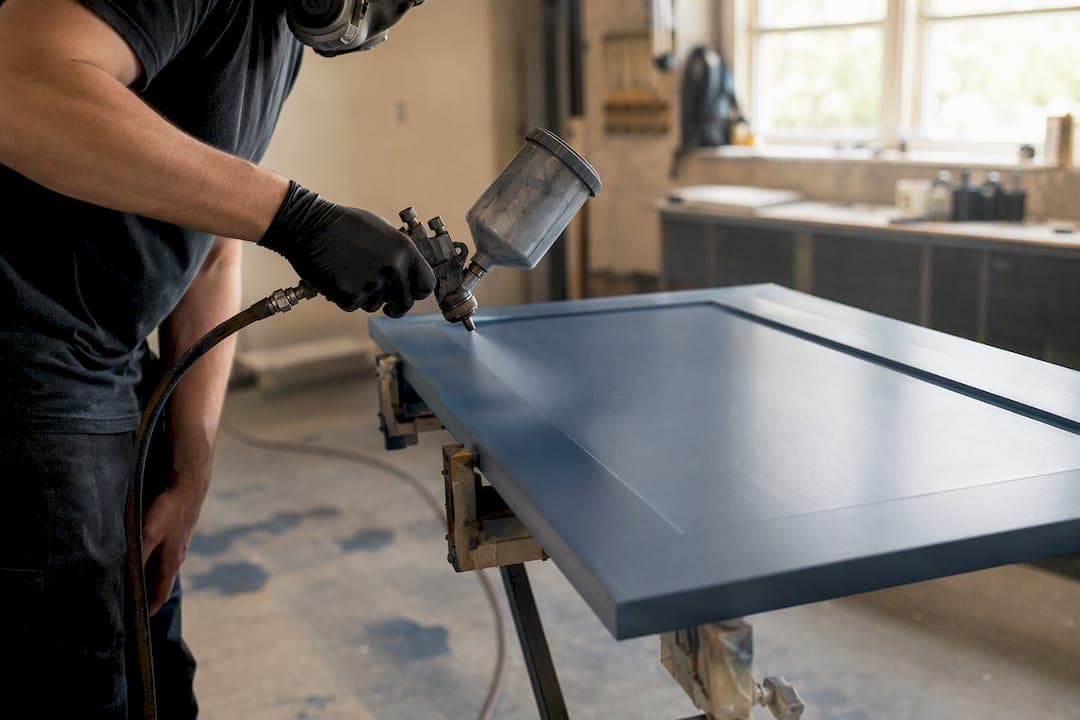
Yes. If your cabinet carcasses are structurally sound, a professional respray is usually the better route to blue kitchen cabinets than replacement, and it costs a fraction of a new kitchen. Workshop spraying, where doors come off and go into a controlled booth, gives the closest thing to a factory finish, while in situ spraying handles fixed panels and end units that can't be removed.
- Most existing doors and drawer fronts in MDF, timber, veneer or laminate respray well when the substrate underneath hasn't failed.
- Respraying typically costs 70 to 90% less than a full replacement when the units are in decent condition.
- Workshop (booth) spraying is the gold standard for depth and evenness on dark blues; in situ spraying is a sensible compromise for islands and fixed carcasses.
Key Takeaways
A professional blue respray restores sound kitchen cabinets to a durable, factory quality finish for a fraction of replacement cost, provided the substrate is prepared correctly.
| Point | Details |
|---|---|
| Check the substrate first | Swollen MDF, warped carcasses or severe water damage mean replacement, not respraying, is the right call. |
| Workshop spraying wins on finish | Booth spraying gives the most even, durable result for dark or glossy blues; in situ suits fixed panels. |
| Budget realistically | Expect roughly £800 to £3,500+ depending on kitchen size, with most work finished on site within 48 to 72 hours. |
| Demand a written warranty | Insist on a five year written guarantee and a sprayed sample before booking any specialist. |
| Refinishingstudio covers South Wales | Offers hand sprayed blue kitchen finishes with a five year warranty and over 1,000 completed projects. |
Table of Contents
- Can your doors be resprayed for a blue kitchen cabinet finish?
- Workshop spraying vs in situ: what actually happens
- How to choose the right blue and finish for a UK kitchen
- What does a blue kitchen respray cost and how long does it take?
- What should you ask a South Wales resprayer before booking?
- Refinishing Studio: a South Wales specialist for blue kitchen resprays
- What this guide gets right that most advice misses
- Ready to book a blue kitchen respray in South Wales?
- Sources
Can your doors be resprayed for a blue kitchen cabinet finish?
Most South Wales kitchens qualify. If the doors are MDF, solid timber, veneer, laminate, UPVC or foil wrapped and the carcass is still square and dry, a specialist can strip back the old finish and build up a new blue coating that will outlast the last lick of paint by years. The test isn't age. A 15 year old kitchen with sound joinery often sprays better than a five year old one that's had a leak under the sink.
Some conditions rule respraying out, or at least mean a mixed approach makes more sense:
- Swollen or delaminating MDF, particularly around sink and hob areas where moisture has crept in.
- Warped door frames or carcasses that no longer sit flush, which no amount of primer will disguise.
- Severe water damage to chipboard carcass panels, as opposed to the doors themselves.
It's common to respray the doors that are sound and replace only the two or three that have taken water damage, matching the new doors to the resprayed finish so nothing looks patched in. Preparation differs by substrate. MDF needs controlled stripping rather than wet methods, veneer needs careful sanding to avoid breaking through the grain, and UPVC needs a specific adhesion primer that timber doesn't.
Pro Tip: Run your hand along the bottom edge of each door where it meets the worktop. If it feels soft, spongy or the laminate has lifted at the corner, that door is a replacement candidate, not a respray candidate.
Workshop spraying vs in situ: what actually happens
Workshop or booth spraying is carried out in a dust controlled, climate controlled environment, which is why it's considered the gold standard for a factory quality blue finish, especially on gloss and dark navy shades where every fleck of dust or uneven cure shows. In situ spraying, by contrast, happens with the kitchen masked off in your home, and it's the only realistic option for handleless end panels, fitted islands and any carcass element that can't be unbolted.
A typical workshop job runs like this:
- Every door and drawer front is numbered and photographed before removal, so nothing gets mixed up.
- Doors are transported to the workshop in sealed racking to protect them from dust and knocks.
- Old coatings are stripped, surfaces are sanded and primed, then a two coat topcoat system is applied with professional spray equipment.
- Finished doors are inspected, cured, then returned and rehung, with hardware refitted and adjusted.
In situ work follows a similar prep and two coat logic but happens on masked panels in place, which means slightly more variability in finish depth but zero downtime waiting for parts to travel.
Colour consistency between a workshop sprayed door and an in situ sprayed end panel is achievable, but it depends on the same paint batch and a technician who has matched the two before. This is worth raising directly with any specialist quoting a mixed job.
How to choose the right blue and finish for a UK kitchen
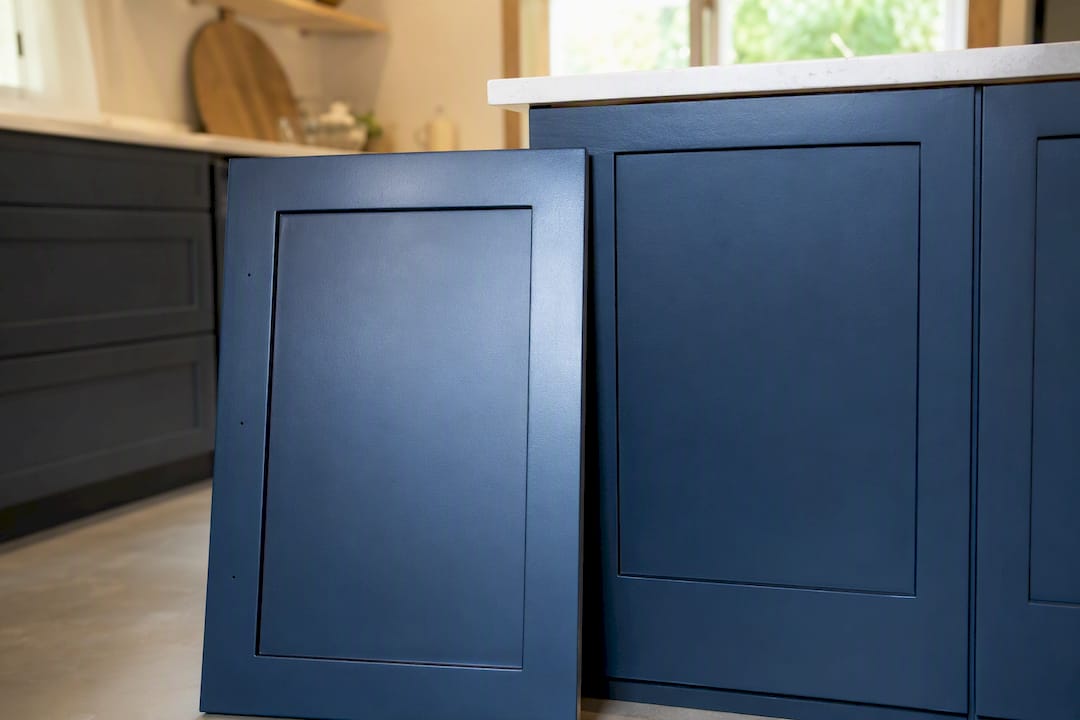
British light is duller and greyer than a lot of paint swatches account for, so a blue that looks crisp on a sample chip can read flat or muddy under a north facing window. Test any shade as an actual sprayed sample on a spare door or offcut and view it at different times of day, morning, midday and under your kitchen's evening lighting, before committing.
- Navy and ink blues hide fingerprints and daily wear well, which suits busy family kitchens and rental properties.
- Mid blues (think a soft denim or slate blue) read as calm rather than bold and work in smaller kitchens where a dark navy could feel closing in.
- Pastel and duck egg blues show scuffs faster but suit period cottages and south facing rooms with plenty of natural light.
On sheen, eggshell and satin finishes are the most forgiving for everyday kitchens: they hide minor imperfections in the substrate and are easier to spot repair than gloss. Gloss gives navy blues real depth and a striking reflective quality, but it magnifies every dent, sanding mark and dust nib, so it demands the workshop process rather than in situ spraying. If you're running an island in a bolder blue against paler wall units, or converting to handleless doors, get the edge profiles matched at the same time so the colour reads consistently from every angle.
Pro Tip: Ask to see the sample sprayed at the same sheen you're ordering, not just the paint colour on a chip. Satin navy and gloss navy can look like two different colours entirely.
What does a blue kitchen respray cost and how long does it take?
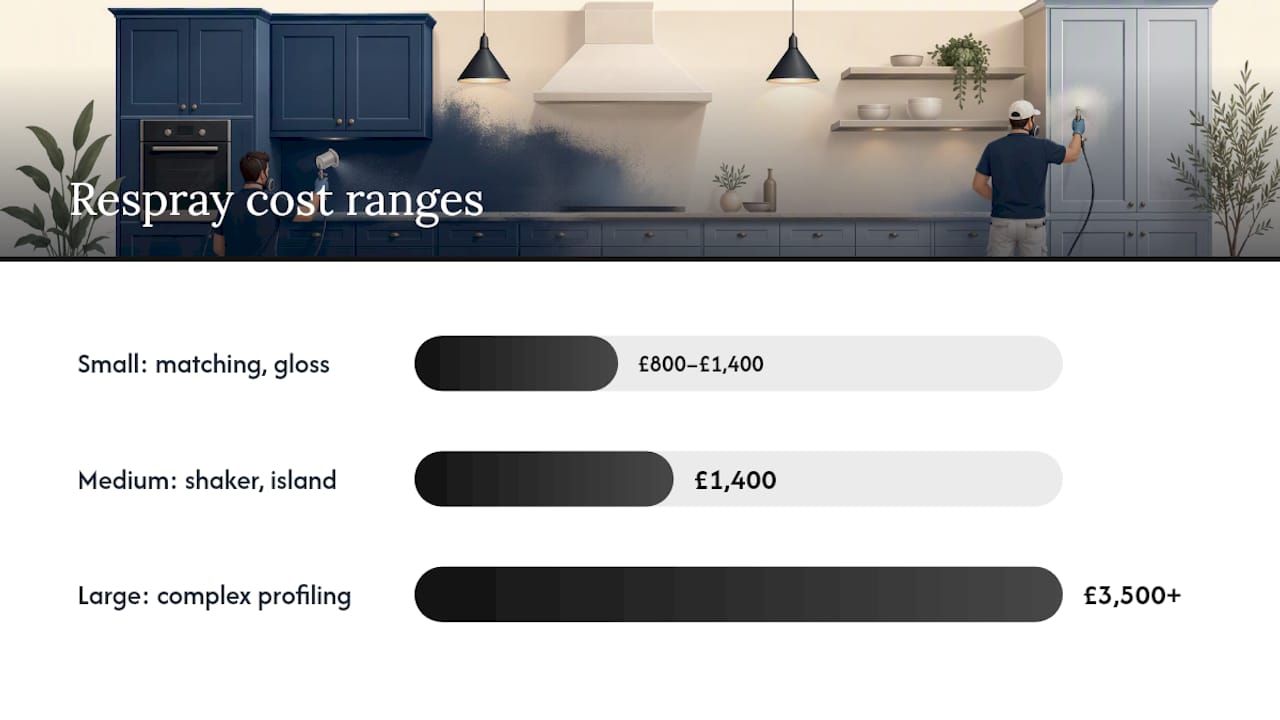
Price depends mostly on kitchen size, door count and complexity of the profiles, not the colour itself, though very dark or very glossy finishes can add a step to the process. UK respray costs typically fall between £800 for a small kitchen and £3,500 or more for a large one, with many firms quoting an average around £1,400 for a standard sized kitchen.
| Kitchen size | Typical cost range | What pushes it higher |
|---|---|---|
| Small | £800–£1,400 | Extra colour matching, gloss finish, hardware upgrades |
| Medium | £1,400 | Shaker or raised panel profiles, multiple colours, island units |
| Large | £3,500 or more | Complex profiling, handleless conversions, extensive repairs |
On timescale, most professional resprays complete the main on site work within 48 to 72 hours for a typical kitchen, with doors away being sprayed in a booth while fixed panels are primed and top coated in situ during the same window. Larger jobs with intricate shaker profiles or multiple colours can run longer. Ask upfront about removal and reinstallation charges, any extra repair costs if a door turns out worse than expected once stripped, and whether a colour matching sample is included in the quote or billed separately. Full pricing detail for South Wales jobs is worth checking before you commit to a date.
What should you ask a South Wales resprayer before booking?
A short phone call sorts the serious specialists from the sign writers who've bought a spray gun. Work through these in order:
- Workshop or in situ? A specialist who only offers one method isn't necessarily wrong for your job, but they should explain clearly why, not just default to whichever is easier for them.
- What paint system and how many coats? Two coats over a proper primer is standard practice; anyone offering a single coat "quick job" is cutting a corner that will show within a year.
- How do you prepare MDF doors? Controlled mechanical or laser stripping avoids swelling the board; wet stripping or excessive heat on MDF is a red flag, not a shortcut.
- What's the warranty, in writing? Many UK specialists offer a five year written guarantee on the finish; verbal promises aren't worth much if the paint lifts in year two.
- What's your removal and reinstallation process? You want numbered doors, sealed transport, and a plan for rehanging and adjusting hardware, not "we'll sort it on the day".
At handover, check the colour match across every edge and end panel under daylight, run a hand over the surface for smoothness, and confirm every hinge and handle has been refitted and adjusted so doors close properly.
Pro Tip: Ask for two or three recent local addresses or portfolio examples in a similar blue. A specialist confident in their work will show you, not just tell you.
Refinishing Studio: a South Wales specialist for blue kitchen resprays
Refinishingstudio sprays kitchen cabinets, doors, drawer fronts, end panels and islands by hand across South Wales, working on MDF, timber, veneer, laminate and UPVC substrates. Every job carries a five year transferable warranty, and the team has completed over 1,000 projects to date, with no subcontractors involved in the spraying itself.
- Wide colour choice across RAL, BS and custom blues, matched to your chosen sheen.
- Workshop spraying for the best possible finish, with in situ work for fixed elements.
- A written five year guarantee backing every completed job.
You can browse finished blue and coloured kitchens in the portfolio before requesting a survey, and the finishes page shows how the same blue looks across matt, satin and gloss. For anyone weighing up sheen options generally, broader colour guidance for doors is a useful starting point too.
What this guide gets right that most advice misses
Most "should I paint or replace my kitchen" content treats the decision as purely financial, and it isn't. The real question is whether the carcass and doors are structurally sound, because a beautiful blue spray job on a swollen MDF door just delays a problem rather than fixing one. The 70 to 90% cost saving over replacement only holds up when preparation is done properly first.
Where conventional advice falls short is treating workshop and in situ spraying as interchangeable. They aren't. A dark navy gloss island deserves the booth. A fixed end panel that can't come off the wall doesn't have that luxury, and pretending otherwise sets the wrong expectation. Prioritise the survey conversation over the colour swatch: get someone qualified to look at your actual doors before you fall in love with a particular shade of blue that might need extra prep work to achieve.
The single best thing a homeowner can do is insist on seeing a sprayed sample, at the right sheen, on their own door, before signing anything.
Ready to book a blue kitchen respray in South Wales?
Refinishingstudio is the alternative to a full kitchen replacement for homeowners across Cardiff, Swansea and the wider South Wales area: the same durable, factory standard blue finish, at a fraction of the cost of new units, with no subcontractors and a five year warranty backing the work.
If you've read this far, you already know whether your doors are worth saving. The next step is getting a specialist to confirm it in person, quote against your actual kitchen rather than a generic estimate, and show you a sprayed sample in your chosen blue before any work begins. Head to the kitchen respraying page for South Wales to request a survey, or check the cost guide first if you want a ballpark figure before you call.
Sources
- Kitchen respray cost (Homebuilding)
- Workshop spraying preferred for kitchen doors (Checkatrade)
- Kitchen respraying vs full replacement (My Helpful Hints)
- Preparation is key to respray success (LaserStrip)